

KINGSTON, R.I. – Nov. 2 – A murder mystery might seem like an unusual way to introduce students to criminal justice, but for Jenelle Santos Gomez ‘27, criminal justice and criminology (CCJ) and human development and family science major, it offered an opportunity to do much more than solve a fictional crime. It challenged students to think beyond familiar stereotypes, consider the human consequences of violence, and explore the many paths a criminal justice education can lead to.
Instead of recreating a realistic crime, she and her fellow CCJ ambassadors (a program she co-founded) developed a fantasy-inspired mystery featuring Halloween characters like a haunted mansion and its ghostly occupants. The event was designed to engage students in an accessible, imaginative way while introducing them to the ambassadors as a peer resource and encouraging a deeper understanding of the criminal justice system.
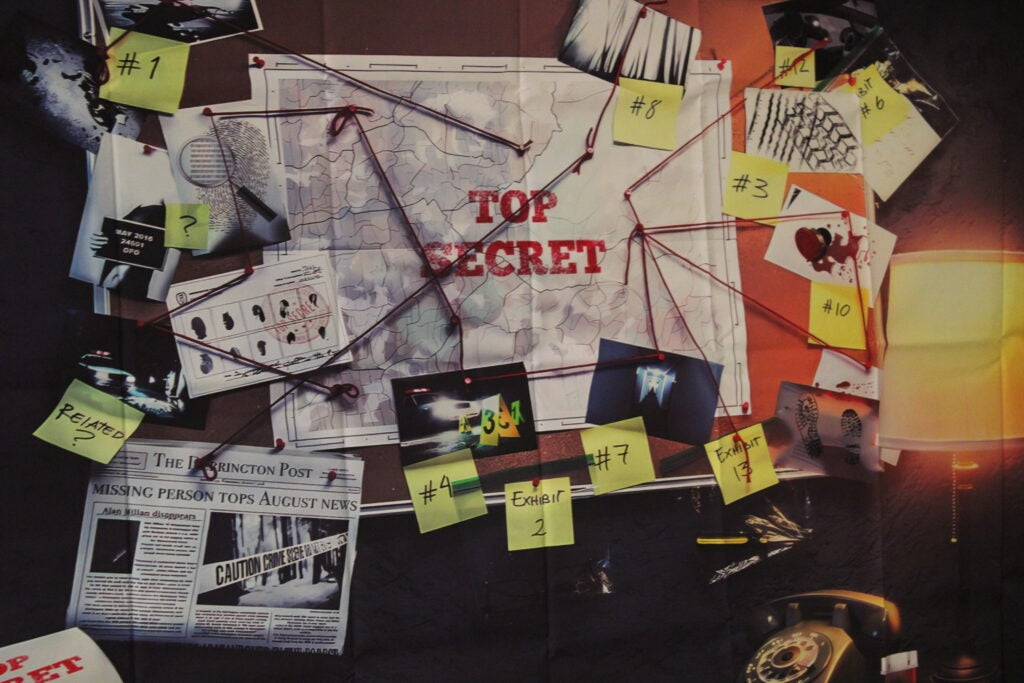
Behind the creative concept was a serious purpose: to remind participants that criminal justice is about more than the crime itself. It is also about the people, circumstances and systems surrounding it.
More often than not, careers in criminal justice indicate a desire to become a lawyer, a detective, or police officer. Initially, that was the advice given to Gomez, but through her studies, she recognized how much broader the field really is; specifically, in the pursuit of advocacy for disadvantaged groups in society. As she completes her final year as an undergraduate, she is most interested in forensic counseling, social work, and other support services.
“I’m passionate about helping people, particularly young people facing behavioral challenges or difficult circumstances. Everyone has a background story and is learning how to work with those with trauma,” said Gomez.
Her commitment to advocacy has also shaped how she supports her peers. After volunteering with Natalie Pifer, professor and chair of CCJ, during Welcome Day events for recently accepted students, she helped establish a group of ambassadors who share their experiences with prospective students and introduce them to the criminal justice program. What began with seven students has grown into an initiative of fifteen students focused on visibility, connection and belonging.

For Gomez, representation is an important part of that work. As a Latina student from Providence, she understands the value of seeing someone with a similar background navigating a university program and pursuing professional goals. That visibility can help prospective students imagine themselves in the program and feel more confident about the possibilities ahead of them.
The ambassadors also recognize that there is no single way to experience criminal justice. Students bring different backgrounds, interests and aspirations to their studies, and those differences can help broaden everyone’s understanding of the field. By making those perspectives visible, the ambassadors help prospective students see both a community they can join, and a field in which they can find their own direction.
“Truth, Lies, and Justice,” the murder mystery event hosted on Oct 19., had 37 attendees (both CCJ majors and non-majors), brought together Gomez’s interests in leadership, community building and criminal justice education. Drawing on her experience as an SRA, where she regularly organizes programs and works with the dean’s office, she approached the event as an opportunity to create an engaging experience with a meaningful educational purpose.
The team wanted to introduce students to the CCJ ambassadors without relying on the sensationalism often associated with crime-related entertainment. A fictional, fantasy-inspired scenario offered a way to make the activity fun while avoiding the recreation of a real tragedy.
The concept also opened the door to a larger conversation about what criminal investigations actually involve.
“Crime stories in popular culture often compress complicated investigations and legal proceedings into a simple narrative,” said Gomez. “In reality, investigations and court proceedings can take months or even years.”
The planning process also raised a more difficult question: What happens when real tragedies become entertainment?

The popularity of murder mysteries and true-crime stories inherently focus on the details of a case while overlooking the ripple effect it can have on the people whose lives have been changed by it. A crime may become a headline, a documentary or a subject of public fascination, such as the recent Lindsey Clancy case in Massachusetts. However, the lesson here is about the consequences that continue long after the crime is committed.
Gomez’s passion and goals in advocacy for those experiencing our judicial system is palpable in everything she does.
“It’s important to me to recognize individuals as more than the worst thing that has happened to them or the actions associated with a particular case,” said Gomez.