
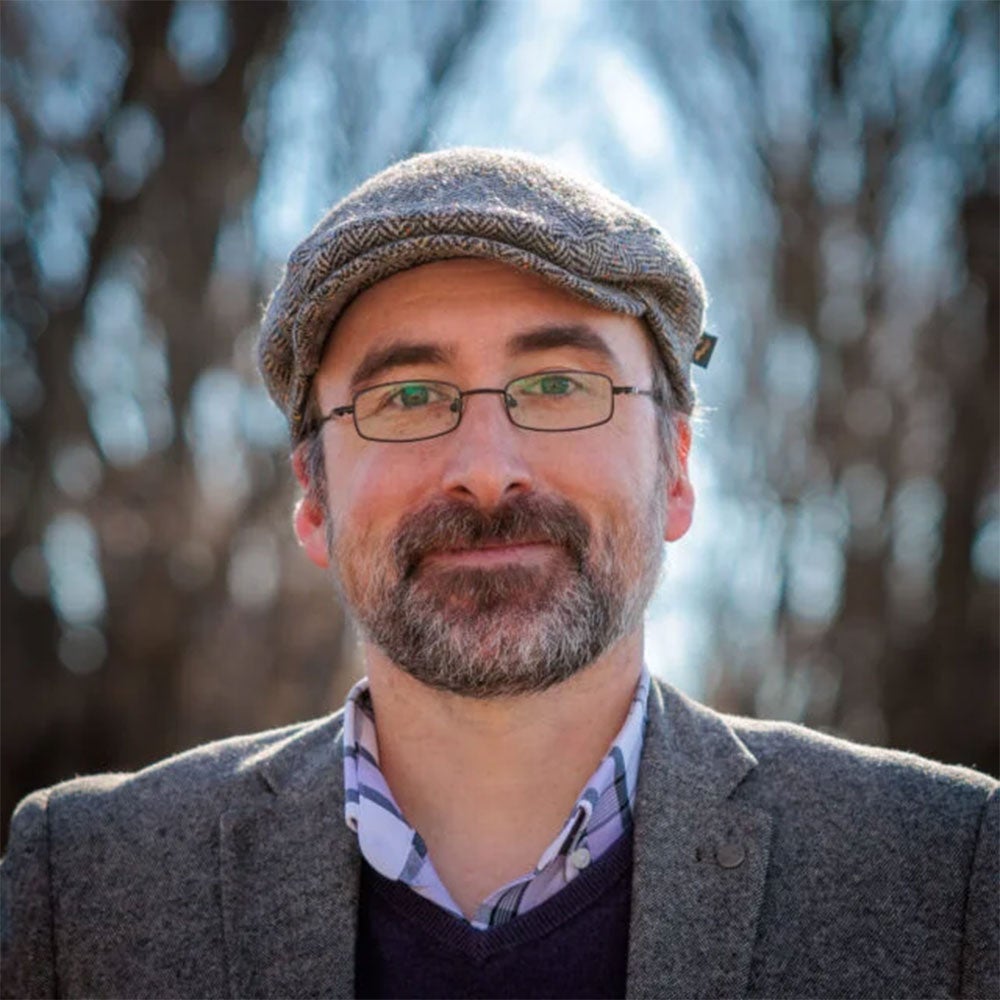
Rob Coyne has always had a deep love for science. After securing a position as a teaching professor of physics in the fall of 2017 at URI, the department simultaneously underwent an exciting cultural shift. Coyne describes his position as nontraditional because he is a research-active professor in a teaching-focused role. In most higher education institutions, the physics field tends to incentivize research. The duality of his role not only benefits how the department functions, but it also allows students to participate in research earlier in their academic careers.
Before finding a home in the Ocean State, Coyne’s academic journey expanded across the country. After growing up on Cape Cod, he enrolled as an engineering major at the University of Massachusetts Dartmouth. However, his passion was in physics, and once he was able to confirm his niche, Coyne moved on to pursue his master’s degree from the same institution. He rounded out his education with a PhD from George Washington University in 2015 and post-doctoral work at Texas Tech University. His research and areas of expertise include astronomy, black holes, gamma ray bursts, and gravity.
“Most of my work is focused on bridging traditional and gravitational wave astronomy. In particular, I study powerful cosmic explosions called gamma-ray bursts, and the exotic remnants they leave behind. The challenge is that detecting gravitational waves from these remnants is tricky. The techniques that we have used so effectively to detect merging black holes and colliding neutron stars simply aren’t optimized for the longer-lasting gravitational waves that these remnants might produce. To better understand what is left behind after these cataclysmic events, we designed new analysis techniques that are tailor-made to detect these long-lived signals,” said Coyne.
Coyne works with LIGO–a large-scale physics experiment and observatory designed to detect cosmic gravitational waves and to develop gravitational-wave observations as an astronomical tool–in 2013. Through this position, he transitioned his membership of the LIGO Scientific Collaboration to the URI campus and is currently serving as the chair of the LSC’s Communication and Education division. From there, the UMass-URI Gravity Research Consortium (U2GRC) was born. The research group is funded through multiple National Science Foundation (NSF) grants, NASA and private foundations (FQXi, The Simons Foundation, and others).
As a member of the collaboration that made the groundbreaking discovery of gravitational waves from the merger of two black holes, Coyne has been recognized by several prominent awards committees, including the Special Breakthrough Prize, the 2016 Gruber Cosmology prize, and the Bruno Rossi Prize. These meaningful contributions and connections with LIGO present an ideal opportunity for doctorate, graduate, and undergraduate students to get real-world experience at the ground floor. This work has provided fertile ground for the gravity and astrophysics department to grow significantly over the past several years.
Since joining the Department of Physics, Coyne believes it is unrecognizable from when he began.
“The physics dept is an incredibly important contributor to URI as a whole, but the complexion of the department in terms of research interests, students we attract, and so on., has changed dramatically since I’ve been here. Developing a sense of community became really important,” said Coyne. “I believe it has enabled us to grow beyond the sum of our parts.”
Developing a sense of community became just as crucial to Coyne’s research and teaching. At each tier of professionalism in the department, there was an eagerness to contribute to this cultural shift. The department went from quiet hallways to group lunches and chats. In a closet-sized office, students play games, plan movie nights, participate in demonstrations, and discuss topics ranging from research to Pokémon with peers and faculty members.
There has also been monumental growth in the department’s astrophysics program. It began with one professor and now has seven faculty members, over a dozen students in the graduate program, and is also developing an undergraduate degree program. The growth is also evident in the U2GRC research group and serves as a reflection of the passionate individuals who go above and beyond their duties.
“I’m so proud of the group we’ve cultivated. We progressed from our small gravity group to regional contributors and ultimately became one of the most prominent contributors to the LIGO Scientific Collaboration in New England,” said Coyne.
Coyne is energized for what the future holds. He hopes to contribute to the establishment of the department’s “three pillars”: biomedical physics, quantum computing, and astrophysics. Next fall, the Honor’s Colloquium will center around interstellar exploration and welcome experts to campus for student talks. The U2GRC and LIGO group wrapped up its fourth observing run, which could be followed by more exposure in outlets like CNN and international media.
“I’m always thinking of ways to work better together. The value of education and outreach is parallel with our scientific efforts,” said Coyne.