
Rhode Island’s electricity costs (~28 cents/kWh) are significantly higher than the national average (~18 cents/kWh), often ranking among the most expensive states and driven by reliance on natural gas, higher demand, and infrastructure costs. One key strategy to reduce energy bills is to make RI’s homes more energy efficient through weatherization, yet many RI residents are not taking advantage of the no cost or low-cost upgrades available to them.
In 2022, the URI Cooperative Extension’s Energy Literacy Initiative (CEELI) was contracted by the RI Energy Efficiency Council to tackle this nonparticipation challenge through policy analysis and targeted community engagement.
CEELI’s approach to this work follows a process tailored to the challenge that includes identifying the issue, studying the current system, identifying and meaningfully engaging partners, gathering input from the community, and establishing structures that build capacity to address the issue in the long term (Figure 1).

The tabs below articulate in detail how CEELI applied this approach to the challenge of nonparticipation in RI’s energy efficiency programs. See URI Cooperative Extension’s Engaging Hard-to-reach Audiences page for more details about this approach.
Issue
Why Energy Efficiency Programs Aren’t Reaching the People Who Need Them Most
Home energy insecurity carries serious health consequences. According to the Energy Justice Institute, when families can’t afford adequate heating or cooling, they face increased risks of temperature-related illness or even death. Poor indoor air quality from inadequate ventilation and the use of hazardous heating methods (like using ovens for warmth) can trigger or exacerbate respiratory conditions. The link between energy insecurity and adverse mental, respiratory and child health is well documented. In Rhode Island, many families face a “heat or eat” dilemma, and must choose between paying their utility bills and paying for food, medicine or healthcare.
In 2023, researchers projected several energy efficiency and conservation scenarios, demonstrating the long-term impacts of household energy use on health and climate outcomes. Thus, home energy efficiency presents a clear opportunity to address these health disparities and decrease energy burden for families.
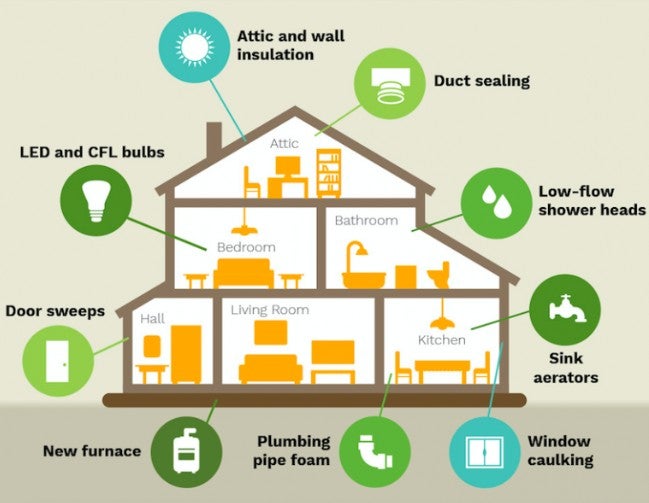
Source: https://medfordenergy.org/gogreen/go-green-residential/faq/
Programs exist to help Rhode Islanders to make their homes more energy efficient, particularly through home weatherization. However, RI residents are not taking advantage of these programs, as is evidenced in the 2022 Nonparticipant Market Barriers Study (RI-21-RX-NPStudy) and the 2025 Rhode Island Energy Efficiency Equity Working Group Report. This has been CEELI’s main challenge over the last several years: how do we increase participation in energy efficiency programs, particularly amongst income-eligible households.
Three interconnected barriers keep income-eligible renters from accessing programs designed to help them:
- Awareness: Many income-eligible renters are unaware that energy efficiency programs exist or that they may qualify.
- Trust: Past experiences with utilities and government programs have created skepticism that conventional outreach struggles to overcome.
- Access: Applications are complex, timelines are long, and the language used (both literally and technically) can feel stigmatizing or exclusionary.
Rental housing adds another layer of difficulty. Unlike homeowners, renters cannot unilaterally authorize weatherization improvements to their homes. Landlord buy-in, pre-weatherization deferral resolution, and multi-step coordination across programs mean that even motivated renters often cannot complete the process without sustained, knowledgeable support.
Community-based health workers (CHWs) and community-based organization (CBO) staff are well-positioned to fill this gap. They already have the trust of the communities most affected, and they are skilled at navigating complex systems on their clients’ behalf. What they currently lack is specific knowledge about energy efficiency programs, weatherization deferrals, and how energy burden connects to the health and housing issues they address every day. The URI Cooperative Extension Energy Literacy Initiative (CEELI) aims to close that gap, equipping trusted community-based workers with the knowledge and tools they need to become Energy Navigators for the families they serve.
System
A Systems Change Approach to Energy Efficiency
Supported by the RI Energy Efficiency Council, CEELI’s work to increase participation in energy efficiency programs in Rhode Island has been grounded in the systems change model (see figure below), which frames institutional change as a combination of three types of changes: structural, relational, and transformational. Our work has moved across all three levels, with current initiatives focused on achieving the hardest and most lasting: transformational change.
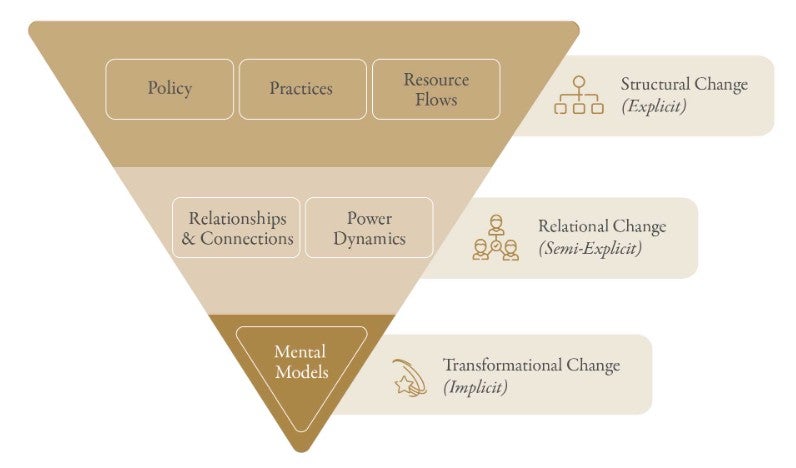
Source: https://www.chandlerfoundation.org/social-investor/systems-change-why-it-matters-and-isnt-just-a-buzzword
Structural Change: Shifting Policies and Practices
In the early years of this work, CEELI focused on structural change: shifts in policies, practices, and resource flows. The annual Plugged Into Energy Research (PIER) Lecture Series has served as a convening place for sharing cutting-edge research, policy, and innovation around energy-related topics, with strong attendance from industry practitioners. Much of the progress achieved in increasing participation in Rhode Island’s energy efficiency programs has also been structural: new energy efficiency policies and programs, and improvements to pre-existing ones.
Relational Change: Building Relationships and Shifting Power Dynamics
To build on structural progress, CEELI has made an intentional effort to focus on relational change — relationships, connections, and power dynamics. This work has included engagement with community-based organizations, collaboration with relevant entities across the state, and the implementation of the Efficient Housing for All Community of Practice (EHACoP), which brought together residents, community-based workers, and industry professionals to inform program improvements and increase participation. These efforts are described in detail in the Community-based Learning tab.
Other efforts have also advanced relational change, particularly through Rhode Island Energy, which has led community engagement through landlord information sessions at local libraries, a customer advocate program, and the Rhode Island Energy Efficiency Equity Working Group.
Transformational Change: Updating Mental Models Through Energy Navigator Training
CEELI’s vision is to achieve transformational change, shifting the mental models of key actors in the system. Community-based workers are the target for this transformation: given their expertise in community engagement and the trust they have built with residents, equipping them to incorporate energy efficiency into their regular work has the potential to create durable, community-level change. We aim to help community-based workers update their mental models to become “Energy Navigators,” incorporating energy efficiency as a tool to help the community members they serve.
Partners
Who We Work With and Why
CEELI works with strategic partners to improve access to information for consumers, professionals, and policymakers around energy efficiency for the home for all. A central focus in recent years has been strengthening the relationship between the University and organizations working directly with communities to improve quality of life. This effort has led to a deepening collaboration with the RI Health Equity Zone (HEZ) Initiative (HEZ) Initiative. In a short time, with support from HEZ leadership, URI has built relationships with a new community of partners — including public health experts, community-based Comprehensive Action Agencies, and HEZ workers who interact directly with Rhode Island’s most vulnerable residents and the communities that are traditionally underserved. Through an ongoing funded partnership with the RI Energy Efficiency Council, awareness of the inextricable links between public health and home energy efficiency continues to grow. Effective partnerships work because each partner contributes something distinct. Below is a description of CEELI’s current partners and what each brings to this work.
Rhode Island Energy contributes technical expertise on program rules, eligibility, and weatherization referral pathways, ensuring Energy Navigators have accurate, up-to-date knowledge about the utility programs they will guide clients through.
Community Health Workers Association of Rhode Island (CHWARI) contributes to developing a workforce incentive structure for CHWs engaging in energy efficiency work and provides cultural context that shapes training content.
RI Department of Health Health Equity Zone (HEZ) Initiative connects CEELI to community-based health workers through its Training and Technical Assistance Program and partners with CHWARI to formalize pathways for CHWs to take on energy navigation roles.
Children’s Friend serves as a trusted community anchor for the pilot in Central Falls, hosting training sessions, supporting bilingual delivery, and helping recruit CHW participants through its WIC, Early Intervention, and home-visiting programs.
City of Central Falls serves as the pilot’s host municipality, supporting renter outreach and connecting the Energy Navigator model to the city’s existing housing, health, and lead-safety programs.
American Council for an Energy Efficient Economy (ACEEE) is providing technical assistance to strengthen program design and curriculum, conducting national scans of comparable models, and supporting evaluation design.
CEELI also maintains collaborative partnerships with the Woonasquatucket River Watershed Council (WRWC), Providence Public Library (PPL), RI Executive Office of Health and Human Services (EOHHS), RI Department of Environmental Management (RIDEM), and RI Office of Energy Resources (RIOER).
Community
Learning From the Front Line: The Efficient Housing for All Community of Practice
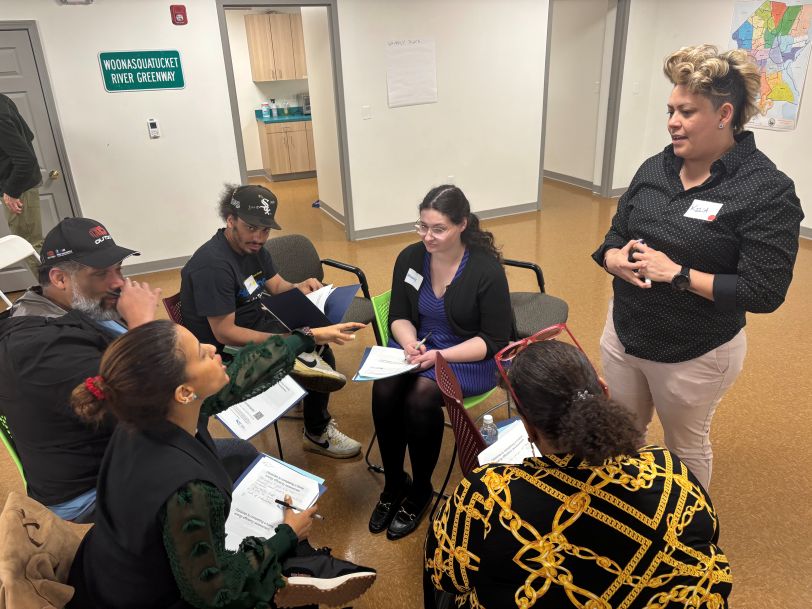
Before designing solutions, CEELI listened. Rather than developing an energy literacy program and presenting it to community partners, CEELI first convened a structured space for learning from the communities most affected by energy burden, bringing together residents, community-based workers, housing advocates, and frontline practitioners to share what they were observing and experiencing. The Efficient Housing for All Community of Practice (EHACoP) is the clearest example of this approach.
In an effort to ensure that Rhode Island achieves an optimal health and climate outcome, CEELI designed and facilitated the EHACoP to engage two key groups:
- Community-based workers at the intersection of environmental and human health; and
- Rhode Island residents with a high energy burden.
The EHACoP provided information about energy efficiency and its connections to health outcomes, Participants worked through scenarios and provided feedback that generated community-informed takeaways and recommendations for energy efficiency program improvements in Rhode Island. Participants were incentivized to participate, earning gift cards and a Certificate of Participation for attending three or more of the six sessions.
Key Takeaways from the EHACoP
- Increased participation in energy efficiency programs requires a combination of structural and relational changes in the policy and engagement landscape — not just program improvements alone.
- Community-based workers are the key to comprehensive, transformational change around issues that affect social determinants of health, if they are empowered to incorporate energy efficiency as a tool for improving conditions in the home.
What CEELI heard through the EHACoP shaped every aspect of the Energy Navigator Training that followed: the emphasis on relational trust over transactional outreach; the decision to train community-based workers who already have community confidence rather than building new outreach pipelines; and the recognition that language, both literal translation and the use of stigmatizing terminology, was a critical barrier to participation. The results of the EHACoP are summarized in the 2025 EHACoP Final Report.
This kind of learning does not end when a program launches. CEELI builds in feedback loops, including evaluations, cohort reflections, and stakeholder convenings, so that what the community teaches us in one round shapes what we do in the next.
CEELI also hosts the annual Plugged Into Energy Research (PIER) workshop: a public forum that shares what the initiative is learning with a broader audience of practitioners, policymakers, and community members, contributing to a statewide learning community that extends well beyond any single pilot or cohort.
Capacity
Building Lasting Energy Literacy Across Rhode Island’s Communities
Sustainable change requires more than a well-designed program, it requires leaving communities more capable than you found them. For CEELI, capacity building is the deliberate, long-term work of ensuring that energy literacy, advocacy skills, and program navigation knowledge take root in Rhode Island’s communities and persist well beyond any single training or grant cycle.
The Energy Navigator Training, funded through the RI Energy Efficiency Council and developed in partnership with Rhode Island Energy, ACEEE, and community partners including Children’s Friend and the City of Central Falls, is designed with this trajectory in mind. At every level – individual, organizational, and systemic – the initiative is building something intended to last.
Building Individual Capacity: The Energy Navigator
The core of this work is the Energy Navigator Training itself. Developed and facilitated by URI Cooperative Extension, the bilingual (English/Spanish) training equips CHWs and CBO staff with specialized knowledge they do not currently have access to through their existing training pathways. Specifically, trained navigators gain:
- An understanding of why energy efficiency matters: its connections to energy burden, indoor air quality, and social determinants of health;
- Fluency in the landscape of both market-rate and income-eligible energy efficiency services in Rhode Island, including commonly used program terminology and the most frequent weatherization deferrals; and
- Working knowledge of the Weatherization Assistance Program application process and the income-eligible programs available to help ratepayers address deferrals.
These are not single-use skills. A CHW who understands energy burden, landlord-tenant program dynamics, and referral pathways is permanently more capable of serving clients across interconnected housing, health, and energy challenges. The long-term goal is for community-based public health workers to integrate an “Energy Efficiency Coach” role into their regular outreach and engagement practice, making energy navigation a durable part of the community health workforce, not a siloed, grant-funded add-on.
Building Workforce Capacity: Formalizing the Role
Building individual knowledge is necessary but not sufficient. If CHWs are expected to take on energy navigation responsibilities without recognition or compensation, those responsibilities will remain informal and fragile. CEELI is working with CHWARI and the RI Department of Health HEZ Initiative Learning Community to formalize a workforce development incentive structure that recognizes and rewards CHWs for their engagement in energy efficiency work.
This effort is about creating a pathway, not just a training event. CHWs who complete the Energy Navigator Training are eligible for Home Energy Assessment Opportunity incentives, providing both immediate recognition and a direct connection to the programs they will be navigating for clients. CHWARI’s involvement in developing the incentive scheme ensures it is shaped by the cultural context and practical realities of the CHW workforce itself.
Building Infrastructure: The RI Home Weatherization Roadmap
A central output of this initiative is the digital RI Home Weatherization Roadmap, a decision-tree web tool that guides community-based workers and ratepayers through the weatherization process step by step: program eligibility, landlord coordination, deferral pathways, and available incentives. Built with input from the RI Energy Efficiency Council and the Energy Equity Working Group, the Roadmap is designed to remain a freely accessible public resource that any navigator, ratepayer, or practitioner in Rhode Island can use, with or without a formal training.
The Roadmap is being developed collaboratively by the CEELI team and the URI Environmental Data Center, incorporating lessons from the EHACoP and technical input from Rhode Island Energy and ACEEE. It represents an investment in shared infrastructure that reduces the knowledge gap CHWs and renters face every time they try to access energy efficiency programs.
Building for Replication: From Pilot to System
The Energy Navigator Training is explicitly designed as a pilot, not a permanent, place-specific program. From the outset, URI Cooperative Extension and ACEEE are building in structured learning and documentation so that the model can be replicated by other municipalities and community organizations across Rhode Island and beyond. This includes:
- Evaluation of both training cohorts, capturing quantitative indicators (applications, assessments, completions) and qualitative learning (navigator experiences, renter and landlord feedback);
- Documentation of the multi-partner model and its lessons learned; and
- Development of training materials, including lesson plans, a participant workbook, and case studies that are modular, translatable, and adaptable by others.
This replication-oriented design reflects a broader principle in URI Cooperative Extension’s community engagement model: the goal is not to own a program indefinitely, but to build knowledge and infrastructure that communities and other institutions can adapt and carry forward. CEELI is investing in local capacity so that its role can shift from primary organizer to supportive technical resource.
Join Our Mailing List
Are you interested in keeping up with the Energy Literacy Initiative’s work?
Sign Up Here!In the News
Rhody Today:
URI Cooperative Extension Aiming to Connect All Rhode Islanders to Increased Home Energy Efficiency
Power 102.1FM:
Por qué no usamos los programas de energía disponibles?

Kevin Drumm

Kate Venturini Hardesty