
Thinking about how to engage hard-to-reach audiences? Considering running a community of practice? Look no further! This page is a tool for practitioners who want to design inclusive, collaborative community engagement programs.
What is a community of practice?
A community of practice (CoP) is a group of people who share a concern and learn how to address it through regular interaction.
Communities of Practice (CoPs) equip passionate individuals with collective goals in order to effectively bring changes and solutions to common or intersecting issues.
Through a supportive network, communities of practice enable groups of people to adapt, build relationships, and expand their fields of knowledge on related issues. Tools and shared information generated through communities of practice can provide members with the essential elements they need for collective growth and problem solving.
Learn MoreOverview
Case Study: 2025 Efficient Housing for All Community of Practice
Energy efficiency through home weatherization presents an opportunity to address these
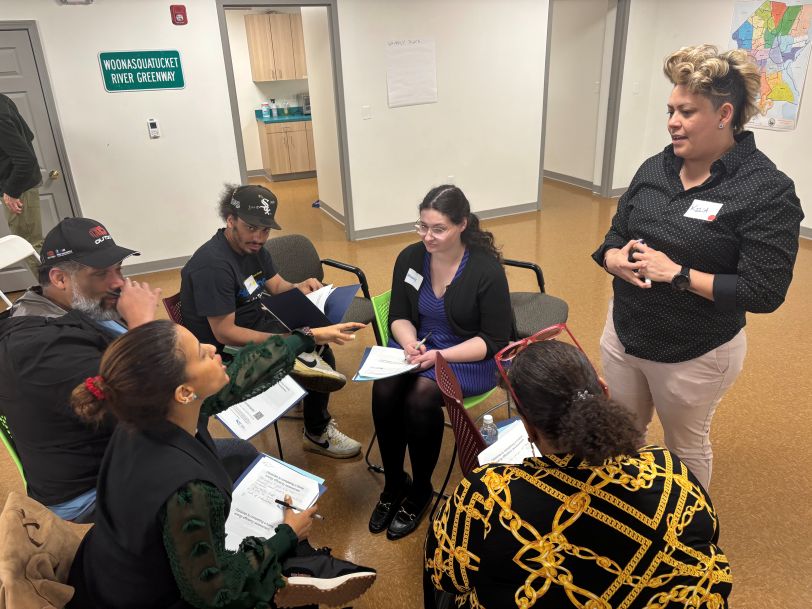
health disparities and decrease energy burden for families. In 2023, researchers projected several energy efficiency and conservation scenarios, demonstrating the long-term impacts of household energy use on health and climate outcomes. In an effort to ensure that Rhode Island achieves the optimal health and climate scenario, the Efficient EHACoP engaged two key groups – 1. community-based workers at the intersection of environmental and human health; and 2. Rhode Island residents with a high energy burden. The EHACoP provided information about energy efficiency and how it relates to health outcomes to participants, and worked through scenarios to collect feedback that generated community-informed takeaways and recommendations for energy efficiency program improvements in Rhode Island. Participants were incentivized to participate, earning gift cards and a Certificate of Participation for attending three or more of the six sessions.
Key Takeaways
The Efficient Housing for All Community of Practice highlighted the importance of a systems change approach. Increased participation requires a combination of both structural and relational changes in the energy efficiency policy and engagement landscape.
Community-based workers are the key to comprehensive, transformational change around issues that impact social determinants of health if they are empowered to incorporate energy efficiency as a tool for improving conditions in the home
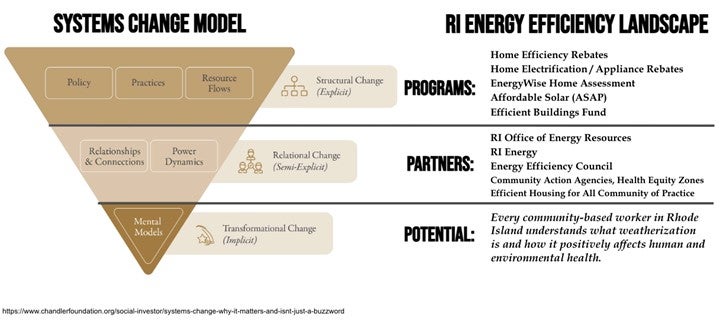
Systems Change Model
The EHACoP was an intentional effort to focus on the elements of relational change – relationships, connections, and power dynamics – to build upon the structural change that has already been achieved and make progress to increase participation in energy efficiency programs in Rhode Island.
Resource Corner
- Systems Change: Why it Matters (and Isn’t Just a Buzzword)
- Community of Practice Facilitation Guide
- Convening Design 2022
- What is Meaningful Community Engagement? Learnings from the Perspective of a National Advocacy Organization
- Community Engagement Toolkit: Essentials for Planning & Facilitating Meaningful Conversations
- Equitable Community Engagement Toolkit
In the News
Rhody Today:
URI Cooperative Extension Aiming to Connect All Rhode Islanders to Increased Home Energy Efficiency
Power 102.1FM:
Por qué no usamos los programas de energía disponibles?
JOIN OUR MAILING LIST
Are you interested in keeping up with Energy Literacy Initiative’s work?
Sign up Here!This work is made possible with support from the Rhode Island Energy Efficiency Council.

Kevin Drumm

Kate Venturini Hardesty