
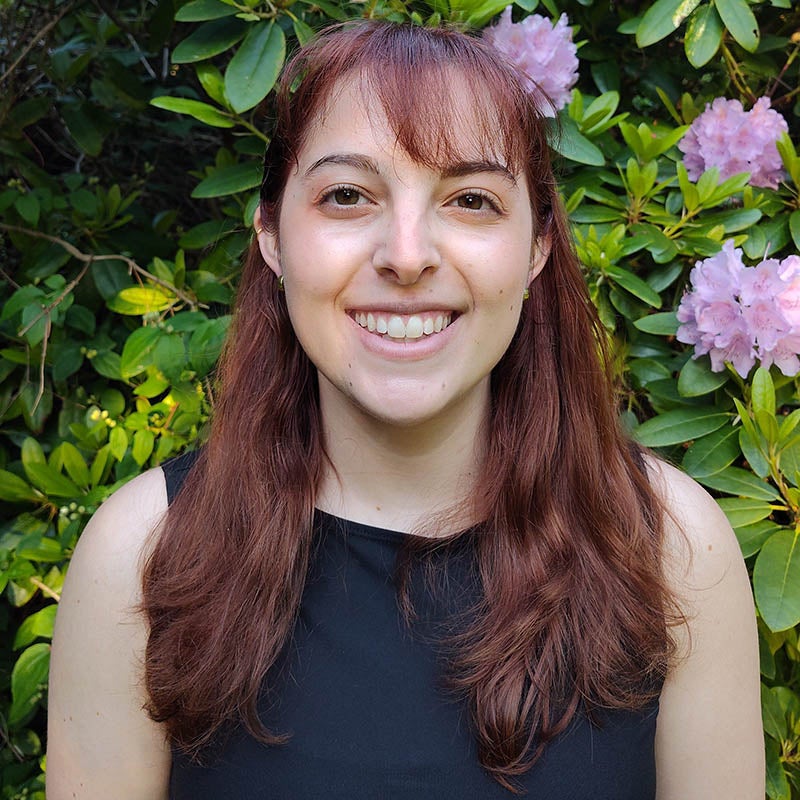
KINGSTON, R.I. – Aug. 17, 2026 – Eleni Mouyos, of Windham, New Hampshire, has just completed a summer internship at the Northeast Fisheries Science Center in Woods Hole, Massachusetts. The internship was possible through the National Oceanic and Atmospheric Administration Ernest F. Hollings Scholarship program, a prestigious, nationally competitive award for students interested in the marine sciences.
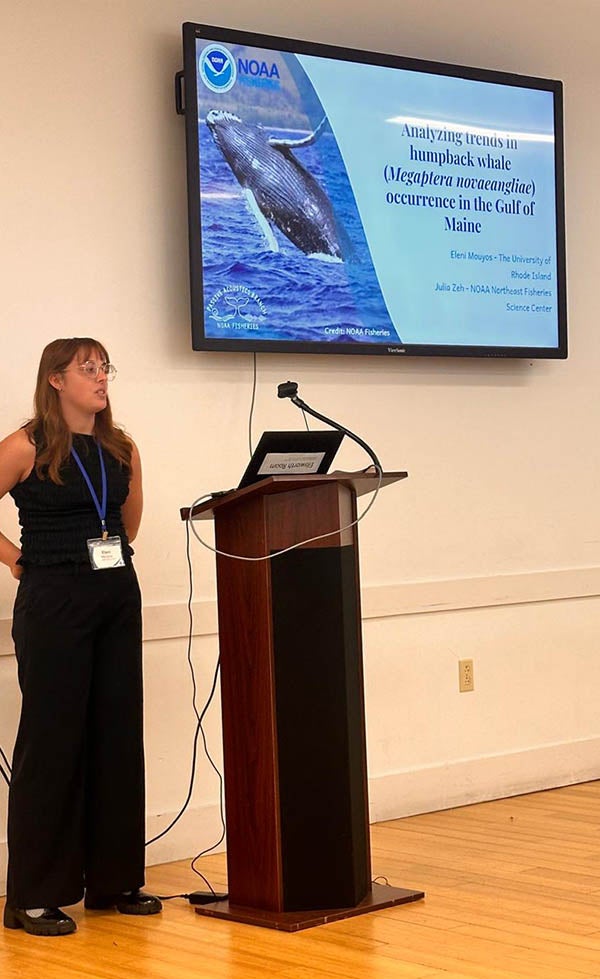
“It has been an incredible experience,” said Mouyos. “I worked with the passive acoustic branch on a project analyzing spatial and temporal trends of humpback whales in the Gulf of Maine, and through the work I developed my skills in data analysis and coding and was introduced to equipment used in acoustics.”
At the end of July, she presented her research in Silver Springs, Maryland, with the other interns in her class at a conference hosted by NOAA.
Mouyos is double majoring in ocean engineering and marine biology, a five-year dual degree program, with minors in robotics and mathematics. “URI has given me access to people and opportunities I don’t think I would have found anywhere else,” said Mouyos.
Academic career thus far
Research has helped shape her path significantly. The Undergraduate Research in Science and Engineering program sophomore year helped her feel comfortable navigating different academic opportunities. She worked in ocean engineering Assistant Professor Che-Wei Chang’s lab as well as biological science Professor Andrew Davies’ lab. They strengthened her engineering design skills and showed the applications of both engineering and biology.
Professor Emerita Jacqueline Webb also mentored her and introduced her to classes at Shoals Marine Lab in Maine and guided her through the application process for the Hollings scholarship. Associate Teaching Professor Maria Donnelly also helped direct her to the Hollings and National Institute for Undersea Vehicle Technology. Jim Miller, NIUVT’s co-director and URI ocean engineering professor, also played an important part in her receiving this scholarship. “Without them, or my fellow peers, I would not have heard about the opportunities I have received, or even felt confident enough to pursue them,” said Mouyos.
Her decision to pursue an engineering degree stemmed from a mix of family influence and an existing interest in design and implementation. Growing up in New Hampshire, her access to the ocean was a short stretch of coastline, but it introduced her to the marine world. Her interest in marine-related things deepened in high school when she joined the Marine Science Club. “My brother, who studied mechanical engineering at URI, told me I could combine both interests with the double major in ocean engineering and marine biology,” said Mouyos.
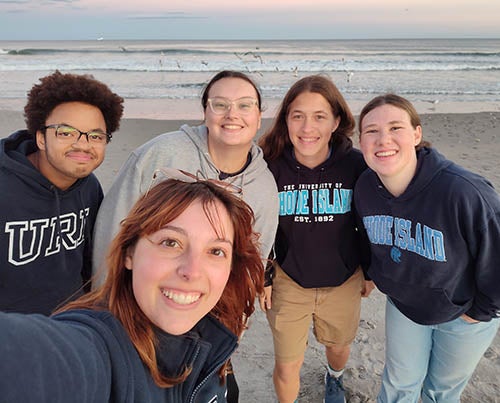
URI’s College of Engineering also stood out because the environment was challenging, but still supportive. There are many resources, including student organizations and career advising available to students. “I felt that I could grow here without fear of judgment,” said Mouyos.
More specifically, the Bay Campus was a major factor for her in choosing URI. “Having a dedicated campus to these fields felt like a great opportunity to learn next to and on the water and being able to see real world research on-site,” said Mouyos.
Student organizations have been a central part of her experience as well. One of the biggest challenges was stepping out of her comfort zone to join organizations and get involved in research. Other students made the transition easier by including her, sharing opportunities, and overall making her feel more confident stepping into new spaces. “Once I became active, it began opening up new doors and introducing me to people beyond just my major and classes,” said Mouyos. “My student involvement shaped my confidence, technical skills, and community.”
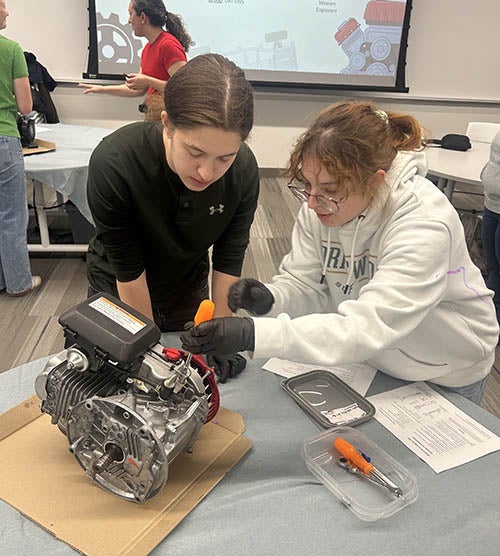
Through the Society of Women Engineers, she gained leadership experience and built a professional network. “That has been especially important as a woman in engineering,” said Mouyos.
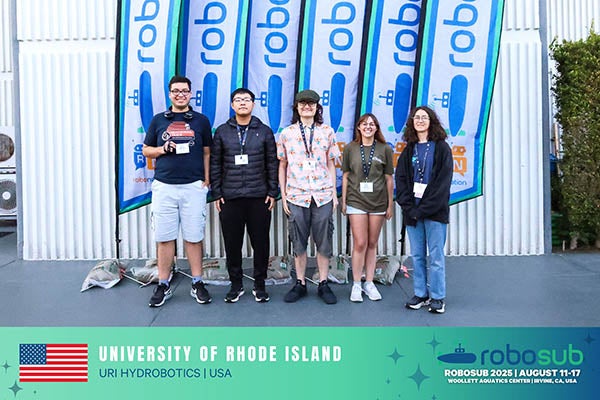
The Hydrobotics Team is a student-run club that develops engineering platforms related to underwater robotics. They compete in the international robotics competition RoboSub with their automated underwater vehicle Tardigrade. Mouyos serves as the club’s treasurer. The team also introduced her to the foundations of robotics and gave her experience collaborating with students across different engineering disciplines. In SWE, she served as one of two engineering representatives to help organize annual networking nights and E-Week activities. This upcoming school year, she was elected treasurer for the society and will help manage the club’s budget and plan fundraisers.
“My student involvement shaped my confidence, technical skills, and community.”Eleni Mouyos
Mouyos has also traveled abroad when she participated in an exploration visit to Australia through the National Institute for Undersea Vehicle Technologies, a partnership between URI and University of Connecticut students and faculty.
After graduation next year, she plans to enter the industry and pursue a career in underwater robotics with applications in marine conservation by designing and developing underwater systems that support conservation and environmental protection.
“What has helped me meet my goals is to push past the initial fear of trying something new. If I let fear stop me from applying, joining, or starting something, I’d never grow. Eventually, I hope to return for graduate school, but I’m still figuring out what path makes the most sense,” said Mouyos.