
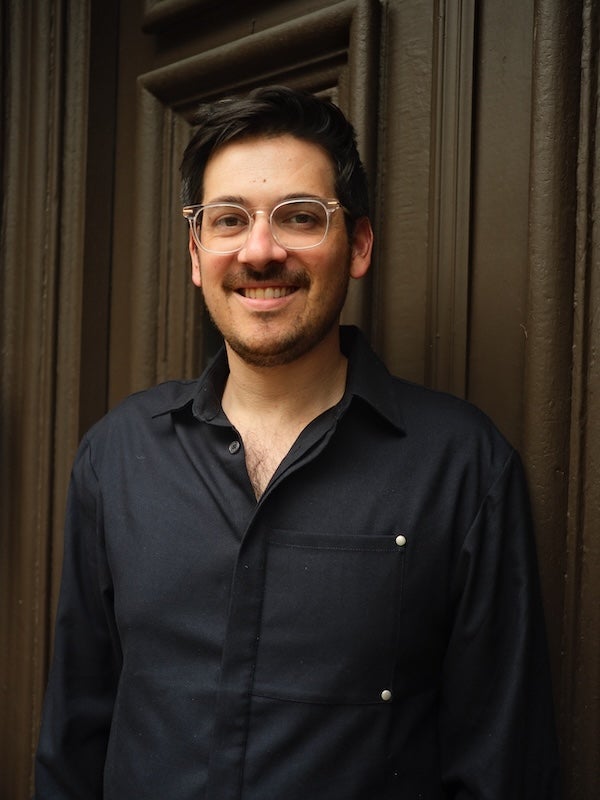
Growing up in Arlington, Virginia, Joseph Huennekens was fascinated by cities. That early interest eventually led him from architecture to urban planning, where he became interested in the policies and regulations that shape how communities grow and change.
After earning his undergraduate degree in architecture from the University of Virginia, he received a master’s degree in city planning from the University of Pennsylvania. He worked for several years before returning to academia to earn his Ph.D. in planning from Columbia University. After 11 years in Brooklyn, New York, he is joining the University of Rhode Island as an Assistant Professor of Planning.
He joins URI at an exciting time: Geosciences and Landscape Architecture recently merged to create the new Department of Earth Sciences, Planning, and Design (ESPD), bringing science, planning, and design together to help communities understand and respond to complex environmental challenges.
Q. What first sparked your interest in cities and planning?
A. I was interested in cities from an early age: drawing cities, playing SimCity on the family PC, building elaborate model cities with Legos, etc. But I thought that meant I should become an architect. Once in college, however, I started to realize how much of city form is determined not by architects, but by urban planners and policymakers (through zoning and other land use regulations). I became fascinated by the rules that govern the size, shape, and location of certain types of buildings, how those rules structure who gets to live and work in which places, and how those rules are formulated (and the political fights over them).
What are you exploring in your research?
There are two main projects that I’m working on right now. The first is a book project that grows out of my dissertation. This looks at a suburb of New York City where rapid densification (i.e. adding more housing, especially multifamily housing) overlaps with demographic change, thus supercharging the already fraught nature of built environment policymaking. The research aims to clarify the mechanisms of large-scale densification in a built-out suburban context and also untangle the unique political dynamics of adding housing when that housing is associated with certain socioeconomic groups. Through that work, I also got interested in land use litigation and the often hidden/overlooked role that the courts play in shaping local land policy. This has led to my second current project, which aims to quantify the scope and scale of land- and development-related litigation; see whether certain clusters of conditions might predict litigation; better understand what leads citizens and environmental activists to sue over local decisions; and determine how lawyers, judges, and other legal actors think about their role as de facto land use policymakers.
How would you explain your research to someone unfamiliar with the field?
I would say that I am interested in conflicts over land and development, especially those that pit the need for new housing against environmental prerogatives. I am interested in who determines what land is used for; which groups have the most power over those decisions; and which policy decisions ultimately get realized, versus which are ultimately blocked.
What excites you most about being part of ESPD?
Planners and designers formulate a vision for a certain space or community by taking environmental inputs (like those researched by our Earth Science colleagues) and combining them with social needs and political realities. I think this department represents a tremendous opportunity for planners and designers to better understand both sides of that process. For planners/designers to better understand the environmental inputs they work with, and, vice versa, for scientists to better understand the challenges and crosswinds of on-the-ground implementation in diverse communities with different priorities. Planning at URI has a long history, and I hope to see community planning grow as a component of this department, with increased course offerings and maybe even degree programs.
What will you be teaching at URI?
This year, I will be teaching introduction to community planning in the fall and environmental law in the spring. Over the coming years, I hope to develop other courses about land use, housing, and urban design.
What are you reading, watching, or listening to lately (academic or otherwise)?
The last great academic book I read was an academic work that didn’t read like one: Radically Legal by Joanna Kusiak. This was about a remarkable housing referendum in Berlin. I also love reading contemporary fiction. Two good novels I read this summer were The Passenger Seat by Vijay Khurana (a disturbing coming-of-age story) and The Emergency by George Packer (a kind of alternate history/allegory that turns into an adventure tale). My wife and I have also been watching the Sopranos for going on two years now – we are finally in the final season!