
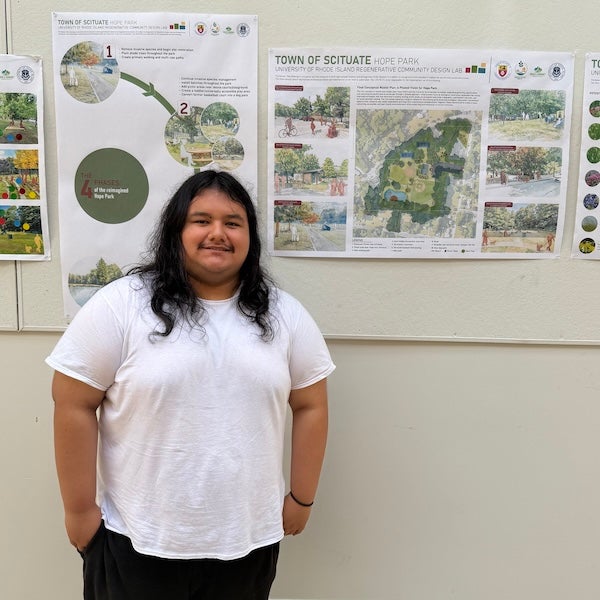
For landscape architecture major Anthony Cordova, CELS Summer Research Fellowship with the Regenerative Community Design Lab (RCDL) offered an opportunity to take what he has learned in the classroom into Rhode Island communities. Working directly with towns, Cordova helped develop conceptual park designs grounded in community feedback, site history, culture, ecology, and topography.
Through site visits, community engagement events, and design work, Cordova explored how landscape architecture can help communities envision improvements to their parks and natural environments.
Q. What is your project about?
A. The main goal we wanted to achieve during the program was to work closely with multiple communities to improve the existing natural and built environment through conceptual designs and planning. We look at a site on a deeper level by examining its history, inventory, culture and topographic information, as well as information about the city it resides in. We then incorporate nature-based solutions that support healthy ecological systems.
We provide our research, design boards and an extensive report about our involvement with the park from start to finish. The communities can use those materials to apply for various grants and potentially incorporate some of the design ideas. This summer, I was able to work with three different communities throughout Rhode Island: North Providence, Scituate and Richmond.
What does a typical day look like during your fellowship?
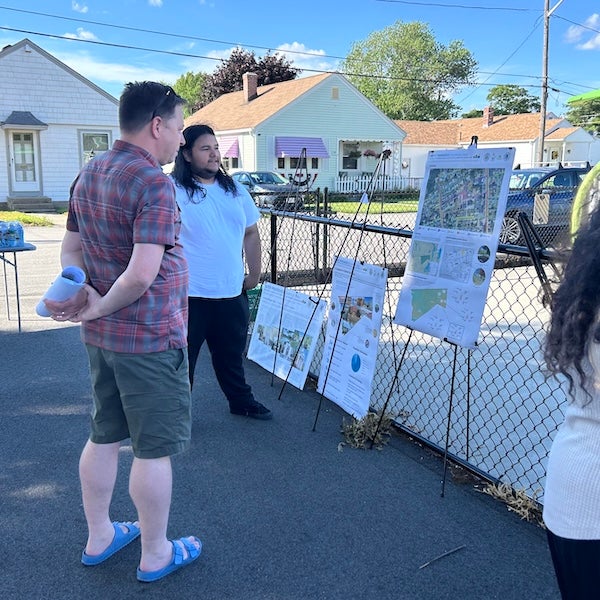
During the beginning of a project, we conduct site visits to get a better understanding of the area we will be working on. On some days, we also conduct engagement events to gather the community together and learn what they would like to see implemented in the park. These results are what we use to start our conceptual designs.
Other than those specific days, we are normally in a room, on our computers, gathering information about the site or working on the concepts.
What’s been the coolest part of the experience so far?
The coolest thing I’ve experienced in this program was the different community members I’ve interacted and spoken with. Working with different communities and people from different backgrounds was a very beneficial experience, as it is something that I will be getting into after graduation.
What’s been one of the most rewarding moments of the summer?
Being able to complete the concepts on time and see the community’s reaction to them was really rewarding. It helped spark conversations about their park and what they could do to make it better. It also helped me push myself to become better at designing, and I gained more confidence in my public speaking from it.
How has working with your faculty mentor enriched your experience?
Dr. Jane Buxton, who leads the RCDL, has been nothing but supportive throughout my time in the program. She teaches and has an understanding of landscape design. I would always get feedback from her when it came to my concept designs. Because of this, I’ve been able to figure out my own personal design style.
What has this experience taught you that you couldn’t have learned in a classroom?
Being able to learn in the real world is very different from what is learned in a classroom. Things like being able to talk to a large crowd or figuring out your own design style are not things that can quickly be taught in a classroom.
What I have learned in the classroom has also helped me during the program, and it feels really rewarding to know that my knowledge can create a positive impact on a community and the environment. I hope to be able to do that again with my own community in the near future.