
The Graduate Student Association (GSA) is a government body maintained by and for the graduate students of the University with the purpose of enhancing the academic, intellectual, and social opportunities of its members. Officers and members of the GSA Senate, elected annually from the entire graduate student body, distribute GSA funds to graduate students and other qualifying groups, organize social events, and serve as graduate student representatives on University-wide committees.
Every graduate student at URI donates to the funds of the GSA through the student activities fee. All GSA programs; events; activities; and decisions are managed by the GSA Senate and executive board as mandated by the GSA Constitution.
Executive Board 2026 – 2027
The Executive Board (referred to as “the cabinet”) is the governing body responsible for carrying out the GSA’s day-to-day operations and executing policies set by the Senate. It is led by the President, who serves as the chief executive officer, spokesperson, and financial overseer, with the Vice President stepping in when needed and managing committee formation and external partnerships.
Cabinet members are nominated by the President and Vice President and confirmed by the Senate. While they hold voting power within cabinet meetings, they do not vote during regular Senate meetings. A quorum of at least three members is required for cabinet decisions, and members can be removed by a unanimous vote of the rest of the cabinet if they fail to carry out their duties.
Senate 2026-2027
The Legislative Branch holds all voting power on legislation during regular Senate meetings. It is led by a Speaker of the Senate, who chairs meetings, manages agendas, and ensures parliamentary procedure is followed. Senators represent their respective departments, and serve on at least one committee. Legislation can take the form of bills (specific actions) or resolutions (formal statements), and requires sponsorship by a committee or five senators before being voted on.
The legislature oversees nine standing committees:
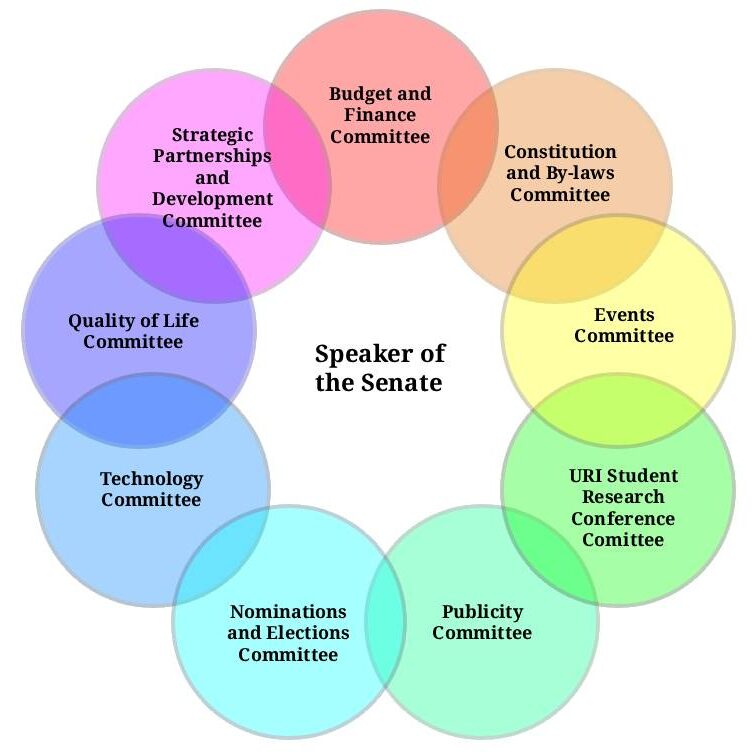
- Budget and Finance Committee – Reviews and approves all financial matters, including organization budgets and the annual GSA budget.
- Constitution and By-laws Committee – Reviews and interprets the Constitution and By-laws, proposing improvements as needed.
- Events Committee – Plans and supports GSA events in coordination with the Director of Events Management.
- URI Student Research Conference Committee – Organizes the annual research conference, handling logistics, submissions, scheduling, and accessibility.
- Publicity Committee – Manages advertising and content creation for GSA initiatives, working under the Director of Communications and Marketing.
- Nominations and Elections Committee – Oversees spring elections and tracks vacancies across the Senate.
- Technology Committee – Maintains the GSA’s digital infrastructure, ensures virtual meeting access, and supports technology-driven initiatives.
- Quality of Life Committee – Addresses graduate student everyday concerns like housing, food insecurity, and access to services, supporting data collection and advocacy efforts. One of their main priorities is representing graduate students as designated advocates on committees throughout the University.
- Strategic Partnerships and Development Committee – Drives external engagement, sponsorship, and partnership development, synergizes efforts across the GSA and includes auxiliary representatives from all other standing committees.
Senate meetings follow Robert’s Rules of Order, are capped at 120 minutes, and must be held at least three times per semester. A quorum requires one-third of the legislature’s voting members, and all members must be notified at least two weeks in advance of regular meetings.
Advisory Board
The Advisory Board is a non-governing, standing body that supports the long-term continuity, strategic development, and external engagement of the GSA. It provides guidance and institutional knowledge to the Executive Board and Senate without holding any decision-making authority over GSA operations. The Advisory Board as a whole and the Alumni Advisory Council is chaired by the Past President.



Advisors
Co-Advisors serve in a non-governing, advisory capacity within the Advisory Board. They are nominated jointly by the President and Past President, approved by a majority vote of the Executive Board, and confirmed by a majority vote of the Senate. The GSA maintains at least two Co-Advisors at all times when possible.
Their responsibilities include providing expertise, facilitating connections, supporting the advancement of GSA initiatives, and co-chairing the Academic & Institutional Advisory Council and the External & Development Advisory Council alongside a student co-chair for each. In the event that no Past President is available, Co-Advisors may also take on a role in nominating replacements for the Advisory Board Chair.

Dr. Beth Meyerand, Vice Provost and Dean of the Graduate School