
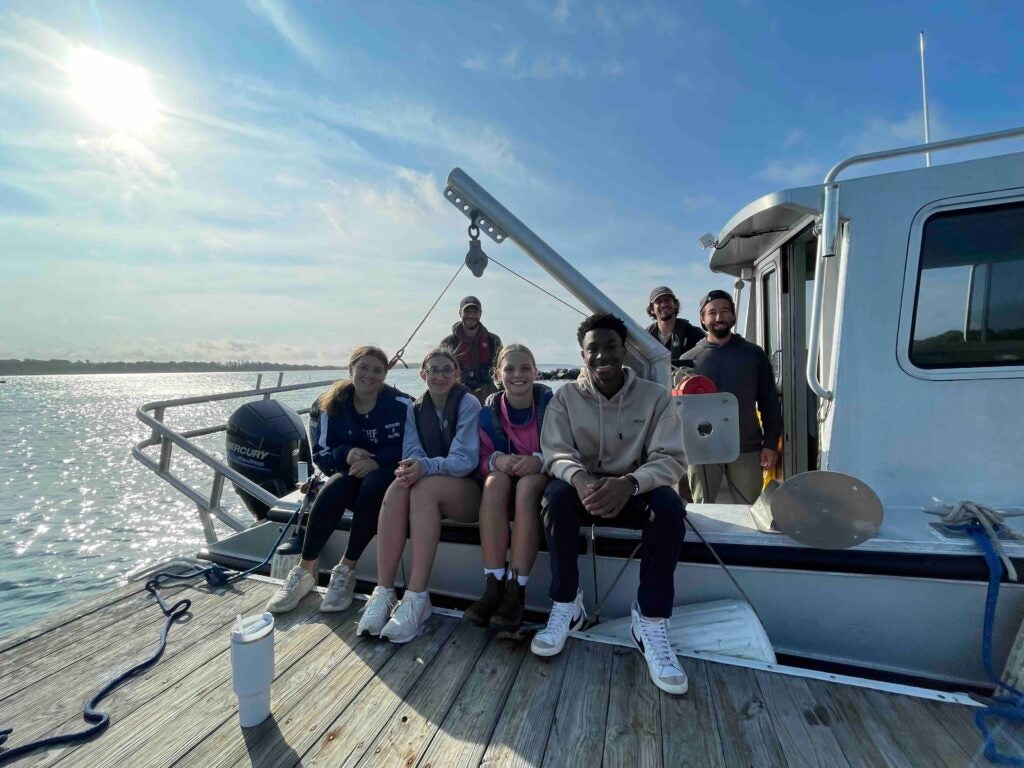
Photo by Chris Kinkaid
For most first‑year students, the semester begins in a lecture hall. For the students in HPR 131G, it began with course instructors Brian Caccioppoli, the Small Boats Program Manager, and Chris Kinkaid Professor of Oceanography on the deck of a research vessel in the middle of Narragansett Bay. In this new Honors course, students learned to drive boats, tie essential knots, deploy oceanographic sensors, and interpret real‑time data — gaining confidence, curiosity, and a sense of ownership over their learning from day one.
What made the course so memorable for students was how quickly they were trusted with real responsibility. Instead of watching demonstrations, they were the ones navigating tight docking maneuvers, programming temperature sensors, building moorings, and collecting data that would shape their final project. As Dr. Kincaid explained, the goal was to see whether students would thrive when given the chance to learn everything from boat handling and navigation to data analysis and problem‑solving. “I was incredibly impressed by how quickly the students picked up boating skills,” he shared. “These skills can be unintuitive and difficult to relate to other skillsets in their lives, so watching them develop was incredibly rewarding.”
Graduate student Teagan Cunningham and her peers played a major role in shaping that experience. Graduate assistants helped deploy and retrieve moorings — even scuba diving when instruments slipped below the surface — and guided students through steep learning curves in MATLAB, a programming and computing platform. “It was amazing to see the undergraduates grow more comfortable working with the data,” Teagan said. “By the end of the semester, each group had a good handle on the analysis and confidence in their final presentations.”
The final project challenged students to analyze data from the West Passage and determine the best location for a hypothetical discharge pipe releasing “Clammy Toxilium,” a fictional pollutant that becomes nontoxic under certain temperature and flushing conditions. Each graduate assistant mentored a group, helping them interpret data collected during two cruises between August and October. For many students, it was their first time applying scientific reasoning to a real‑world scenario — and their first time seeing themselves as capable of doing so.
Standout moments filled the semester: knot‑tying races that brought energy into the classroom, breakthroughs in MATLAB that sparked genuine excitement, and the pride students felt when they realized they could drive the boat, retrieve their own instruments, and explain their findings with confidence. As Dr. Kincaid put it, students went from “never being on a boat, to comfort driving the boat, to much harder to master docking skills.”
The course left students with skills, confidence, and a sense of possibility that will carry them far beyond their first semester.
Story by Anxhelika Deda