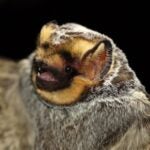
 Bat beat: URI wildlife researcher Patrick Bailey answers questions about fall’s favorite winged mammal - All eight of Rhode Island's bat species are now listed as species of greatest conservation need. URI researcher Patrick Bailey explains why they matter and how to help.
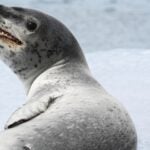 A Previously Unknown Gathering Place for Leopard Seals Comes into Focus - A new study led by URI's Dr. Emily Sperou offers the first systematic look at South Bay, Antarctica, as a location where leopard seals feed, linger, and may reproduce.
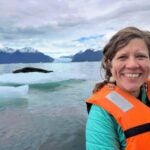 URI professor receives NSF CAREER Award for study of Southern Ocean predator - Assistant professor Sarah Kienle was selected for a National Science Foundation CAREER Award, one of the nation's top awards for early-career faculty, for her work studying the female leopard seal.
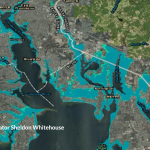 RI homeowners already suffering due to sea-level rise, Sen. Whitehouse says - Some Rhode Island properties
especially those along the coast, may be underwater within 30 years according to Rhode Island’s STORMTOOLS website, which is hosted by URI's Environmental Data Center.
RI homeowners already suffering due to sea-level rise, Sen. Whitehouse says - Some Rhode Island properties
especially those along the coast, may be underwater within 30 years according to Rhode Island’s STORMTOOLS website, which is hosted by URI's Environmental Data Center.- Parts of Barrington will be underwater by 2035, sea-level data shows - URI's Environmental Data Center manages an ArcGIS Server that is getting a lot of use as people concerned about climate impacts in Rhode Island explore STORMTOOLS. STORMTOOLS helps Rhode Islanders assess their risk from coastal inundation.
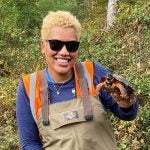 Statewide search is on for one of RI’s rarest turtles - NRS graduate student, Chloe Johnson, is surveying the state to identify local populations of one of the rarest turtles in RI--the wood turtle--and the habitats they use.
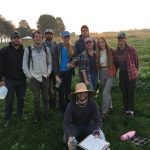 URI headed to National Soil Judging Competition - The URI soil judging team won first place in the Division 1 Soil Judging Competition, earing a trip to the National Soil Judging Competition in Ohio in April of 2022. URI students competed against 63 students representing 8 schools on their ability to describe, classify and interpret soil profiles; hand texture soils; and identify soil […]
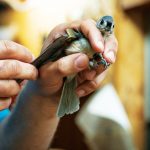 Avian Affection - URI faculty and URI’s Kingston Wildlife Research Station have been the starting point for many who’ve made careers out of their love of birds.
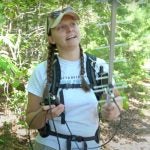 Tracking fishers in R.I. - In this video produced by the Rhode Island Department of Environmental Management, Natural Resources Science doctoral student Laken Ganoe, talks about a three-year project to capture and track fishers throughout western Rhode Island.
 New online graduate certificate programs for natural resource professionals - URI’s College of the Environment and Life Sciences is launching three online graduate certificate programs in 2021 to help professionals working in natural resource and environmental fields improve their skills and expertise.
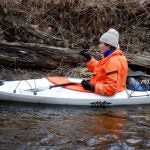 URI scientists investigate distribution of muskrats, beavers, otters in R.I. - Traveling via kayak, graduate student John Crockett will be scouring lakes, ponds and wetlands over the next three years to search for signs of the three semi-aquatic mammals.