
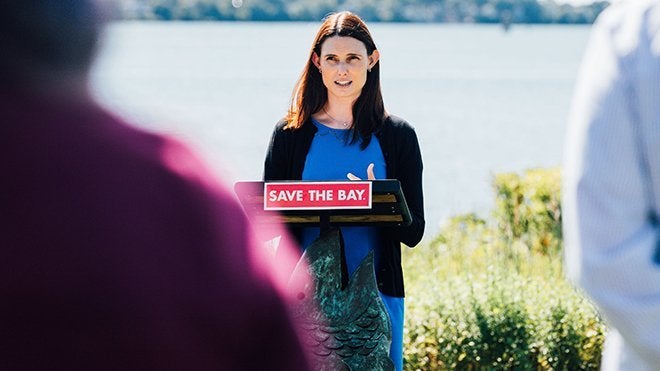
Rhode Island NSF EPSCoR investigator Lillian Jeznach spoke about her research on microplastic contaminants in Narragansett Bay and the benefits of a new Environmental Engineering and Science Lab, made possible with funding secured by Reed.
Researchers from Roger Williams University joined U.S. Senator Jack Reed at a press conference Thursday along the shores of Narragansett Bay to advocate for coordinated action at the local, federal, and global level to tackle plastic waste and pollution including stepped-up research, regulation, and coordinated action around microplastics.
Along with experts from RWU, Save The Bay, and the University of Rhode Island, Reed discussed the threat of microplastics, tiny particles of plastic waste less than 5 millimeters in diameter that pose a significant risk to water quality, human and animal health, and climate and ecosystem stability.
“Microplastics are a macro, large-scale, global problem. We need comprehensive, coordinated action to help protect people, communities, public health, and environmental health,” said Senator Reed. “I commend the Biden-Harris Administration for spurring other nations to do their part and join the U.S. in tackling plastic pollution. America is working with our partners at the United Nations on a major, evidence-based treaty to rein in contamination from microplastics. Last month, the Biden-Harris Administration released the first comprehensive, government-wide strategy to target plastic pollution at production, processing, use, and disposal. A key part of that plan calls for developing standard methods for collecting, quantifying and characterizing microplastics. This will ensure regulators have good data they can use to set limits on microplastics in our food and water.”
This piece was originally published by Roger Williams University on August 22, 2024. Read the full story!
 RI NSF EPSCoR is supported in part by the U.S. National Science Foundation under EPSCoR Cooperative Agreements #OIA-2433276 and in part by the RI Commerce Corporation via the Science and Technology Advisory Committee [STAC]. Any opinions, findings, conclusions, or recommendations expressed in this material are those of the author(s) and do not necessarily reflect the views of the U.S. National Science Foundation, the RI Commerce Corporation, STAC, our partners or our collaborators.