
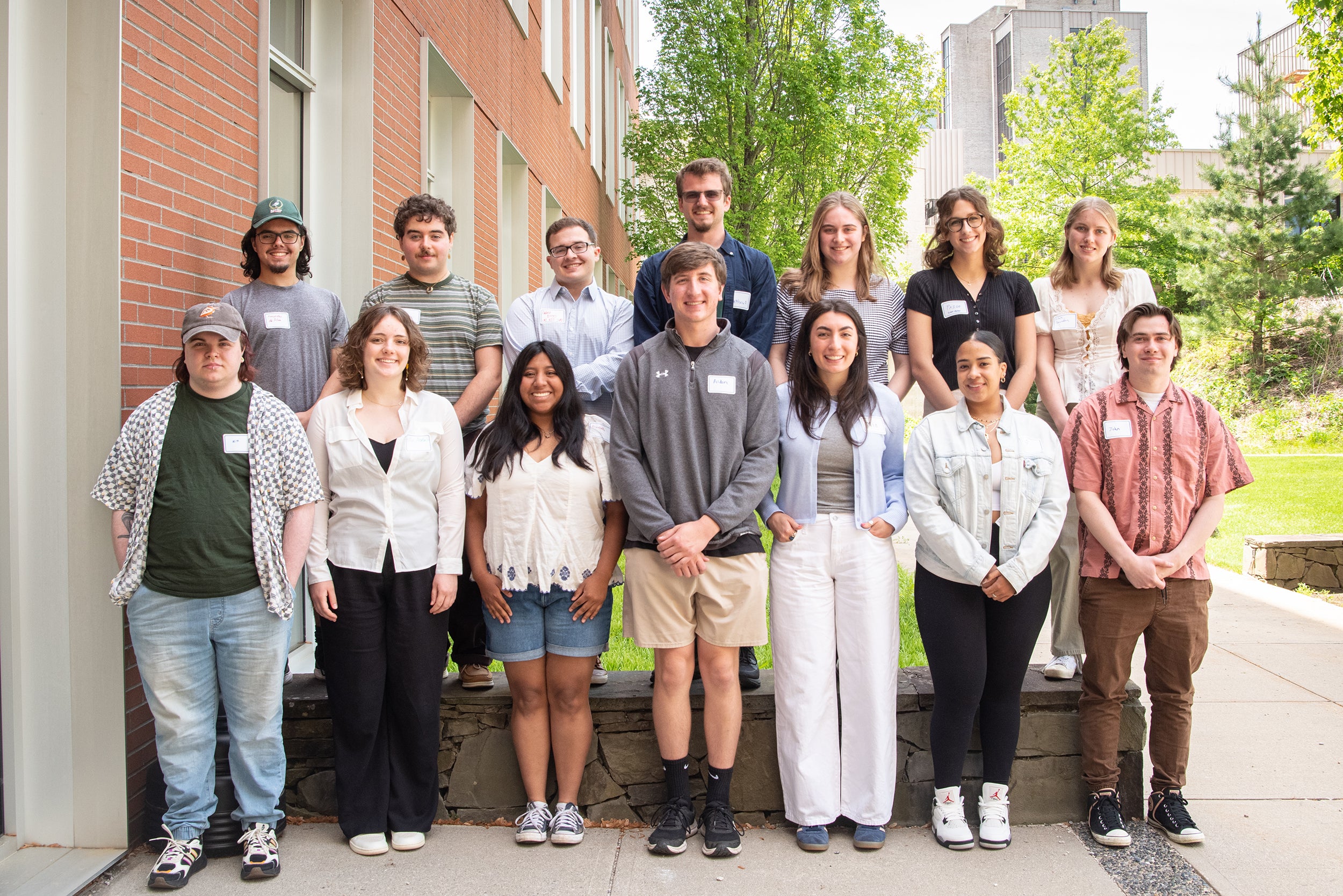
As the EPSCoR Summer Undergraduate Research Fellowship (SURF) program’s home, RWU strengthens its commitment to advancing undergraduate research and fostering collaboration among Rhode Island’s scientific community.
Roger Williams University will serve as the new home of the Summer Undergraduate Research Fellowship (RI NSF EPSCoR SURF) program and lead a STEM workforce development effort, as part of an $8 million grant from the U.S. National Science Foundation (NSF) aimed at enhancing scientific research and technological innovation across Rhode Island.
The NSF grant establishes the Rhode Island Inclusive Network of Excellence in Science and Technology (RII-NEST), a partnership among RWU, Brown University, the Narragansett Indian Tribe, Rhode Island College, Rhode Island School of Design, and the University of Rhode Island, designed to elevate the state’s research competitiveness and workforce development. Facilitated by the NSF EPSCoR Collaborations for Optimizing Research Ecosystems Research Infrastructure Improvement (E-CORE RII) program, the project seeks to transform scientific findings into real-world applications by connecting academic institutions, nonprofit organizations, and industry.
“Roger Williams University is committed to enhancing Rhode Island’s scientific capacity and fostering a culture of innovation across disciplines,” said Margaret Everett, Provost and Senior Vice President for Academic Affairs. “This partnership represents a powerful opportunity to unite the strengths of multiple institutions and build a foundation for future breakthroughs that can resonate throughout the state and beyond. We are dedicated to ensuring that the benefits of scientific progress are widely distributed, contributing to a more equitable and prosperous future for all Rhode Islanders.”
This piece was originally published by Roger Williams University on October 30, 2024. Read the full story!
 RI NSF EPSCoR is supported in part by the U.S. National Science Foundation under EPSCoR Cooperative Agreements #OIA-2433276 and in part by the RI Commerce Corporation via the Science and Technology Advisory Committee [STAC]. Any opinions, findings, conclusions, or recommendations expressed in this material are those of the author(s) and do not necessarily reflect the views of the U.S. National Science Foundation, the RI Commerce Corporation, STAC, our partners or our collaborators.