
Description
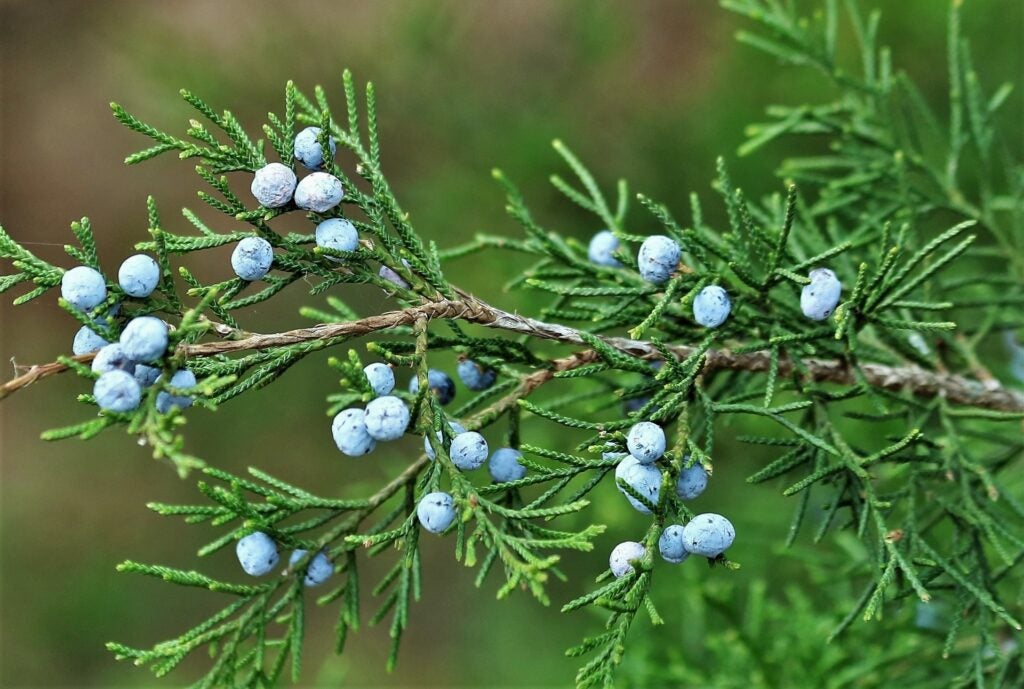
There are different types of cedar, but the most common variation native to southern Rhode Island – specifically, in traditional Niantic territory – is eastern red cedar (Juniperus virginiana). Eastern red cedar is an evergreen, aromatic tree, used in both medicine and ceremony among the Narragansett. The leaves and inner bark can be used for making teas, and the berries can be used both for cooking and medicine. In ceremony, the wood of the tree has been incorporated into both physical structures such as cedar arbors for singing, or made into musical instruments. Cedar carries significance as both a form of ceremony and physical medicine.
Audio Transcript
I think cedar is probably, for me, in my opinion, one of the most sacred medicines that we have. In Rhode Island, particularly the southern part of Rhode Island, within traditional Niantic territory, there is a large population of eastern red cedar. Where our reservation is now in Charlestown, Rhode Island, is part of the Great Cedar Swamp in Charlestown, so there’s lots of eastern red cedar on our reservation. The Narragansett and the Niantic tribes merged as one, so many of us who are Narragansett today are also Niantic, so that was traditionally Eastern Niantic lands, but now it’s Narragansett lands.
So that white (correction: red) cedar that grows on our reservation, we’ve had a lot of relationship with, even as access became more and more difficult for our community, because we had a point of access within our tribal reservation where we could collect. So I grew up with cedar. I grew up right along the boundaries of the reservation. That’s where my family’s land is, so our rez was literally my backyard. So my dad used to take us down in there. My mom had a thing about putting little cedar rings in every drawer, make things smell good, keep things clean. So he would always go down and you would look for felled trees or just take a branch from a tree, and he’d cut that into rings to bring that back to her.
My dad’s traditional name, his ceremonial name, was “Chikkupwe,” for tall cedar. It was the name that was given to him, and he was six foot five, big guy, and he was a medicine person. He was a Christian minister. He counseled many people. He was at people’s funerals, people’s celebrations, people’s weddings. He’s such a big part of ceremony in our communities, and so he presided over medicine. So that name was given to him as a young man, and yet it carried out into his life that he was a person that brought medicine to people.
And it’s one of the most pleasant medicines. If you’ve ever smelled eastern red cedar, it’s the most beautiful scent. It’s even a beautiful wood when you cut it and that deep red inside. So in our language, we have two words for cedar. There is Mishquawtuck, which is talking about the red wood, but there’s also Chikkup, which is the actual name of the tree. So eastern red cedar was incorporated into so much ceremony in so many different ways. Our arbors that are created, they’re kind of like structures that would go up where ceremony would be held underneath. Those arbors were created from cedar boughs. They are a medicine plant that you are going to have your medicine and ceremony underneath. So they would be, those arbors would be created for games. A lot of our games are ceremonial. So you’d have cedar arbors for games. You’d have cedar arbors for singing. To this day, our Narragansett Annual August Meeting Powwow, on our grounds, those singers and those speakers stand under a cedar arbor. And that gets repaired as needed. But it lasts for a very long time. Cedar is the most rot resistant. If you treat the parts that are going to come in contact with the ground by doing a controlled burn, it makes it even more resistant to wear and rot. So it’s going to last a really long time.
For a plant to have that kind of longevity, isn’t that the kind of model you would want for longevity of good health? So having cedar as a part of that healing, that medicine, kind of symbolically. So cedar is incorporated into musical forms for ceremony. The handles of your rattles, your bases of your drums, flutes, those were all made from cedar. So you’re literally creating those instruments that are going to be used in ceremony from the material that is ceremonial to you. So you’re putting medicine into all of that, through the use of that plant. It also has a physical medicine to it.
There’s lots of different ways of consuming cedar as a medicine. From the inner bark, teas that can be made, the berries that grow on it, those can be used both as a cooking resource, but also as a medicine resource. Making a tea from it: particularly, I like northern cedar, northern white cedar. The leaves of that have a very lemony flavor to them when you make a tea, and they’ve got lots of vitamin C in them, and it’s a more pleasant tea. You can make a tea from eastern red cedar. It is a medicine. It’s rugged. So it’s not as delicious to consume. But it has physical medicine in the plant as well as all of this spiritual connection.
Next: Echinacea