
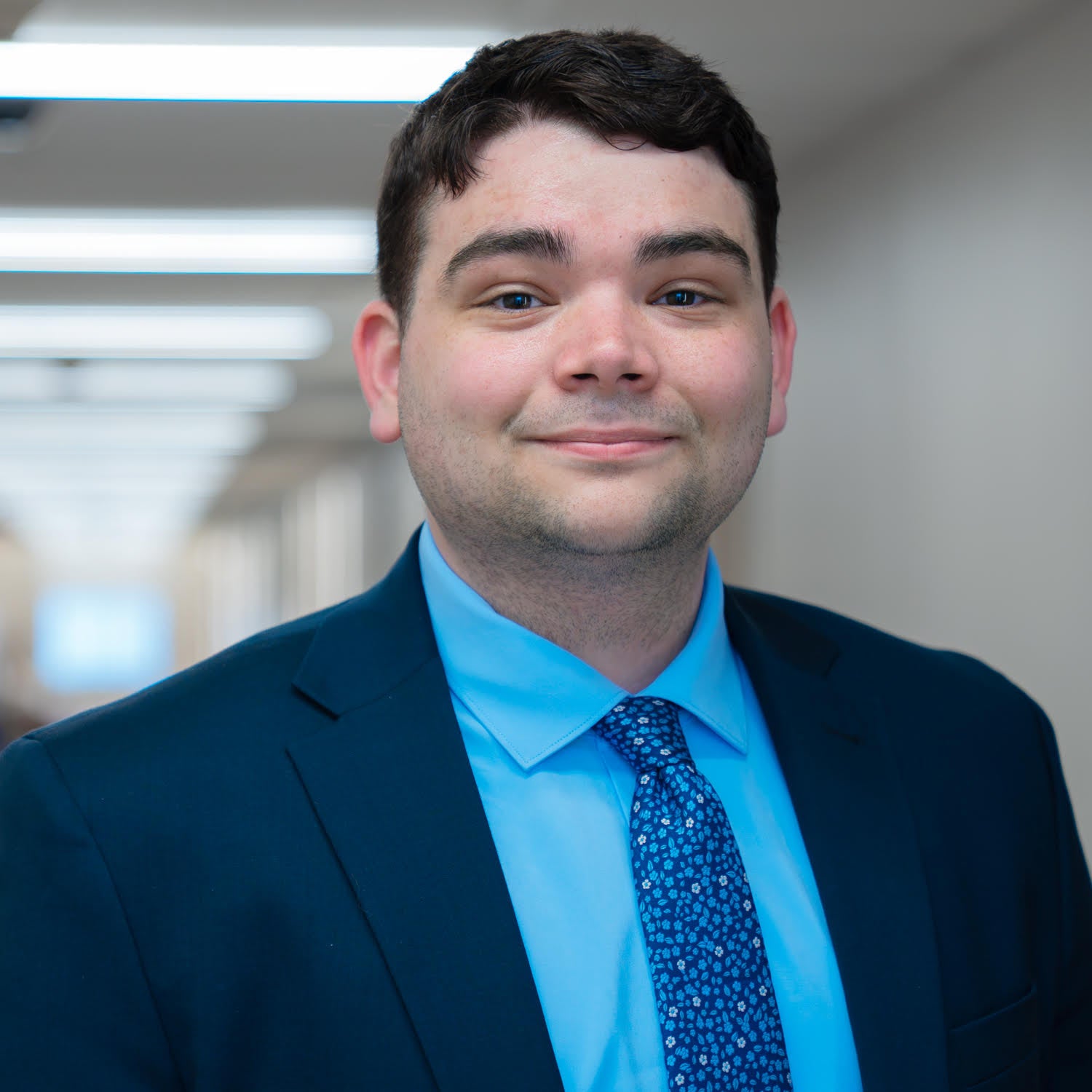
Drew Larivee came to the University of Rhode Island for computer science, but a moment in class made him realize he wanted something different. That shift led him to criminology and criminal justice, where he found a way to combine technology, data, and real-world impact. With guidance from Dr. Brittany Martin, Drew got hands-on fast, from the RIDOC Correctional Academy to analyzing court data and working on cold case investigations. Along the way, he learned to look beyond surface-level assumptions and understand the bigger picture behind people’s actions. Now focused on data analysis in the justice system, he plans to start his career with the state and eventually return to URI for a master’s in data science.
What made you choose URI?
I chose URI because I was originally interested in computer science and wanted to explore its programs. Staying close to home and having access to a strong cybersecurity minor made it the right fit. What kept me here was the flexibility to change direction without losing momentum.
Was there a specific experience or moment that pushed you toward this field?
Yes. I was sitting in a computer science class, looking up at a board full of code and different syntaxes, and I realized software development was not the path for me. I had already started my cybersecurity minor, which I was, and still am, deeply interested in. After looking at different major pairings, I landed on Criminology and Criminal Justice. I was wary at first. I had not heard much about the major, and I was starting it in my junior year. That summer, after my second semester in CCJ, I had the opportunity to participate in the Internship Correctional Academy with RIDOC. That experience showed me CCJ is much more than police officers and lawyers. I started to fall in love with the criminal justice system as a whole. Becoming a research assistant for Dr. Martin sealed it. I saw a way to combine everything I was learning into a career in data analytics.
What’s been the most interesting topic you’ve studied in your major?
The most interesting topic I studied was CCJ 285, the courts class taught by Dr. Martin. The course focused on how the U.S. court system actually operates behind the scenes. It was the first time the class had ever been offered, which made the material feel fresh and the discussions genuinely exploratory. Dr. Martin has a talent for taking what you think you understand about a subject and revealing the complexity underneath. By the end of the semester, I walked away with a mentor for life and real skills in conducting, interpreting, and presenting research. One recurring assignment required us to sit in on courtroom proceedings and build original research around a topic of our choice. The experience pulled me in so much that I approached Dr. Martin after the semester ended and asked if I could help with her research. That conversation opened the door to what I now see as my true calling.
Has this major changed how you view people or behavior?
Yes, significantly. My time in the major taught me that everyone’s definition of normal differs from my own. Watching courtroom proceedings and working inside the RIDOC Correctional Academy showed me how context shapes behavior. What looks like poor judgment from the outside often makes sense given someone’s background, environment, or circumstances. The major trained me to be more empathetic and to ask questions before making assumptions.
What area of criminal justice interests you most right now?
The area that interests me most is data analysis within criminal justice. As a research assistant for Dr. Martin, I work on a large court records dataset using R, Python, and Stata, which has taught me how much insight you can draw from information people overlook. I also intern at the Rhode Island Attorney General’s Cold Case Unit, where I get to apply that same kind of analytical thinking to investigations that have sat unresolved for years. Cold case work has shown me how much patience and careful review matter, and how answers are often already there waiting to be found. Getting to sit at the intersection of research, technology, and public safety has shaped where I want to take my career.
What’s been the most challenging part of this major?
Catching up. I started CCJ in my junior year, which gave me two years to complete a four-year major. It took long days and late nights, but it was worth every one of them. The pressure taught me how to prioritize, how to build strong relationships with professors quickly, and how to trust myself under a tight timeline. I was also selected for the inaugural CCJ Student Ambassador cohort, one of seven students chosen to represent the department. In that role, I represented CCJ at URI Day at the State House and helped moderate the department’s first career panel. Being trusted with that kind of visibility while still catching up in the major meant a lot to me.
What are your plans after graduation?
I plan to work as a data analyst, hopefully for the state of Rhode Island. Once I am settled in my career, I intend to return to URI to pursue a master’s program in Data Science. My goal is to combine applied analytical experience with advanced technical training so I can continue growing in the field I found my way into at URI.
This story was written by Sonie Zilian, intern for the Harrington School Social Media Agency.