
KINGSTON, R.I. – April 2026 – Next year the University of Rhode Island will welcome back one of its own—Helen Croskell, who’ll serve as the executive in residences for the College of Business.
Her yearlong role will focus on bridging the divide between academia and the professional world.
For the English-born Croskell, the return to Kingston, Rhode Island carries a bittersweet note. She earned her Doctor of Business Administration in 2024 and was among the program’s earliest graduates. She described the experience as one that has left a lasting impression.
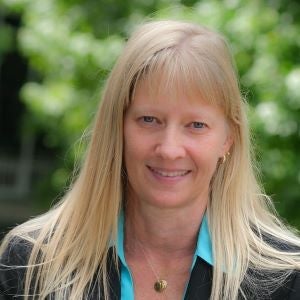
Croskell enrolled in the program in 2021—a year after the program launched. Her reason for choosing the newly minted program included URI for a multitude of reasons: one being she wanted an accredited business school and another being class size.
“When I did my MBA back in the ’90s, I was in a cohort of 90 and a class of 900 and I just felt a little bit overwhelmed,” said Croskell. “I’m not really a crowd person so the program at URI was the perfect size.
She also cited affordability and the program’s relative newness as deciding factors.
Still, her first semester proved challenging. Having earned her MBA from a major Southern research institution in the 1990s, and her undergraduate degree from the University of Birmingham in her native England, she had been away from the classroom for years.
It took a semester to regain her footing, but after that point it was off to the races.
“I just really felt like I couldn’t get on top of the work and get to grips with everything,” said Croskell. “The other students, really helped me out a lot with that, we had a WhatsApp group that was constantly pinging.”
Support extended beyond her peers. Croskell credited one of her professors in particular for adapting coursework to the realities faced by working professionals—many of whom enter the DBA program while still active in their industries or with significant academic experience.
“She stood out to me because of her understanding of how her classes needed to function to accommodate busy working professionals and people who’d been out of education for 25 or 30 years,” said Croskell.
Melding research and academia
Croskell met one of those requirements having spent over 2 decades working in the energy sector, primarily in oil and gas. Instead of spending weeks hundreds of miles offshore in the middle of the ocean drilling for petrol Croskell worked on the financial side.
“I worked really closely with a lot of engineers and geologists on the project economics behind all the decisions the companies I worked for would make,” said Croskell.
Unlike the oil being pumped out of the ground Croskell says it wasn’t a steady career, and experienced layoffs several times. But even with the layoffs she was fortunate in that during the last part of her career the company she worked for was “really big into offshore wind”.
“I became very convinced in about the last 10 years of my career about the urgency of the transition, which is good if people in oil companies are realizing that,” said Croskell.
It was that conviction, that shaped her dissertation.
For most of her career her work focused on analyzing contracts between energy companies and developing countries, particularly how project cash flows are structured. The terms of these contracts govern revenue sharing, infrastructure development, workforce training, and education provisions—effectively determining how the benefits of a project are distributed.
She likened it to dividing a pie, where each slice represents a stakeholder’s share and influences overall project viability.
Croskell says, “Sometimes the contracts would have stipulations like build soccer pitches and random things like that, and that’s why I love it so much, because yes, that does cost the energy company a bit more but they’re all pretty rich and can afford to invest a little in these countries.”
Her familiarity with these terms in contracts informed her research, which was later published.
Using cash flow modeling and interviews with oil and gas executives, Croskell examined whether contract terms common in fossil fuel projects could be adapted to offshore wind development.
‘’I was thinking if developing countries could get the same deal out of an offshore wind farm, that they could with offshore drilling would they do that offshore wind farm instead of the next oil field?” said Croskell.
After interviewing industry leaders, she concluded that such arrangements are feasible, albeit with narrower profit margins.
Her findings suggest that offering comparable incentives could make offshore wind projects attractive to both energy companies and host countries
“I thought one of the outcomes might be that there’s a benefit to both contract parties would and that is true to some extent,” said Croskell. “There is less cash flow profit coming off a wind farm than there is some oil fields but it’s still viable.”
Croskell views the shift toward renewable energy as a promising development within her field. She noted that while the oil industry has historically advanced through deeper drilling, the next frontier may lie in expanding wind energy capacity.
As she prepares to begin her role next year, she is particularly eager to engage with students.
“I mentor one student right now and I’m really looking forward to being able to talk to more of them and have an impact on more students,” said Croskell.