
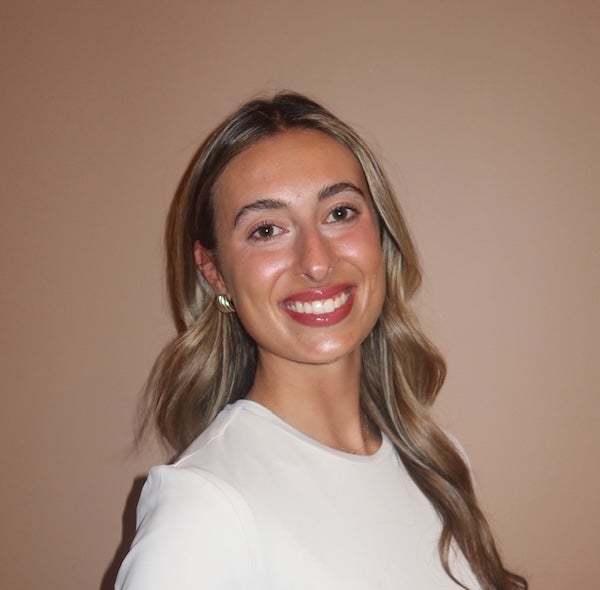
Angela Marses ’26 describes her education at University of Rhode Island as an experience whose value extended far beyond lecture halls and textbooks. Shaped as much by unexpected opportunities and personal growth as by coursework, her college journey blended academic rigor with enriching experiences outside the classroom — while also helping her become, as she puts it, “a better version of myself.”
A pre-med student majoring in molecular neuroscience, Marses says the university’s academic challenges, combined with opportunities ranging from studying abroad to serving as vice president of her sorority, Zeta Tau Alpha, have been especially meaningful as she prepares for her next step after graduating this month: medical school.
An Unexpected Path
A native of Cranston, Marses didn’t originally plan on staying in-state for college. She hoped to “try something new” outside of Rhode Island and applied to URI at the last minute. That plan shifted when she was invited to interview for the competitive Thomas M. Ryan Scholars program, which awards select students full four-year scholarships along with mentorship and professional networking opportunities. The program is supported by a $35 million gift from Thomas M. Ryan ’75, Hon. ’99, and his wife, Cathy Ryan, to strengthen neuroscience education and support high-achieving students.
As a Ryan Scholar, Marses chose molecular neuroscience for its strong alignment with pre-med requirements and its focus on the intersection of brain science and medicine. “I liked that the science classes were focused more on humans and medicine,” she says. “Molecular specifically aligned very well with pre-med requirements.”
At URI, several professors helped shape her academic experience, particularly through courses that asked her to think critically about the ethics and practice of neuroscience. In a neuroethics course, taught by Dr. Jessica Alber, Marses was introduced to complex questions around informed consent and research ethics.
Dr. Lisa Wyandt’s clinical neuroscience course offered a more interactive, applied approach. “It was so hands-on and so engaging,” she said. “It felt like more of a conversation than being lectured at.” With guest speakers, collaborative learning, and active participation, she credits the course with deepening her understanding of the field.
Outside the classroom, Marses gained extensive hands-on experience through a neuroscience research lab led by Dr. Nicole Logan. She assisted with participant studies, EEG data collection, and neurological analysis. “We were able to see actual participants come in,” she said. “I helped put on EEG caps and analyze that kind of stuff, which was cool.”
She also participated in neuroscience research methods coursework that included lab-based experimentation, such as staining mouse brain samples. These experiences helped her connect theoretical knowledge to real-world application, something she considers essential preparation for medical school.
Marses has also gained significant clinical experience outside the University. She currently works for an eyelid and facial plastic surgeon, where she assists with patient care and surgical procedures. “We see about 40 to 50 patients a day,” she said, noting that her role includes both clinical visits and surgical assistance. “On Wednesdays and Thursdays, we actually get to assist in the surgeries, which is so cool.”
Expanding Horizons
Beyond academics and clinical training, Marses credits the Ryan Scholars program with broadening her horizons. In addition to financial support and mentorship, it provided opportunities for networking and international study. She spent a semester in Florence, Italy, fully funded by the scholarship. “I was able to take classes that were fun,” she says. “It felt like I was able to have the full experience.”
For Marses, the most meaningful part of her time at URI has been the way it blended academic challenge with personal growth. “It felt like more than just getting good grades and getting involved to be a strong med school applicant,” she said. “It felt like I was becoming a better version of myself.”
On campus, that same sense of fulfillment also came from getting involved. Over her four years, Marses served as vice president of her sorority, Zeta Tau Alpha, joined the tour guide executive board, and helped lead URI’s chapter of the National Marrow Donor Program, which recruits students to join the national stem cell donor registry. She also found a close-knit community among the seven students in her Ryan Scholars cohort.
Looking back, she encourages prospective students to remain open-minded about their college choices and experiences. “Keep an open mind,” she said. “You never know what you might be interested in! URI is what you make of the experience.”
For Marses, that mindset has defined her time at URI. What began as an unexpected scholarship interview has become a foundation for a future in medicine – and a college experience she says she would not trade. “I’m so grateful for the opportunities that URI gave to me,” she says.