
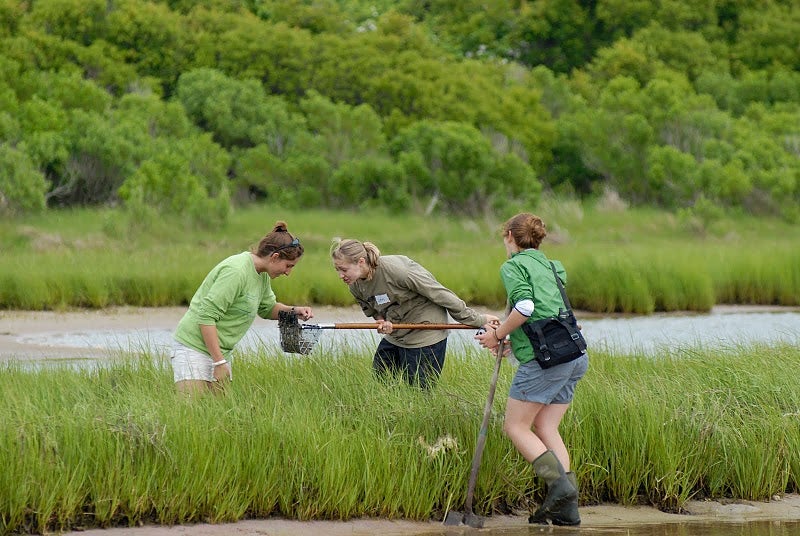
Starting at 2pm June 5, some 300 volunteers will have just 24 hours to find as many species of life as possible at two sites in Kingston in the 27th annual Rhode Island BioBlitz, organized by the Rhode Island Natural History Survey. There will be academic scientists and skilled amateurs, families, and over 80 students going out in teams to target woods, fields, ponds, and swamps looking to document biodiversity. A large tent will house event headquarters including displays of finds, videos, microscopes, checklists, and reference materials.
Overnight, volunteers will continue working with moth lights, bat detectors, and searches for nocturnal mammals. Bioblitz events are held around the world. The Rhode Island Natural History
Survey began holding annual bioblitz events in 2000, shortly after the concept was invented, and the Rhode Island BioBlitz is the longest running such event in the world. The Rhode Island BioBlitz visits a different site every year. Since inception, 4,800 volunteers have made 27,500 species IDs.
The BioBlitz is designed to increase our awareness of the variety of life that surrounds us even in our own backyards, to foster collaboration among those with shared interests in biodiversity, to inspire young people to engage with Nature, and to provide inventories and other observations to support the management of East Farm and the Kingston Wildlife Research Station. A marine
team will even be investigating fish, birds, plants, and invertebrates at the South Ferry Beach in Narragansett, adjacent to URI’s Narragansett Bay Campus. “East Farm has been site of decades of research and outreach, but I’m not aware of any overall biodiversity surveys here” said David Gregg, executive director of the Natural History Survey, “We should find well over 1,000 species including
plants, mosses, and algae, fungi and lichens, insects, herps, birds, and mammals.”
Scott Ruhren, Audubon Society of Rhode Island’s Director of Conservation said, “Having a BioBlitz inventory of the animals and plants at the Kingston Wildlife Research Station, one of the longest-running bird banding sites in North America, will greatly enhance the value of the bird data we’ve been collecting there.” Participation in Rhode Island BioBlitz is for pre-registered volunteers only, there are no walk-in opportunities for the public. Support for BioBlitz 2026 is provided by the Survey’s members and Biodiversity Programming Sponsors. The site co- hosts are URI’s College of the Environment and Life Sciences, East Farm Campus, and the Audubon Society of Rhode Island, Kingston Wildlife Research Station.
This piece was written by David Gregg of the Rhode Island Natural History Survey
Rhode Island Natural History Survey is a member-supported, non-profit
organization founded in 1994 to educate about and foster public involvement in
environmental science and the use of science-based solutions to environmental
challenges. Housed at the University of Rhode Island’s College of the
Environment and Life Sciences, the Survey supports collaborative research
involving academic, nonprofit, and government partners, student engagement
with research and conservation partners, biological inventory, databases