
When Katherine Zmich talks about her time at the University of Rhode Island, one theme keeps coming up: you don’t have to have everything figured out, you just have to be willing to try. “I thought I had to come in with my life figured out and that I had to stick with it no matter what,” she says. “But you’re not meant to have your life figured out at 18.”
Zmich’s path at URI hasn’t been linear. She arrived as a chemical engineering major, driven in part by academic success. By the middle of her first year, she made a change that would redefine her college experience: she pivoted to environmental studies, a decision she says immediately felt right. “Everything fell into place, and I felt like I was where I was meant to be,” she says.
That decision led her to complete two majors – environmental science and management and wildlife conservation biology – by her junior year. She later added a third major in environmental education. “I don’t want to be good just at one thing,” she says. “I want to understand the whole picture.”
Learning by Doing
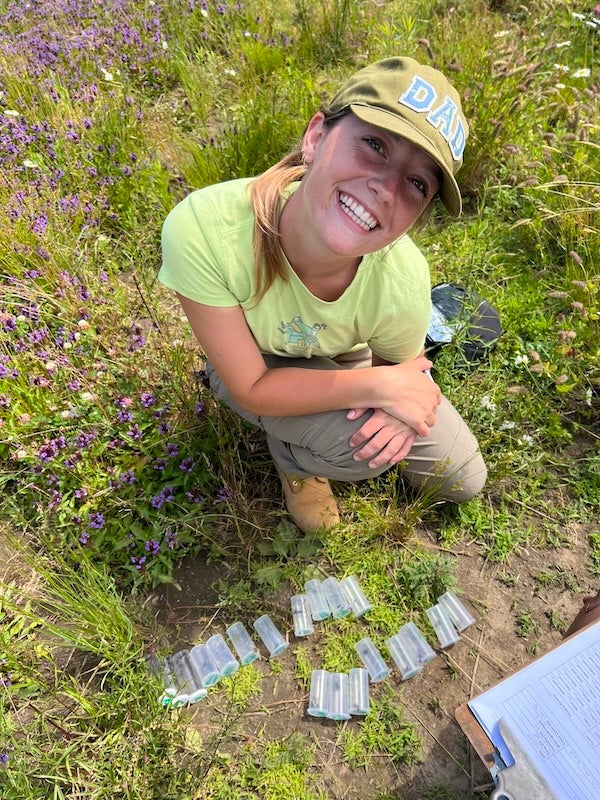
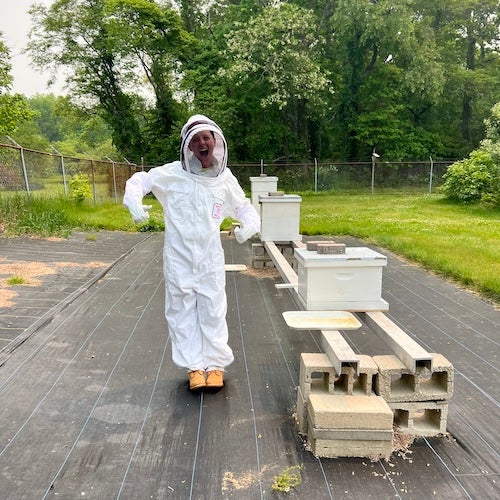
Zmich’s first big leap into sciences came when she completed a CELS Summer Research Fellowship at URI’s East Farm, working with 36 domesticated beehives and native pollinators, gaining experience in field research. “This is where I found my love for being involved in the work,” she says, “especially being outside and learning new things.”
Hands-on field courses in wildlife conservation – like ornithology labs, herpetology field trips, botany hikes, and wildlife field technique surveys – further fueled her passion. While she valued the policy and economics she learned in environmental science and management, she says she’s been energized by courses that have taken her outdoors and into real ecosystems. “You start to appreciate the small things and realize how important they are,” she says.
She also sought out additional research experiences beyond her fellowships, including work with faculty on plant-herbivore interactions involving slugs, reinforcing her interest in applied ecological systems.
Just as productive as discovering what she loves has been discovering what she doesn’t feel as passionate about, she says. A later fellowship studying microplastics in freshwater systems helped further clarify her direction. “I appreciate the work, but it’s not for me,” she says. “I don’t want to be in a lab. Failures are just as important as successes, because then you learn what you are good at and what you like.”
A Global Perspective
With two majors nearly done, Zmich decided it was time to chase a long-held dream: studying in Australia. There wasn’t a pre-built study abroad program that matched what she wanted, so she worked with URI’s study abroad office to create one. She ultimately chose Bond University on the Gold Coast for its mix of beach, city, and outdoor culture.
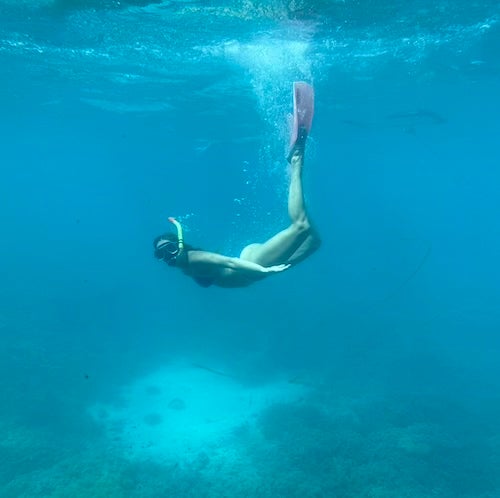
Because her major requirements were largely complete, she filled her semester with courses like surf culture and storytelling, adventure tourism, content creation, and an immersive island class where students spent a week living and working on a nearby island, conducting beach cleanups, bird surveys, and crab research.
Being in Australia illuminated the importance of broadening one’s perspective by being immersed in new environments. It also deepened her awareness of sustainability and Indigenous rights. “Sustainability and inclusivity are built into their systems,” she says. “It’s part of the culture.”
Back in Rhode Island, those experiences helped inspire a project in her Program Development and Evaluation class, where she’s working to integrate Indigenous knowledge into environmental education at Norman Bird Sanctuary, a local nonprofit where she also teaches. There, she sees firsthand how environmental knowledge can transform young minds. “All of these kids are finding a passion for the environment,” she says. “That spark is what moves me.”
Again, trying a new experience – teaching – revealed a new sense of purpose. “I realized the impact isn’t just the research, it’s what people do with it,” she says. “The real impact happens in how you communicate it.”
Building Community at URI
At 22, Zmich’s resume reads like someone twice her age because it reflects a college experience defined by involvement and exploration.
She credits much of her growth to URI’s College of the Environment and Life Sciences (CELS) Peer Mentor and Ambassador programs, as well as the support of their coordinator, Steven Marstjepovic, whose efforts have helped make these opportunities accessible to students.
As a member of the first cohort of CELS’ mentorship program, she stepped into a leadership role early, building relationships with students, faculty, and staff across campus. Over time, that involvement grew into coordinating events and managing social media, helping transform the program from one-on-one mentorship into a broader, connected network.
That sense of belonging, she notes, opened doors she hadn’t expected, ultimately giving her the confidence to pursue new opportunities and take on roles she once might have hesitated to try. “It started to feel more like a community rather than just the school I go to,” she says. “I know so many people now, and I feel comfortable putting myself out there.”
For other students, Zmich’s advice is simple: take the risk. “Put yourself out there,” she says. “What’s the worst that can happen?”
She also emphasizes that URI offers the flexibility to explore. “You don’t have to choose one lane,” she says. “You can combine everything. URI is what you make it.”
“You’re not meant to be in a box,” she says. “Start small. Join a club, talk to a professor, apply for that fellowship that scares you. Each step leads to another. That’s how you find where you’re meant to be.”
With one year left to finish her third major and a minor in leadership, Zmich is looking forward to life after graduation and considering multiple paths, from graduate school to environmental outreach roles to environmental outreach travel programs. What matters most isn’t the specific job title, she says, it’s the impact she’ll be able to make.
“My lifelong goal is to make a difference,” she says. “Whatever gets me there, if it’s something I’m good at, something I enjoy, and something that makes an impact, that’s where I’ll be.”