
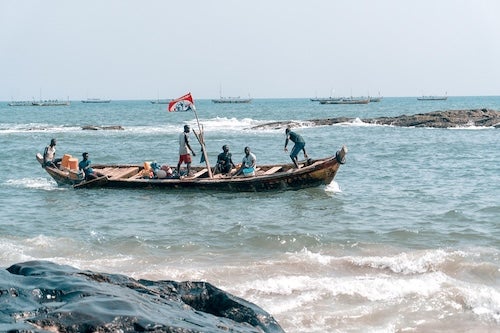
Ghana is on track to establish its first Marine Protected Area (MPA) early this year, a milestone more than a decade in the making that aims to restore marine habitats and support coastal communities in the West African country. URI alumni Dr. Evans Kwasi Arizi ’19 and Justice Camillus Mensah ’13 have played central roles in guiding the science, policy, and community partnerships behind this historic effort.
A New Model for Marine Protection
MPAs are areas of the ocean or coast that are formally designated and managed to protect marine life, ecosystem services, and cultural heritage for long-term conservation. Located at Greater Cape Three Points in Ghana’s western region, the MPA is designed to protect critical breeding and nursery grounds, restore degraded habitats, and reduce the country’s reliance on imported fish.
Unlike temporary fishing closures, the MPA will provide year‑round, area-based protection while allowing regulated, sustainable fishing methods—such as hook-and-line techniques that avoid catching juvenile fish—to support local livelihoods. It will be managed collaboratively with participation from local communities, authorities, and relevant stakeholders in the fisheries sector.
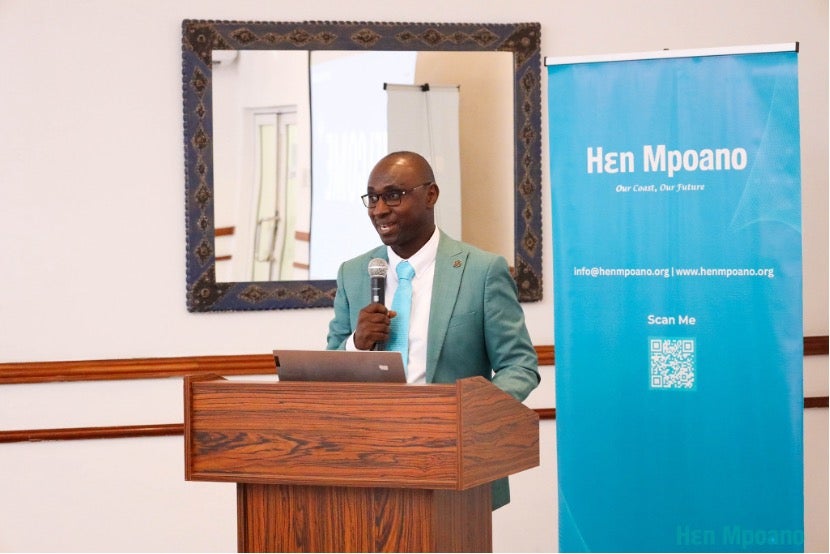
Now a senior lecturer at the University of Cape Coast, Arizi serves as the chair of the MPA Technical Advisory Committee, which provides strategic guidance and oversight on the establishment and management of the MPA. He also supports the Ministry of Fisheries and Aquaculture in policy formulation, stakeholder coordination, and technical guidance regarding the implementation and monitoring of the MPA.
Mensah currently works as programs manager at Hen Mpoano, a nongovernmental organization focused on coastal and marine conservation, fisheries governance, and community livelihoods. He has led stakeholder consultation; facilitated community engagement; and supported the integration of livelihood considerations, governance frameworks, and safeguarding measures into the MPA development process.
People-Centered Conservation
Developing Ghana’s MPA is not simply about ecological conservation, Mensah says, because the process involves mapping local ecological knowledge from fishers and coastal residents. That qualitative data is combined with scientific evidence gathered via underwater surveys, ensuring conservation strategies are both “locally informed and scientifically robust.”
He adds that the MPA demonstrates how conservation can be people-centered and inclusive by recognizing the roles of women, youth, and small-scale fishers while also addressing social risks such as livelihood loss and gender-based violence.
“By integrating ecological protection with social equity, we are hopeful that Ghana’s MPA will offer a compelling example of how biodiversity conservation can be balanced with the well-being of coastal communities, a model that could be adapted by other countries in West Africa,” he says.
A Lasting URI Legacy
In 2014, USAID awarded URI’s Coastal Resources Center a five-year cooperative agreement to lead the Sustainable Fisheries Management Project (SFMP) in Ghana. Arizi came to URI during the implementation of the SFMP. “I was awarded a scholarship to pursue a Ph.D. in a fisheries-related program so I could help build human capacity, advance scientific research, and provide sound scientific advice for rebuilding fish stocks and improving fisheries management in Ghana,” Arizi says.
He notes that his doctoral training in biological and environmental sciences prepared him to help guide one of Ghana’s most significant marine conservation initiatives. “It taught me to blend expertise with a commitment to providing sound scientific advice for fisheries management, collaborate with fisherfolk to do quality research, and more,” he says.

Mensah was one of two beneficiaries of a USAID-funded Integrated Coastal and Fisheries Governance Initiative to receive a scholarship to pursue a master’s degree at URI. He studied environmental science and management. “I was particularly drawn to the program’s emphasis on practical, policy-relevant training that could be directly applied to addressing real-world conservation challenges in Ghana and across West Africa,” he says.
He credits URI’s applied, interdisciplinary approach with shaping his leadership path. “I vividly recall a Marine Affairs class in 2012 where we discussed how marine protected areas had helped countries rebuild collapsing fisheries,” he says. “I remember thinking that Ghana would one day establish MPAs. Little did I know I would later help champion this very effort.”
Although the initiatives with the Coastal Resources Center have since concluded, the legacy continues. As Arizi and Mensah serve as leaders in Ghana’s historic marine conservation efforts, their work illustrates the enduring global impact of URI’s investment in capacity building and marine conservation.
Both Arizi and Mensah are featured in this video about the MPA.