
When: Friday, December 5, 3:00 PM
Where: Tyler 055
Abstract
There are over 7 million people with intellectual and developmental disabilities (I/DD) in the US. I/DD (e.g., Down syndrome, Williams syndrome, Autism, Smith-Magenis syndrome, etc.) are a set of disabilities that negatively affect the trajectory of an individual’s intellectual, emotional, and/or physical development. The abuse of adults with I/DD is at crisis levels in the US. Even worse, incidents of abuse committed against people with I/DD are woefully under reported. One of the major reasons for this lack of reporting is that people with I/DD often do not know what constitutes abuse. In this talk, I will discuss my experience in designing an accessible tool to educate adults with I/DD about abuse called R3: Recognize, Report, Respond. Further, given the prevalence of abuse, it is not surprising that a significant number of individuals I/DD have experienced trauma. We will follow up our discussion of R3 with a short discussion on our work on a related project — called Bodhi — that aims to help individuals with I/DD with self-regulation to cope with this triggers resulting from their trauma. We will end our talk with a discussion on some of our current endeavors in designing for the I/DD community.
Bio
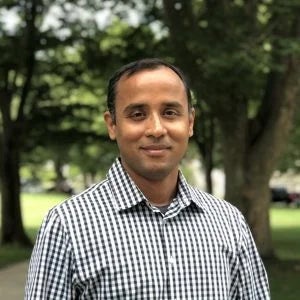
Prof. Krishna Venkatasubramanian is an Associate Professor of Computer Science in the Department of Computer Science and Statistics at the University of Rhode Island (URI). He directs the Accessible and Socially Aware Technologies (ASSET) lab, which focuses on building technologies for and with marginalized populations using ideas from the fields of accessibility and human-computer interaction. His work often utilizes theories and methodologies from fields like the humanities and social sciences in our approach to addressing technical design problems. His research is being funded by the National Science Foundation (NSF), the National Institutes of Health (NIH), and the Massachusetts Disabled Persons Protection Commission.