
By Jo Fisher
From veterinarian to English teacher to inclusive education advocate to a PhD in inclusive education and appointments at multiple universities, it was an inspiring personal and professional journey Olga Fert shared with a large audience on the University of Rhode Island campus on Thursday, September 24. Fert is a lecturer and research associate at Technische Universität Braunschweig, a research associate at the Institute of Special Education at Leibniz University Hanover in Germany, and a professor in the Department of Special Pedagogy at Ivan Franko National University in Lviv, Ukraine.
To start the event, Dean of the Feinstein College of Education Danielle Dennis welcomed the audience, and Vice Provost for Global Initiatives Kristin Johnson introduced Fert, acknowledging URI’s longstanding partnership with TU Braunschweig. The evening also included a Q&A with the audience.
In dialogue with Adam Moore, associate professor of special education, Fert presented “A Scholar Displaced, a Mission Continued: Inclusive Education During the War in Ukraine.” She shared the experience of raising her daughter, Julia, who was diagnosed with autism spectrum disorder, in a post-Soviet country that offered no services for people with disabilities other than institutionalization.
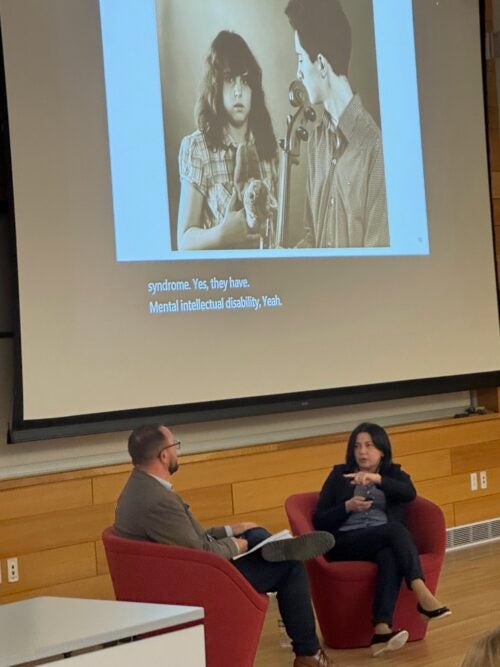
Her daughter’s birth was the “starting point of my new journey in my understanding of difference, diversity, and disability,” Fert said. Despite professional advice to institutionalize Julia, Fert decided to keep her at home. In a society not used to seeing disabled people, this was “a very difficult choice to take the hand of my daughter and say we will do it together,” Fert shared. Her family supported the decision.
With the aid of a Canadian agency, Fert advocated to have Julia attend an inclusive school. Within a month of entering a kindergarten that utilized Montessori methods, her daughter had learned skills she had been struggling to learn for months and even years. At age 7, Julia began talking. Now she speaks both Russian and Ukrainian, and she “writes better than me,” Fert said.
Fert continued to support the Ukrainian-Canadian Project “Inclusive Education for Children with Special Needs in Ukraine,” where she helped establish two resource centers—one in Lviv and one in Crimea to support families of children with disabilities. She and her colleagues were able to support hundreds of families seeking inclusive educational opportunities for their children.
Their lives changed dramatically on February 24, 2022, when Russia invaded Ukraine. With the invasion came blaring sirens and alarms, which posed challenges for Julia, who experiences sensory sensitivities. They left two days later, crossing the border into Poland, carrying only a couple of small bags. After a short time in Poland, they eventually settled in Germany, where Fert took up her position at TU Braunschweig and Julia was able to receive important educational and employment services in Germany.
With the ongoing war, the inclusive education system Fert worked hard to build in Ukraine is suffering. “Now children with disabilities are not a priority because there are so many other things to worry about,” she says. Yet she continues her work, both in Germany and Ukraine. And she continues to support her daughter and other Ukrainian refugees with disabilities while navigating a new language and culture.
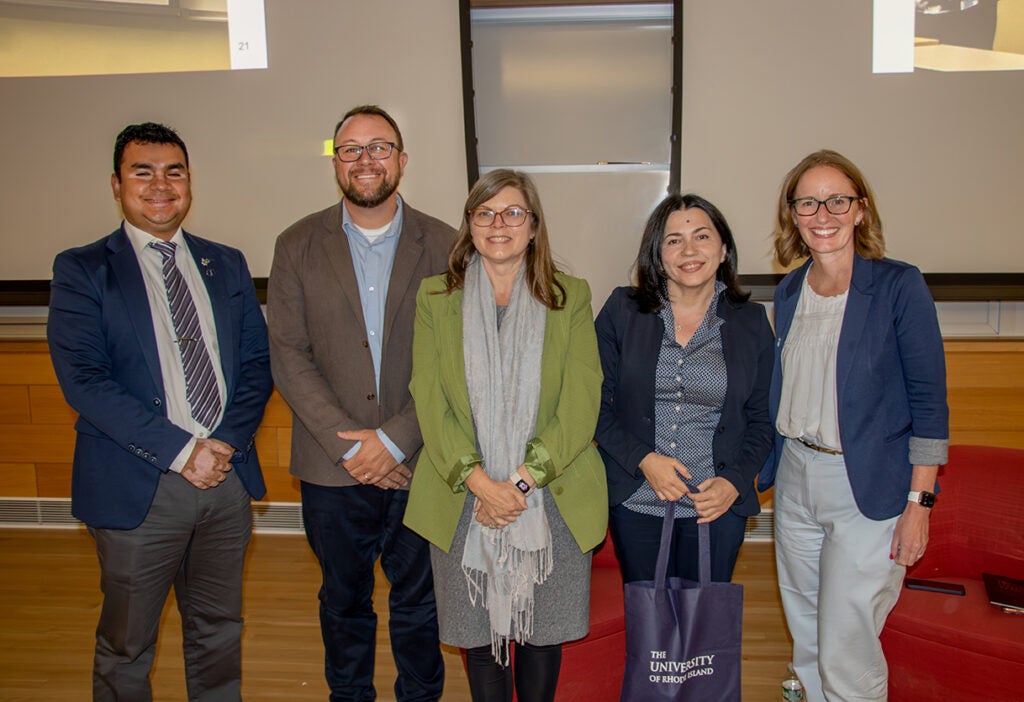
While at URI, Fert also spoke in several classes on campus. She also visited the Meeting Street School in Providence, the nation’s first school to provide comprehensive educational, therapeutic, and developmental services to children with disabilities. And she visited the Refugee Dream Center, which supports refugees in Rhode Island to find new opportunities, develop independence, and thrive in their new community.
Fert’s visit was part of URI’s continuing collaboration with the Technische Universität Braunschweig, through a DAAD-funded project. The talk was sponsored by URI’s Feinstein College of Education with URI’s Project SUSTAIN program, a $1.1 million U.S. Department of Education funded program that aims to address critical shortages in qualified special education personnel across Rhode Island.