
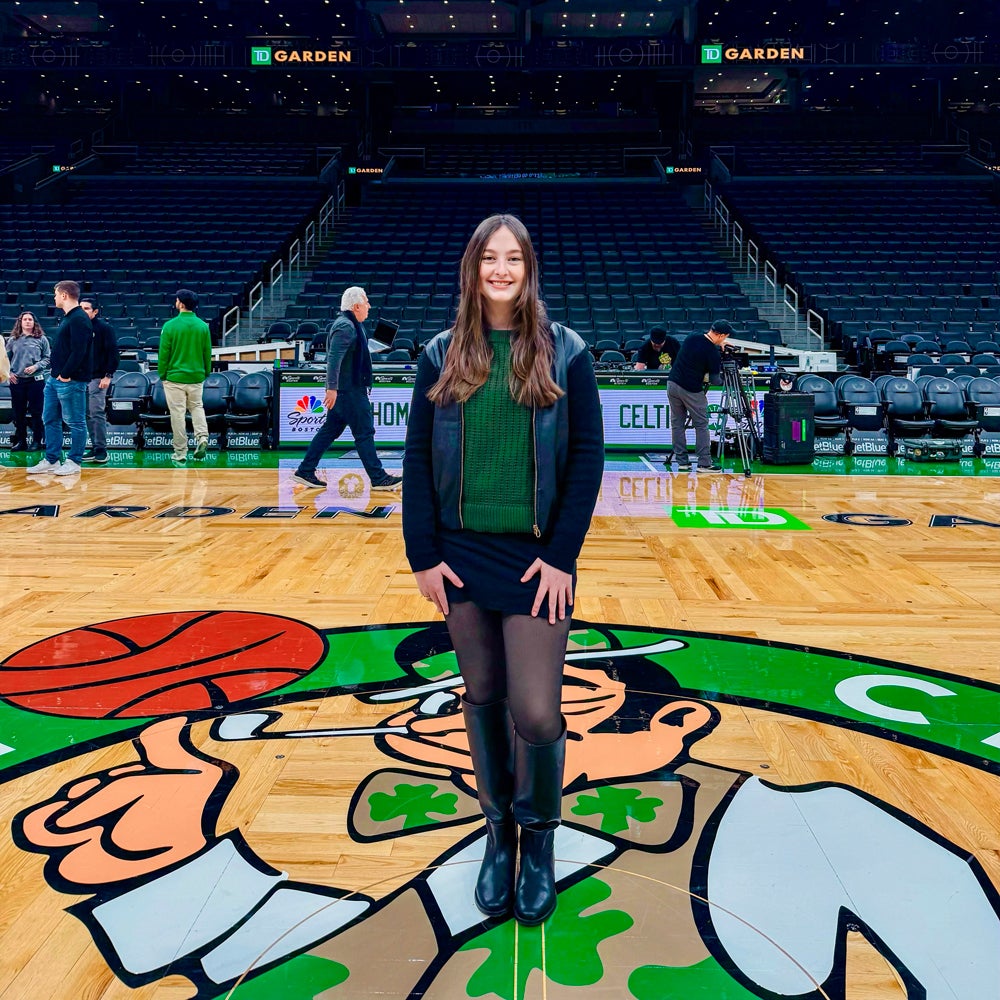
Brigid Locke ’26, a double major in sports media and data science, combines her passion for analytics and sports to carve out a unique path both in the industry and at URI. She enjoys analyzing fan behavior and uncovering trends that highlight the connection between data and real-time action in sports. Through her work in sports media and on social platforms, Brigid focuses on turning statistics into compelling stories. Looking ahead, she hopes to continue working in sports environments where data informs decisions across multiple different areas of the game.
What got you interested in combining sports and data in your career?
It really started at URI. We didn’t have a sports management major or sports analytics, and I’ve always loved STEM classes, but I’m also very creative and love storytelling. There wasn’t an existing path that combined those things, so I decided to create it for myself. Our whole school approach has been about thinking big, so how can we build something new on campus that doesn’t already exist? Over time, I pushed the university to offer classes in this area, and now URI is even starting a sports management major because of the demand for sports and analytics. That kind of interest and persistence really shaped my career path.
When you’re analyzing data or fan insights, what’s the most exciting thing to discover?
I really enjoy spotting patterns and trends, especially with fan behavior. Every fan has a unique perspective, but there are underlying themes. For example, even a small interaction, like a staff member greeting a fan, can completely change their experience. Seeing how data reflects those human moments is really rewarding because it connects the numbers back to real, personal experiences in sports.
How do you turn numbers or analytics into stories that fans actually connect with?
For my work with The Good 5¢ Cigar, I run their social media. I start by looking at the most popular stories, particularly on campus and what people would most likely engage with. Club sports and athletics tend to do well, but recently, arts and culture pieces have also gained traction. For example, one story about Greek life sparked real conversations online. Once we see what resonates, we figure out ways to continue the conversation, spin it in new directions, and use that momentum to feed the algorithm. Essentially, we listen to what the audience responds to and create more content that connects.
What’s one challenge you face when trying to make data more engaging for people?
A big challenge is remembering that people aren’t robots. Many sports students don’t understand the math behind certain stats, and as sports betting rises, it’s important to present data in a digestible way. We have to simplify complex stats, explain correlations, and show why certain outcomes are likely or unlikely without overwhelming people with technicalities. It’s about making data relatable and actionable.
Are there any athletes, teams, or sports brands that inspire how you approach your work?
One example that really stands out to me is the Minnesota Timberwolves. They built their own online ticketing system that allows them to dynamically adjust any seat in the arena in real time, which is extremely rare in sports. I find this inspiring because it takes significant teamwork, technical expertise, and resources to pull something like that off. Being a trailblazer in such a fast-paced industry is not easy, and seeing organizations push those boundaries motivates me. I love being part of a collaborative team, and examples like this show what’s truly possible in the sports industry.
What’s been your favorite thing about working with the Celtics so far?
The people have been the best part. I started with a lot of imposter syndrome because to my knowledge, I was the first URI student they’ve hired, and most of their interns come from local Boston schools. But the culture they’ve created is incredibly supportive. They encourage learning, give constructive feedback, and make you feel like part of the team. Everyone treats interns as equals and wants us to grow. Even though most of my department is incredibly experienced and I’m the only intern, the camaraderie among everyone makes it a personal and positive experience. I’m especially grateful to Sarah Burbank for being an incredible supervisor and mentor, and to the entire Business Intelligence & Operations team for their guidance, patience, and trust within this role. Even though it’s bittersweet to be ending my internship and heading back to school, I’m excited to take everything I’ve learned with the Celtics and bring it back with me to URI.
This story was written by Leili Mahrouk, intern for the Harrington School Social Media Agency.