
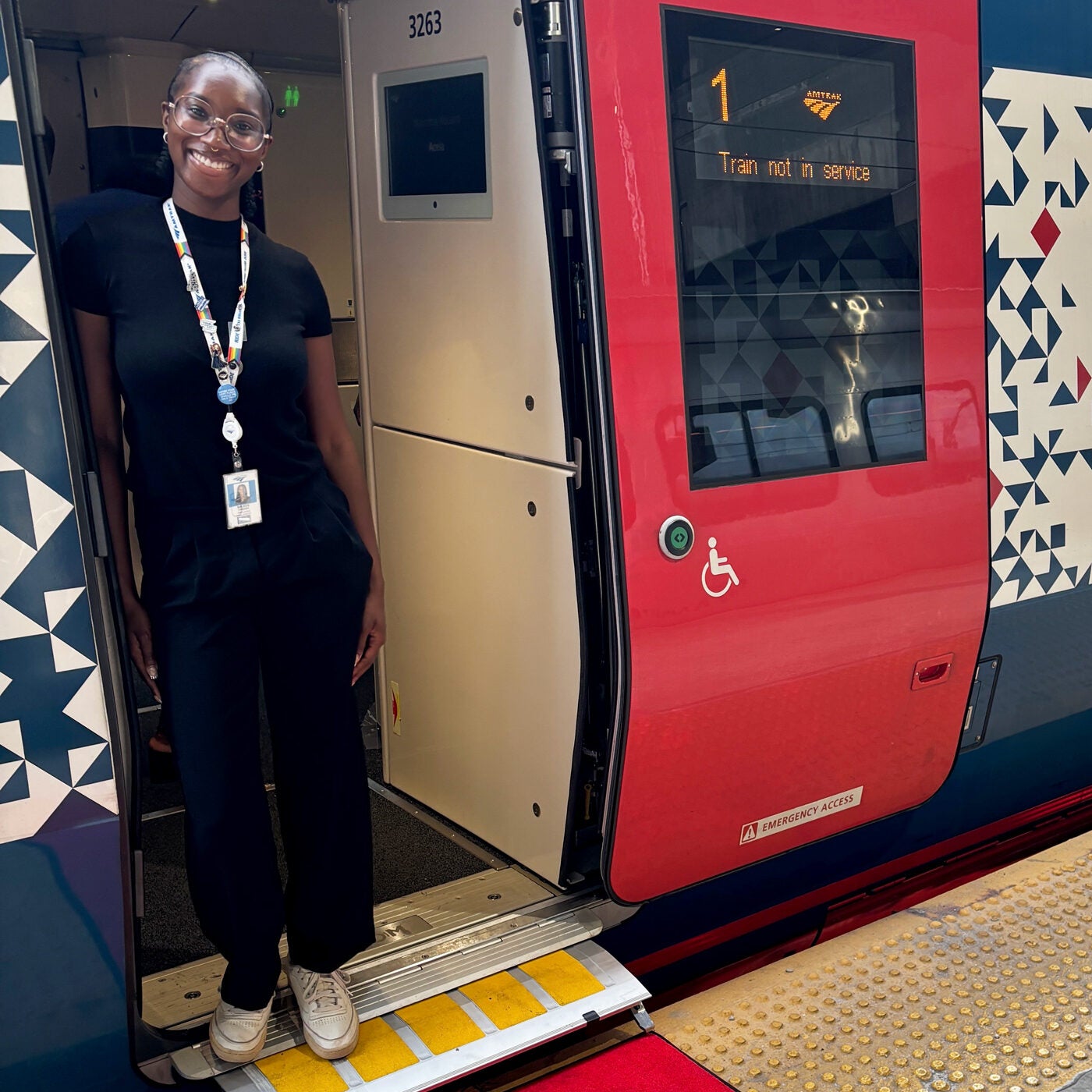
Naleen Camara ’21, a professional and public writing and public relations major, is a social media manager at Amtrak, specializing in organic content, who believes that success doesn’t look the same way. Navigating social media today, she emphasizes adaptability, a quality that’s carried her through her time at the University of Rhode Island, her career journey, and her work. Her coursework at URI, experiences in student organizations, and post-graduate opportunities have all shown her the importance of pivoting, a skill she recommends to anyone considering a career in social media.
Why did you choose URI?
As a born-and-raised Rhode Islander, it made the most sense for my lifestyle and my transition from teenagerhood to adulthood. I was also admitted to the Talent Development Program, which helped encourage me to make that final decision. I’m extremely thankful for the opportunity to go through the Talent Development summer program and experience that previews college life. Coming to the Harrington School and being introduced to my professors and peers was very encouraging.
Can you walk us through your career journey? What surprised you?
I graduated from URI in 2021 during a global pandemic, which was understandably stressful. I was part of the T. Howard Foundation Program, where I gained hands-on experience in the entertainment industry with established media agencies. I then interned for Saatchi & Saatchi, an advertising and communications agency, where I gained experience in corporate sponsorships and activations. After that, I worked as an administrative assistant at Howard University before joining Amtrak, where I started as a social media specialist. From there, our efforts began by supporting internal teams, as social media as a program was still fresh. Over time, my experiences and involvement culminated in developing a program for my team that outlined the use and purpose of social media. I then became a Senior Social Media Specialist and now lead our team on organic content.
How did your time at URI help prepare you for a career in social media and marketing? What has been the biggest advantage of your time at URI that you have carried with you in your career?
At the Harrington School, we had a community that was nurtured and felt people-powered, in the way it encouraged our motivation and provided support. The sense of camaraderie between peers and classmates was very uplifting. As an alum, I still communicate regularly with professors and attend community events.
In my public relations major, I pursued the social media track and took classes tailored to a social media lifestyle career, which helped me understand alternative platforms and ways people connect online. It prepared me to pivot when needed and to understand and develop a personal voice and brand. The programs I was part of, such as being a resident advisor (RA) and an orientation leader, helped me speak to different groups and build relationships. A big part of building your professional career is relationship-building, and I felt very supported in my campus jobs, activities, and classes, so I wasn’t afraid to speak to people.
How do you balance trend-driven content with maintaining a consistent brand voice across platforms?
I think you have to ultimately sit back and say, “Does this matter or not?” Your audience knows what matters and what doesn’t; they know what makes sense for your brand and what they expect to see.
How do you pivot as algorithms and mediums change? (Short-form content and the reintroduction of carousel posts)
Something my team always likes to say is, “Social media is our new TV.” It’s so well curated now that it shows me what I want to watch without the hassle of searching. Now, we’re trying to build social media into these preexisting media, and that’s where we can also see the success of nostalgia baiting.
People want old media, and we mask that with social media. As we learn how to adapt with algorithms, mediums, and formats, it’s important to keep in mind that these platforms are temperamental. What works on one platform won’t work on another.
What’s been the most rewarding campaign or moment in your career so far?
I would be remiss not to mention our best-performing video, Summer Train-Tacular, which is inspired by ’90s monster truck ads. We posted it last summer, and it blew up, well beyond what I thought. It’s our most-liked, most-engaged, and most-shared content on Instagram, and it is all organic. I’m so proud that it’s organic and well-liked, showing that people really do like fun things.
If you could give your five-year-ago post-grad self one piece of advice, what would it be?
Success definitely doesn’t look one way! As well as, not everything in your journey is a failure, and adapting to that mindset is crucial. I’m passionate about the work I do, but it’s important to keep in mind that work is not the only way to find personal satisfaction. And from your career experiences, assess how your skills are transferable across different roles and industries. I used to think I didn’t do enough, but looking back, I did too much. Patting yourself on the back, being kind to yourself, and knowing that change is in your hands is the advice I’d leave her with.
What’s your favorite URI memory?
I met some of my best friends to this day at the Leadership Camp, which ultimately shaped who I am today and how I present myself to others. I was on the executive board of the Student Entertainment Committee, where I met and interviewed many people in the entertainment industry.
The trust that the program instilled in me was empowering and helped shape me into the professional I am today. I was able to learn so much about myself in so many different positions that each taught me something different I took with me. I held many different positions around campus, including an RA, an Orientation Leader, a library worker, and an assistant in the dean’s office.
What advice would you give current URI students who want to pursue social media or brand marketing? What skills or experiences should students focus on?
It’s important to be fluid. You need to be okay with rolling with the punches, because this is still a burgeoning industry. As we’re headed from an influencer economy to an AI-powered economy, it’s important to know when to pivot. Adaptability is also important; no single strategy is going to last the entire time of your social media career. It’s important to know who your new audience is and to be adaptable across different industries. In social media, it’s also important to know what’s going on and what’s trending. You and your content have to cut through the noise and deliver your core message.
This story was written by Madi Siedliski, an intern for the Harrington School Social Media Agency.