
In Spring 2027 URI offers courses that teach artificial intelligence through its use in the sciences rather than as a computer-science subject. They are aimed at different students and go to different depths, so they complement each other. The courses are listed by level. Questions about whether a course is right for you are best sent to the instructor directly.
Undergraduate courses
| OCG 494 AI in Marine & Earth Sciences | CMB 427X Life Sciences Applications of AI | AMS 490 Applied Mathematics for ML and AI | |
|---|---|---|---|
| Register for | OCG 494-0012 on e-Campus (listed as “Special Problems And Independent Study In Oceanography”) | CMB 427X-0001 | AMS 490-0001 (listed as “Intermediate Topics in Applied Mathematics”) |
| Level | Juniors and seniors | Juniors and seniors; also open to graduate students | Undergraduate |
| Credits and grading | 3 credits, pass/fail | 3 credits, letter grade | 4 credits, letter grade |
| Meets | Mon & Wed 3:00–4:15 pm, Bliss Hall 210 | Time and room to be announced | Mon & Wed 2:00–3:50 pm, Chafee Hall 208 |
| Dates | Jan 26 – May 3, 2027 | Jan 26 – May 3, 2027 | Jan 26 – May 3, 2027 |
| Enrollment cap | 20–25 | 20 | 35 |
| Approach | Use AI tools on real data and judge their results critically | Apply existing AI models to biological data, build simple neural networks, and evaluate how well they work | Learn the mathematics behind machine learning and implement it yourself in Python |
| Topics | Landmark AI applications in the field; species distribution and habitat mapping; clustering, remote sensing and time series; model trust and validation | AI applications in genomics, structural biology and imaging; sequence, structure and image data; CNNs, autoencoders, graph networks, RNNs and transformers; AlphaFold 3 and Segment Anything | Multivariable calculus and the chain rule; linear algebra, eigenvalues and SVD; optimization and gradient descent; tensors and automatic differentiation; activation and loss functions |
| Coding | None required; notebooks and AI coding agents provided | None required; Python and PyTorch introduced in class, all work in Google Colab | Working Python required; Jupyter notebooks, with PyTorch taught in the weekly labs |
| Project | Individual or pair, data-analysis or critical-assessment track | Two projects, individual or teams of up to 3: each applies AI models to biological data in a report with a literature review | Small group: model and solve a real-world problem, with proposal, report and presentation in place of a final exam |
| Instructor | Meng (Matt) Wei, Oceanography | Pengyu (Peter) Liu, Mathematics and Applied Mathematical Sciences, Cell and Molecular Biology | Pengyu (Peter) Liu, Mathematics and Applied Mathematical Sciences, Cell and Molecular Biology |
| matt-wei@uri.edu | pengyu.liu@uri.edu | pengyu.liu@uri.edu | |
| Syllabus | Syllabus (PDF) | Syllabus (PDF) | Syllabus (PDF) · Flyer |
Which one is for me?
- Marine biology, geosciences, environmental sciences, natural resources, fisheries, aquaculture or marine affairs, and no coding background: OCG 494.
- Life sciences, with an interest in genomics, protein structure or biological imaging, and no programming experience: CMB 427X.
- Calculus, linear algebra and some Python, and you want the mathematics that makes machine learning work: AMS 490.
Graduate courses
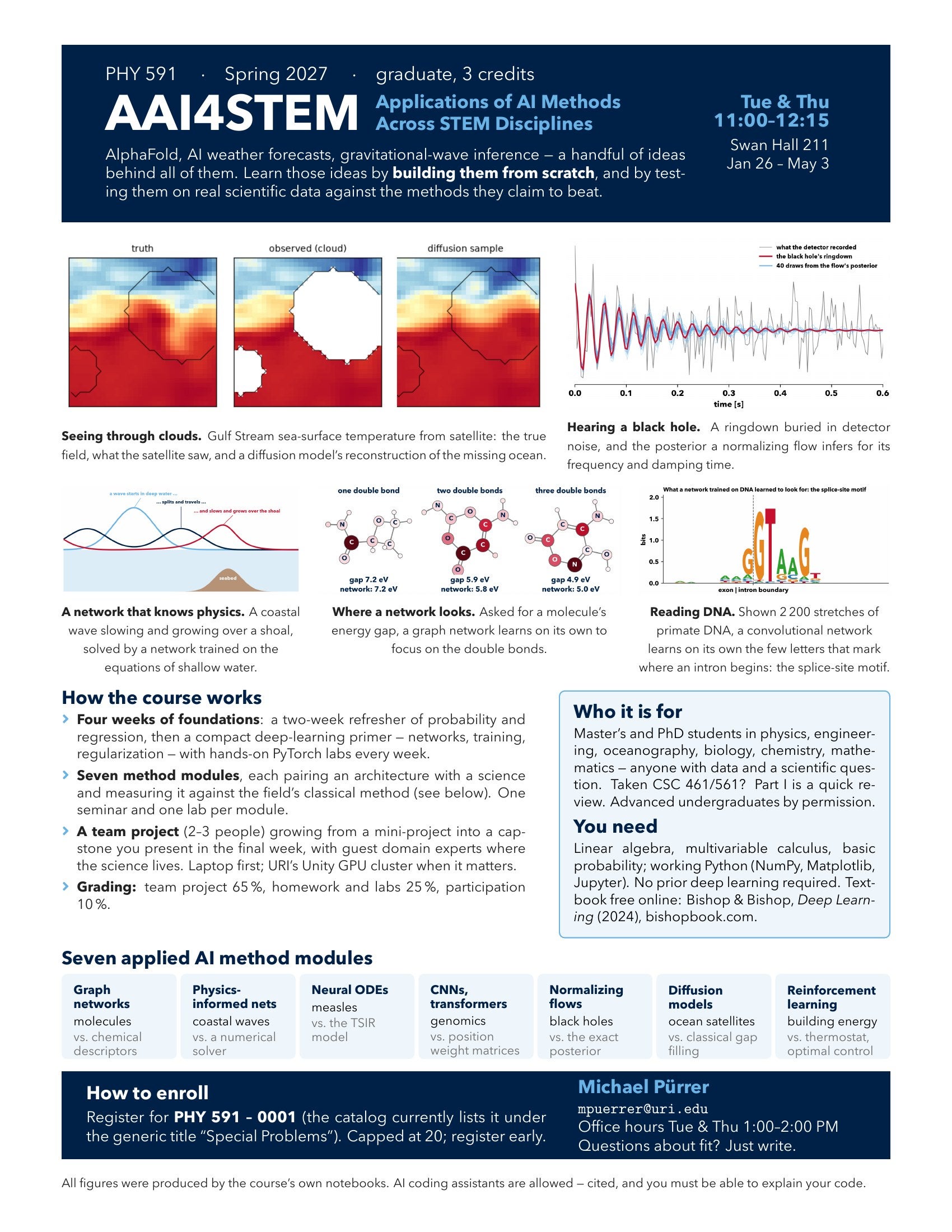
| OCG 593 AI Tools for Graduate Research in the Ocean, Environmental and Life Sciences | PHY 591 AAI4STEM: Applications of AI Methods Across STEM Disciplines | |
|---|---|---|
| Register for | OCG 593 (listed as “Special Studies”) | PHY 591-0001 (listed as “Special Problems”) |
| Level | Graduate (MS and PhD, thesis or non-thesis) | Graduate (MS and PhD); advanced undergraduates by permission |
| Credits and grading | 3 credits, letter grade | 3 credits, letter grade |
| Meets | Mon & Wed 9:00–10:15 am, Watkins Hall 12, Narragansett Bay Campus | Tue & Thu 11:00 am–12:15 pm, Swan Hall 211 |
| Dates | Jan 26 – May 3, 2027 | Jan 26 – May 3, 2027 |
| Enrollment cap | — | 20 |
| Approach | Use off-the-shelf AI tools on your own research data, verify everything they produce, and decide when they help | Build AI methods from scratch and test them against classical methods |
| Topics | What language models can and cannot do; AI policy and disclosure; reproducible project folders with Claude Code and git; data cleaning, analysis and figures; literature and science communication; public-data pipelines and lab tools; data privacy and environmental justice | Probability and deep-learning foundations; graph networks, physics-informed networks, neural ODEs, CNNs and transformers, normalizing flows, diffusion models, reinforcement learning |
| Coding | None required; students work in Claude Code | Working Python required; PyTorch taught in the course |
| Project | Individual, on your own research data or a course dataset: a project folder, verification log and AI-use statement for your thesis | Team of 2–3: a mini-project that grows into a capstone |
| Instructor | Kris Lewis, Oceanography | Michael Pürrer, Physics |
| kristy.lewis@uri.edu | mpuerrer@uri.edu | |
| Syllabus | Flyer (PDF) | Syllabus (PDF), flyer |
Which one is for me?
- Ocean, environmental or life sciences, and you want to use AI tools on your own thesis or project data while checking everything they give you, with no programming needed: OCG 593.
- Any STEM field, with linear algebra, calculus, probability and some Python, and you want to understand and build the methods behind modern scientific AI: PHY 591. Advanced undergraduates with that background can join by permission.
OCG 593 and PHY 591 meet at different times and can be taken together. Graduate students in the life sciences can also take CMB 427X, listed with the undergraduate courses.
Teaching an AI course at URI? To have it listed on this page, write to mpuerrer@uri.edu.
Last updated November 2026.