
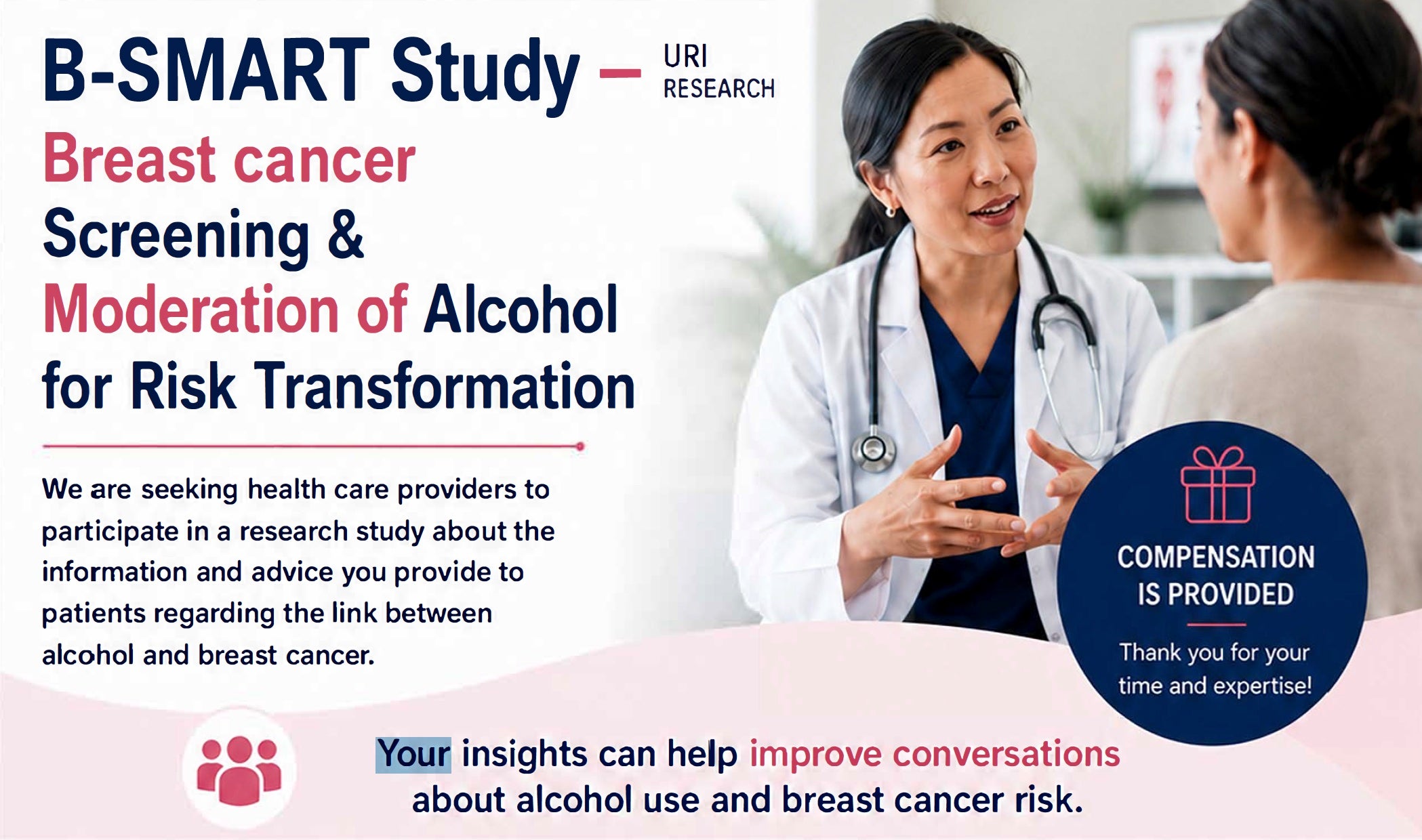
Researchers aim to educate healthcare providers on conveying risk to patients
While the relationship between alcohol use and cancer—specifically breast cancer—is well-established, evolving research and fluctuations in official recommendations can make it difficult to fully understand the level of risk alcohol poses, not just for patients but also for providers. That has prompted two University of Rhode Island College of Nursing researchers to study health practitioners’ understanding of the association between alcohol and breast cancer, and how they convey that risk to patients.
The Breast Cancer Screening & Moderation of Alcohol for Risk Transformation (B-SMART) study will examine the knowledge, attitudes, and current practices of nurse practitioners and physicians regarding alcohol use and breast cancer risk among women. URI nursing Associate Dean for Research and Scholarship Patricia Cioe and Assistant Professor Erica Liebermann will conduct in-depth online interviews (via Zoom) with healthcare providers, followed by a Zoom interview, during which the researchers will question participants about their perceptions of the relationship between alcohol use and breast cancer risk, the information and advice they share with patients, the barriers to these conversations, and ideas for tools or resources that could help.
“We are hoping to understand healthcare providers’ perspectives on the importance of alcohol use in breast cancer development and risk, and the level of knowledge that healthcare providers have regarding the association,” Cioe said. “We’re hoping to understand what they share with patients about that risk, and whether or not they feel a need for further education on the subject.”
The project originated from Cioe’s involvement in a working group at Brown University School of Public Health, where Cioe is adjunct professor, that is focused on conveying the risks of alcohol use to patients who present for breast cancer screening (mammography). They plan to examine how much patients know about the association, and what types of behavioral changes they are willing to make to reduce risk. A personal experience Cioe had with her own healthcare provider prompted her to change the subjects in the new study.
“I just happened to ask my healthcare provider their perspective regarding alcohol and breast cancer, and found my provider was not very concerned and said they did not talk with their patients about it,” Cioe said. “That led me to think that in addition to looking at what could be done from the patient’s perspective, we should think about the perspectives of healthcare providers around the state—what advice they give to patients, and whether they would be interested in additional education related to counseling patients about alcohol use.”
Continuing education on new guidelines is critical as research continues to evolve. For example, the National Institute on Alcohol Abuse and Alcoholism has stated that one drink a day for women, and two a day for men was considered a safe level. However, newer reporting from the U.S. Surgeon General states that essentially no level of alcohol is safe. Even one drink a day can increase cancer risk.
“Practitioners are accustomed to emerging, shifting evidence. But it does challenge us to keep up with that information,” said Liebermann, who is a nurse practitioner and expert on women’s health. “We need to fully digest it, and then convey that to patients, who are sometimes less comfortable with the fluctuations in guidelines. I think there is a degree to which newer information in terms of risk is not talked about. There may be limited awareness among practitioners of the association, but I think it probably has more to do with practitioners not feeling inclined or equipped to talk to patients about it.”
The researchers are seeking to learn how equipped practitioners are. They are currently recruiting 20-25 physicians and nurse practitioners across Rhode Island to take part in the study. Healthcare providers interested in taking part can visit the research website, or contact Cioe and Liebermann at projectBSMART2026@gmail.com.
“This is our first step in developing a line of research,” Cioe said. “This is information gathering to better understand the issue, with the goal of potentially developing an educational program for healthcare providers and for patients. This is a step in that direction.”