
Rhode Island NSF EPSCoR’s Sharp, Sarris lead Portsmouth High School students to explore coral research and biotechnology.
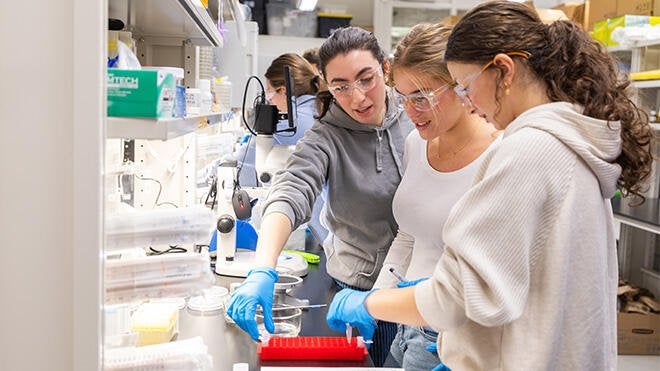
Portsmouth High School students traded classroom theory for active research last month, stepping into Roger Williams University labs to explore how ocean science is shaping real-world environmental solutions.
Hosted by RWU’s Center for Economic & Environmental Development (CEED) at the Feinstein School of Social and Natural Sciences (SSNS), the visit immersed STEM students in coral research and marine biotechnology through a blend of discussion and hands-on learning. The experience offered a closer look at how marine science intersects with pressing environmental challenges.
“This is a chance to see concepts we’ve learned in class actually happening in real life,” said Sean Gray, a senior at Portsmouth High School.
The visit was led by RWU students alongside Koty Sharp, CEED Director and Associate Professor of Marine Biology, who opened with a lecture on coral biology and reef ecosystems. She explained that while coral reefs cover less than 0.2 percent of the ocean, they support more than a quarter of marine life and play a critical role in coastal protection, tourism, and medical research. Sharp also pointed to the growing threat of climate change, with projections that up to 70 percent of coral reefs could be lost by 2050.
This piece was originally published by Roger Williams University on March 26, 2026. Read the full story!
 RI NSF EPSCoR is supported in part by the U.S. National Science Foundation under EPSCoR Cooperative Agreements #OIA-2433276 and in part by the RI Commerce Corporation via the Science and Technology Advisory Committee [STAC]. Any opinions, findings, conclusions, or recommendations expressed in this material are those of the author(s) and do not necessarily reflect the views of the U.S. National Science Foundation, the RI Commerce Corporation, STAC, our partners or our collaborators.