
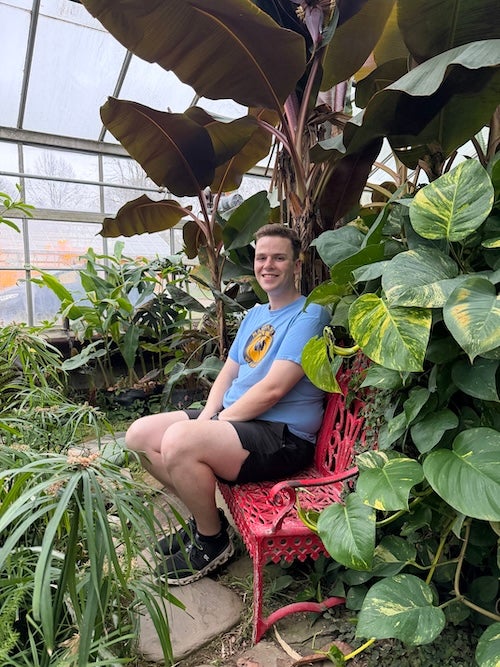
When Justin Levesque arrived at the University of Rhode Island, he was looking for something hands-on and rooted in living systems. He found it through an introductory course that introduced him to a major he had never seriously considered before: plant sciences.
What stood out to him immediately was the way the material is taught. “This is a major for the doers,” he says. “It’s a lot of hands-on work. You’re not just sitting there trying to synthesize big abstract projects; you’re doing it.”
A community with purpose
That emphasis on experiential learning is central to plant sciences at URI, where students work directly in greenhouses and outdoor labs. For Levesque, that approach quickly felt more engaging than traditional lecture-based coursework.
Over time, the campus itself became an extension of the classroom. Walking between buildings turned into opportunities for observation and identification. “I walk places now and I know the trees,” he says. “I was always an indoor person, but now I understand where I am outside.”
Much of that transformation, Levesque says, comes from the faculty who shape the department with their expertise, accessibility, and enthusiasm. He credits Professor Nathan Lambstrom, among others, for bringing energy and depth to field-based learning. “You can throw anything at him and he just knows it,” Levesque says. “He’s passionate in a way that makes you want to pay attention to every word.”
He sees that same student-centered commitment in Professor Rebecca Brown, chair of the Department of Plant Sciences and Entomology. “She’s incredibly knowledgeable and quick-witted, but also the kind of professor who will sit with you, set up extra study sessions, and walk you through anything if you have the passion,” he says. “She’s not just here for a paycheck – she’s here for the betterment of the field and her students.”
For Levesque, that kind of engaged teaching connects to something larger: URI’s land-grant mission in action as knowledge is not simply generated by shared and applied. Whether in hydroponic labs, greenhouses, or fieldwork, he sees students contributing to work with a real impact.
“So much of what Dr. Brown does is about other people,” he says. “She’s constantly thinking about how to support the food system in Rhode Island and make sure there’s no food insecurity on campus. A lot of what we grow goes to help feed students. That’s her first thought: how this work can serve others.”
That sense of purpose also shapes the department’s culture. Levesque has found a strong sense of belonging. “It’s like a family,” he says. “Every teacher is approachable, knowledgeable, and actually invested in you. They’re here because they care about the field and about students.”
“The greenhouse is our place,” he adds. “We’re always there, helping each other out. It’s not just a class; it’s a community.”
“I made a mark”
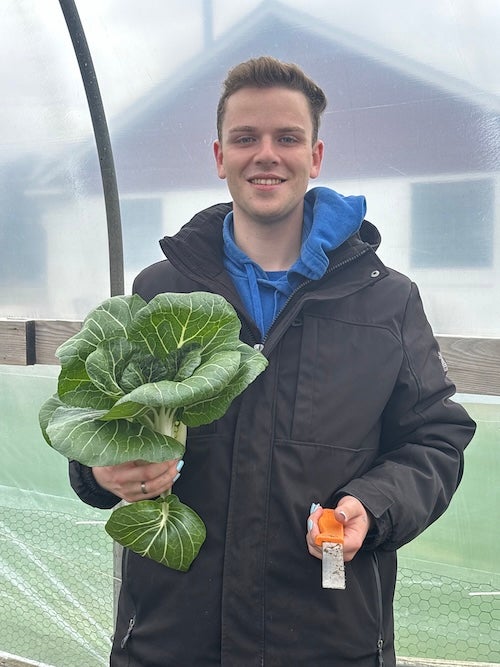
Levesque believes plant sciences is especially valuable for students who learn best through doing rather than abstract theory. “There are people who don’t thrive in traditional lecture settings,” he said. “But they could have so much fun here. They could be outside, working with their hands, actually seeing what they’re learning.”
For Levesque, though, the impact of plant sciences goes beyond career preparation. He points to moments that reshaped how he thinks about time, purpose, and impact: planting trees on campus, propagating plants that will outlive him, and even growing seeds brought from halfway across the world. One of his proudest moments was planting a date palm in URI’s conservatory from seeds a friend brought from Jordan.
“When you come back years later and see something you planted, that’s powerful,” he says. “It’s like, ‘I was here. I made a mark.’”
In a fast-paced, increasingly digital world, Levesque sees plant sciences as a way to reconnect with nature, with community, and with a sense of permanence. “You’re cultivating life,” he says. “You’re helping something grow that’s going to last beyond you. That’s not something you get everywhere.”
As he prepares to graduate later this year, Levesque hopes more students will discover the major the way he did – even if it’s by chance. “Just take one class,” he says. “You might realize it’s exactly what you’ve been looking for.”