

Associate Professor of Natural Resources Science Madison Jones, who holds a joint appointment in Professional & Public Writing, has been at URI since 2020. His expertise lies at the intersections of writing and rhetoric, science communication, and digital humanities, exploring interdisciplinary pathways to approaching environmental advocacy and public engagement with the natural sciences. As both a student and advisee of Dr. Jones, I was eager to hear more on his perspective on science communication and rhetoric. Dr. Jones is one of the professors at URI who emphasizes outdoor learning opportunities, cross-disciplinary approaches to learning, and incorporating students’ creative interests into their work. His passion for connecting people with the environment through visual and rhetorical elements, as well as his excellent mentorship and guidance, have personally helped me grow in my writing abilities as a science communicator.
Below are Dr. Jones’s responses, in which he talks about his teaching experiences at URI, the teaching philosophies he incorporates into his courses, and the connections between rhetoric and ecology in science communication.
-Written by CELS Communications Fellow Yvonne Wingard, M.E.S.M. ’26
Q. How would you describe your teaching philosophy/pedagogy?
A. I come from a tradition that’s often known as post-process theory, which challenges the idea that writing is simply a one-to-one reflection of thinking, when in reality, it’s a much more messy and complicated process than we might think. I think that encompasses the disciplinary background of my teaching philosophy: in my classes I want students to view writing as more of a practice than any kind of product. I really want students to learn how to work in new genres and with new technologies and methods for communicating whatever topic they’re interested in. I am less concerned with students meeting academic standards than I am with developing a toolkit of skills that will serve them in professional, public, and creative situations in the future.
What has been the most surprising or unexpected part of teaching?
If I could describe my experience in one word, it would be pivot. We’re living in a time where we are facing a poly crisis at the global scale and in education: we have a lot of different, really big, wicked problems that we are having to confront, and so finding the best way forward through some of those things requires a lot of change and thought and reinventing the wheel.
Who was the most inspiring teacher in your life and why?
The professor who most changed my life was Dr. Lee Rozelle at the University of Montevallo. He’s the one who introduced me to environmental studies. I was so interested in ideas coming from ecocriticism and environmental studies, and he supported and mentored me in developing lines of inquiry based on my interests. He went above and beyond his duties as a professor, helping me apply for and navigate grad school. Part of what motivates me as a teacher is a desire to pay that forward, helping students as much as I possibly can. (Note from Communications Fellow Yvonne: This is exactly the type of professor Dr. Jones has been for me, having greatly inspired me in the field of ecocomposition and rhetoric of science. He has also been an incredible mentor and advisor to me during my time at URI!)
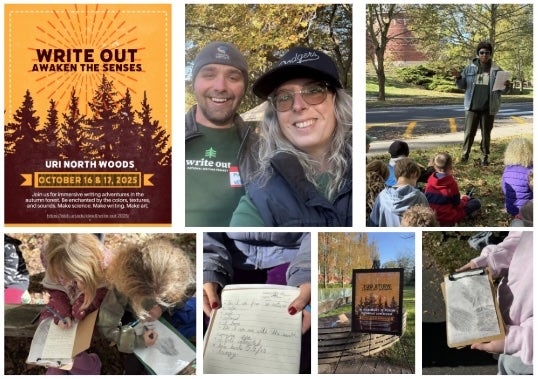
How do you incorporate hands-on learning into your courses?
Typically in writing courses, we don’t think of outdoor research. One of the many things that makes URI special is we have North Woods right on our campus. I’ve been taking students out to North Woods for several years now in different class contexts. I’ve been taking my undergrads there for field trips, practicing taking field notes and generating a technical report based on the notes they take over several weeks. By taking manual field notes, they’re writing in a way that is non-networked: you’re out in the woods, recording your thoughts with pen and paper. The process of going out, slowing down in the environment is a powerful way of thinking about writing. And it’s wonderful to see them come alive out in the field.
How would you describe the field of RSTM (Rhetoric of Science, Technology, and Medicine) and its importance?
The rhetoric of STM (RSTM) is an interdisciplinary field that is applying tools, perspectives, and methods of rhetoric to examine how knowledge, practices, values, and disciplinary identities are constructed within the fields of science, technology, and medicine. I sometimes see people balk at the idea that science is rhetorical. But given the current politicization of science – changing federal funding landscapes, widespread misinformation and distrust in science online, and increasingly complex environmental and public health challenges – these things have placed in stark relief that science has a social and political function that is more than just this basic truth-seeking inquiry. That’s where the rhetoric of science comes into play. It’s really about interdisciplinary connection. Putting science with rhetoric is a really powerful space, not just for teaching but also for research. It’s the most honest way to achieve good communication – to really immerse yourself in more than one discipline.
If students want to take classes with you, where can they find you?
I teach undergrad WRT 334: Science Writing every year – it’s my mainstay.
I will also teach courses in technical/professional writing and digital rhetoric. Those encompass my areas of study, so it’s great that I can have that reflected in the courses I get to offer at the undergraduate level.
At the graduate level, I teach WRT 533: Graduate Writing in the Life Sciences and NRS 530/WRT534: Visualizing Environmental Advocacy. Those courses are part of the SciWrite Certificate and geared toward offering students with a wide array of disciplinary backgrounds training in how to communicate their science to non-specialist audiences.
My favorite class to teach is Visualizing Environmental Advocacy – it focuses on the connections between visual media and advocacy, and through that topic, we’re able to look at everything from politics to science communication and everything in between. It’s a really rich space for interdisciplinary inquiry and students get a lot out of that class.