
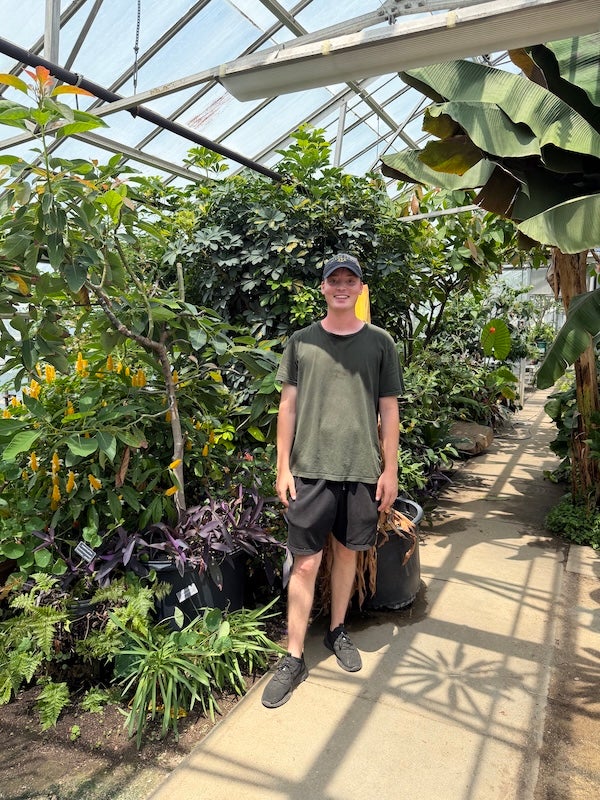
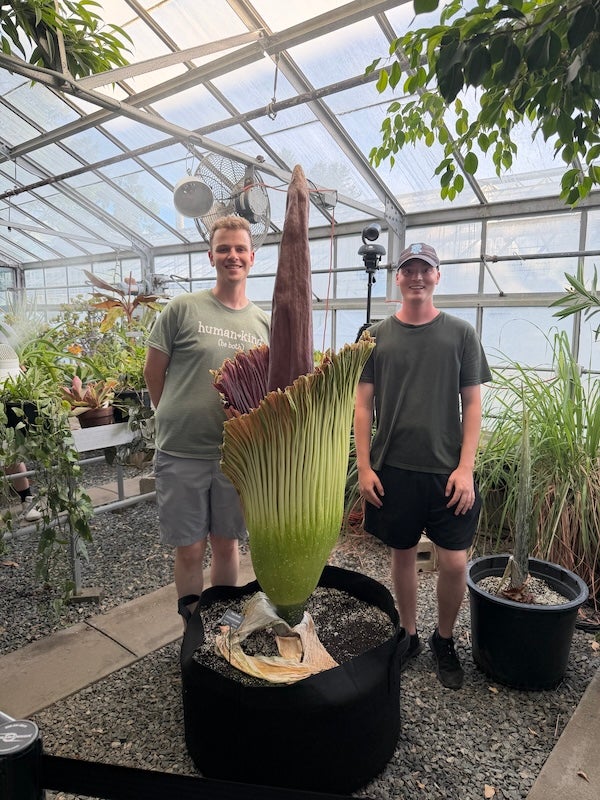
This spring, the University of Rhode Island’s Horridge Conservatory became one of southern Rhode Island’s busiest destinations. Visitors lined up for hours to catch a glimpse—and a whiff—of Morticia, the greenhouse’s rare corpse flower (Amorphophallus titanum), and its historic bloom. Amid the crowds stood Daniel Meservey, a student worker who’d answered the same questions hundreds of times and still hadn’t tired of it.
“I loved teaching people about the corpse flower,” he says.
It was a fitting moment for someone who has spent more than two years becoming one of the greenhouse’s most trusted hands.
Learning by doing
Meservey has always been drawn to caretaking. Some of his earliest memories are from his childhood in Russia, where he remembers standing in the snow, watching a snow monkey and a hawk perched calmly on a handler’s arm, scenes that left him in awe of how people care for other living things.
Growing up, he imagined becoming a veterinarian, drawn to the idea of helping animals heal and seeing the relief on owners’ faces when their pets recovered. But as he began studying animal science at URI, another passion was tugging at him.
At home, Meservey tended an indoor garden that shifted with the seasons: cherry tomatoes, zucchini, grapevines, and towering sunflowers. “I always loved taking care of my mother’s plants,” Meservey says. “I just did it as a hobby. It never occurred to me that I could major in this and make money off it and enjoy it.”
It wasn’t until he switched to majoring in plant sciences that he realized he’d found the right path.
Changing majors was a significant leap, so Meservey didn’t wait for opportunities to find him—he made one, volunteering in the URI greenhouse. “I just went in and started weeding,” he recalls. “But they told me I was doing a good job.”
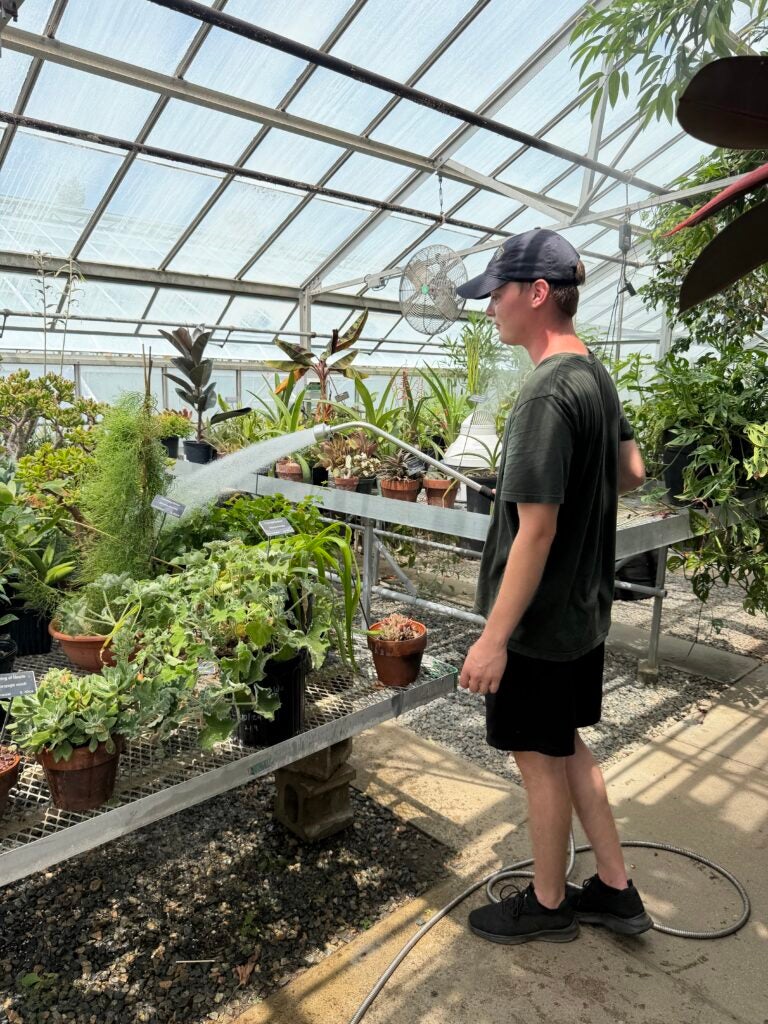
That initiative turned into a student position. Meservey is now an indispensable part of the greenhouse team, splitting his time between general greenhouse work, the pharmaceutical greenhouse, and ongoing plant research.
No two days look the same. Some are spent watering thousands of plants, adjusting schedules around weather forecasts and greenhouse temperatures. Others involve diagnosing nutrient deficiencies, tracking pests, maintaining greenhouse systems, or helping researchers with their projects.
The work has taught him things no textbook could. “If I didn’t have this hands-on experience here, I most likely would’ve thought differently about plant science,” he says. “I learn a lot by actually seeing what’s wrong with the plant.”
Over time, he’s developed an instinct for diagnosis. “The plant will tell you where to start,” he says—an approach rooted in observation and patience, in noticing the subtle clues hiding amid lush foliage and spectacular blooms. “I’m looking at all the little details.”
The work has even changed his relationship with insects: integrated pest management has turned bugs from something he avoided into allies in keeping plants healthy.
Meservey credits URI’s plant sciences faculty with helping him connect scientific concepts to real growing conditions, each professor contributing a different piece of the puzzle. “Every single professor has their own tips and tricks,” he says. “They all come together to help the plant as a whole.”
Working alongside greenhouse manager Ben Robbins has stretched his education further still, into greenhouse infrastructure: environmental controls, irrigation systems, heating, ventilation, electrical work. “I always want to learn,” Meservey says.
Rising to the moment
His preparation was put to the test this spring, when Morticia’s bloom turned the greenhouse into a popular destination. Meservey became one of the welcoming faces guiding over 5,500 visitors over the course of a few days through the experience—explaining the biology behind the plant and keeping the event running smoothly.
Despite the long lines, he says the visitors were “some of the nicest people,” convinced that plants bring out the best in those who come to see them.
On bloom day, he stayed in the greenhouse until 3 a.m., watering thousands of plants after the last visitors left around 2.
But for Meservey, the long hours were a reminder of why he’s always been drawn to caretaking. Whether tending to an animal or helping someone discover the wonder of a rare plant, he says the reward is the same: cultivating a meaningful connection between living things.