
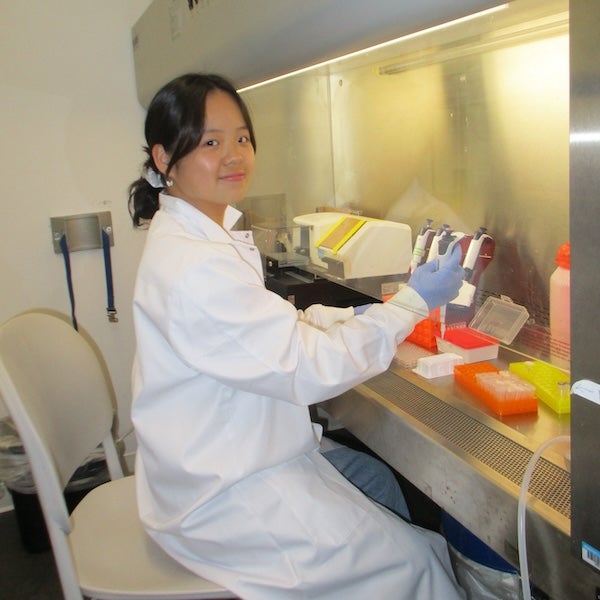
A rising sophomore majoring in biotechnology, Miranda Lin is conducting research through the CELS Summer Fellowship program in the Harvey Lab. Interested in immunology and infectious disease, she is studying how the immune systems of wild diving ducks respond to avian influenza, helping researchers better understand how disease resistance may differ from that of domesticated birds. This summer, she’s performing laboratory assays, analyzing samples, and developing the technical and research skills needed to investigate complex questions at the intersection of disease ecology and biotechnology. Learn more about her work below!
Q. What are you working on this summer?
Wild ducks can carry avian flu without always displaying sickness, making them important in how the virus spreads. My research looks at how part of their immune system works by measuring proteins and antibodies that help fight infections. By comparing ducks with and without bird flu, we hope to gain a better understanding of how their immune systems respond, which could help scientists improve wildlife monitoring and reduce the spread of the virus.
What’s the coolest thing you’ve experienced so far?
I would have to be watching the hemagglutination-hemolysis assay develop in real time. When the duck serum is introduced to foreign cells, the natural antibodies attach to the foreign blood cells and agglutinate, causing some wells to appear as a large foggy blob rather than a singular uniform button. After another long incubation, complement proteins will lyse the foreign blood cells in some of the wells, causing them to appear as a translucent red fluid. It was amazing to watch part of the duck’s immune system in action right before my eyes.
What’s been one of your favorite moments this summer?
One of my favorite moments this summer has definitely been connecting to the people in my lab. I love the environment in my lab where everyone shares similar research interests, making it possible for everyone to collectively nerd out about their passions.
How have you grown through your work in the fellowship?
It made me realize that the idea of not knowing something does not make you any less intelligent, regardless of how much education you received. After working in the lab with my mentor, Niel Bauer, I realized the phrase “I don’t know” is actually not a setback but rather an opportunity to learn more. When it comes to research, the key is to keep an open mind. Working with Niel has shown me that when we hit an obstacle, there are always multiple ways to approach it. Whenever I bring up a problem I’m having, Niel always asks, “Have you tried this?” and suggests solutions I otherwise would have never considered. This has pushed me to think more creatively and strengthened my problem-solving skills. It also taught me that no matter how much education someone has, no one knows everything. There’s always something new to learn, and that’s what research is all about! I don’t think I could’ve learned that better than I did while working in this lab