
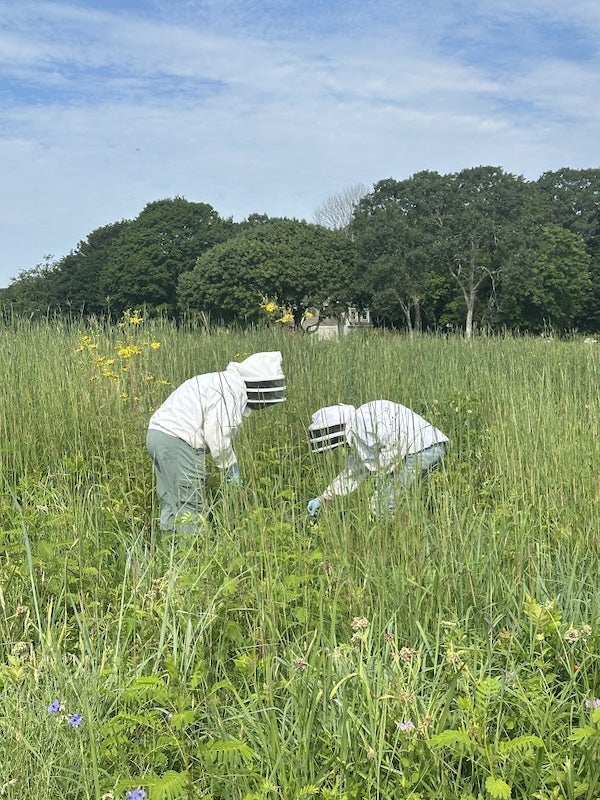
Fiona Dell’Antonio is a double major in plant sciences and wildlife and conservation biology. A senior, the native of Barrington, Rhode Island is investigating whether artificial nest boxes can provide effective nesting sites for wild bumblebees, with the goal of reducing growers’ reliance on commercially raised bumblebees. As part of her research, she and her team monitor 300 nest boxes across five sites, recording bumblebee presence and species as well as use by other animals. When bumblebees have completed or abandoned a nest, the team collects the remaining nesting material to estimate colony size.
Q. What is your research about?
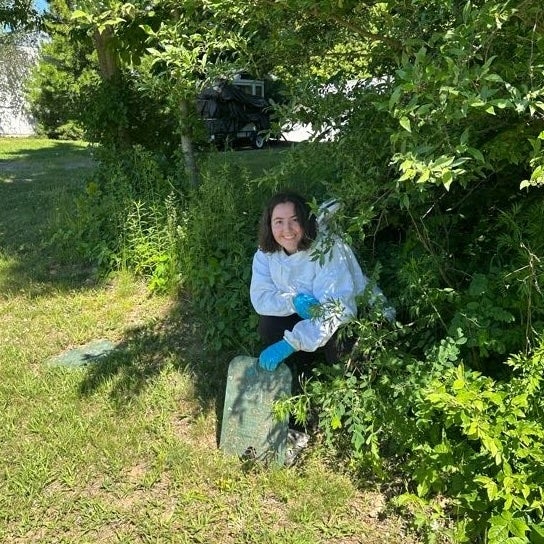
A. My project uses in-ground irrigation boxes that have been modified to include a ramp and filled with cotton as artificial nest sites for wild bumblebee colonies. Different chemical lures were placed in the boxes to determine whether bumblebees can be attracted to these boxes for better nesting rates. If successful, these artificial boxes could be used by local growers to encourage wild bumblebees to nest near and pollinate their crops. This would decrease the need to purchase commercial bumblebees, which are expensive and contribute to environmental concerns.
What’s the coolest thing you’ve experienced so far?
Bumblebee nests are not common sites, and knowledge is lacking on individual species’ nesting habits and biology, so it has been a treat to be able to peek into and handle these nests so often. We’ve found a variety of species in the boxes, and I’ve really enjoyed seeing the differences in seasonality and defensive behaviors.
What’s been the most rewarding moment of your summer?
One of the highlights so far was, on the first time we went to check on these boxes, seeing that bees were actually setting up nests and using our boxes. Pollinator declines, especially of native bees, is a very important issue for me, and it was very exciting and rewarding to see that the bees were using the boxes!
What have you learned from working with your faculty mentor?
Working with Dr. Steven Alm and the URI Bee Lab has been such a wonderful experience. His knowledge and passion for pollinators and the natural world in general is infectious. I’ve been able to explore my interest in entomology through my work with this lab and develop my own passion for bees and wasps. Dr. Alm’s guidance and expertise has been invaluable throughout this project, and my time in the lab.
What has this fellowship taught you that you couldn’t have learned in a classroom?
The practical skills and firsthand experience gained through this fellowship definitely outshines what I could have learned in a classroom. For instance, bumblebee buzzing will sound different when the bee is angry, curious, or just passing by, and I learned that from directly interacting with the bees. In general, animal behavior and body language can be taught in a classroom, but it is really important to see it in person to fully understand and apply the knowledge. I have really enjoyed learning more and teaching others about bumblebees and their nesting habits.