
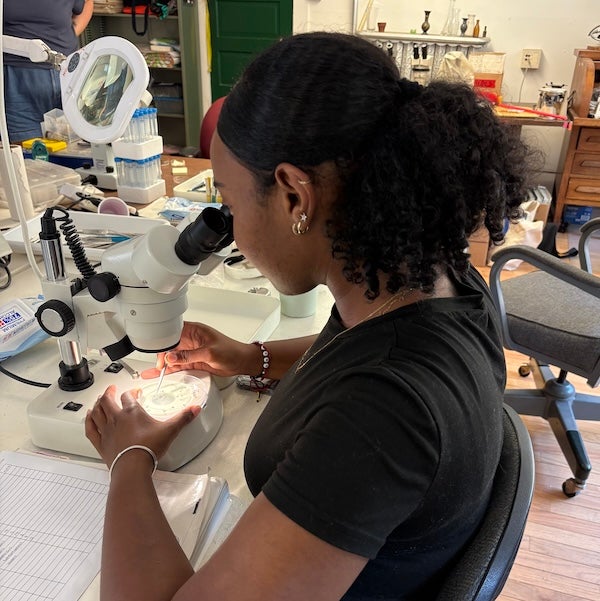
Biotechnology and biochemistry major Azaliah Lopes spent her summer with the Rhode Island Department of Environmental Management’s (RIDEM) mosquito abatement program, working on vector-borne disease surveillance. As a CELS Summer Research Fellow, her work combined field work and lab work: trapping mosquitoes at sites across the state, identifying each one down to species, and sending samples to RIDOH to be tested for West Nile Virus (WNV), Eastern Equine Encephalitis (Triple E), and Jamestown Canyon Virus. When a sample tests positive for one of these viruses, the team takes the necessary steps to warn the public and share preventive care measure
Q. How would you explain your work to someone without a science background?
A. Mosquitoes make great vectors for many different viruses. Vectors are any organism that carries and transmits infectious pathogens from one host to another. In order to help minimize the number of human cases for these viruses, RIDEM mosquito abatement aims to find which mosquitoes specifically are carrying these viruses, along with which area these mosquitoes are found in. This is all done to be able to warn the public and limit human cases.
What does a typical day look like?
Each day looks a little different. On Mondays we usually set traps, which consist of light traps that collect all different species of mosquitoes and gravid traps, which mainly target gravid (pregnant) mosquitoes. These traps are set all over Rhode Island, including Block Island. Each intern has their own route that consists of anywhere from six to eight sites. I have the coastal route, which includes sites in North Kingstown, Jamestown, Portsmouth, Tiverton, Warren, Bristol, Barrington, and East Providence. On Tuesdays we collect all the traps that were set the day before, bring them back to the lab, and identify each mosquito using morphological characteristics down to species. For the rest of the week, we continue identifying mosquitoes and sorting them by town and species so the samples can be sent to RIDOH for testing. All this data is entered into a weekly data sheet and then turned into maps and graphs.
Why is mosquito surveillance important for Rhode Island?
Mosquitoes kill more people than any other animal each year because they’re such effective vectors for so many diseases. In Rhode Island, we specifically look for WNV, Triple E, and Jamestown Canyon virus. WNV and Jamestown Canyon tend to affect immunocompromised people and children more severely, while Triple E can be particularly deadly in severe cases. That’s why mosquito surveillance matters so much here — it lets us warn the public about where these viruses are showing up and advise people on precautions, from limiting outdoor exposure to reducing mosquito breeding grounds by getting rid of tires, trash, and other containers that collect standing water. All of this helps limit the number of human cases.
What have you learned about mosquito identification or monitoring that surprised you?
There are so many different species of mosquitoes, and a lot of them look very similar — sometimes it’s the smallest difference that separates one species from another, which I found really interesting. It’s also been informative to watch how trends among the different species shift over the course of the summer, especially with changing weather.
What has it been like working with your faculty mentor and the RIDEM mosquito abatement team?
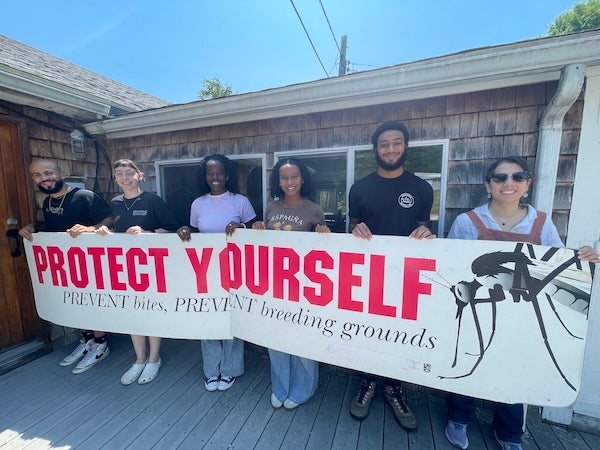
Working with everyone in this lab has truly been an exciting and educational experience. Everyone has been so welcoming and has created a comfortable environment from the beginning. I’ve learned how important it is to lean on your coworkers for help and support. I’d like to give a special thank-you to our mentors, senior biologist Domingo Lora Medina and Dr. Jannelle Couret, who have been so kind and helpful throughout this whole experience, as well as my fellow interns, Arman Araujo and Emma Vollucci.