
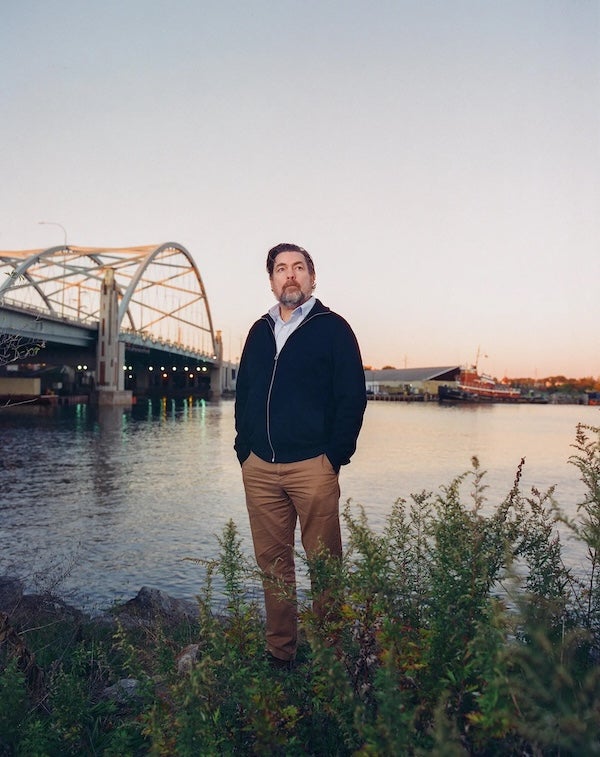
Austin Becker, professor of Marine Affairs at the University of Rhode Island, develops advanced coastal flood warning and decision-support tools that help communities prepare for increasingly severe storms and rising flood risks.
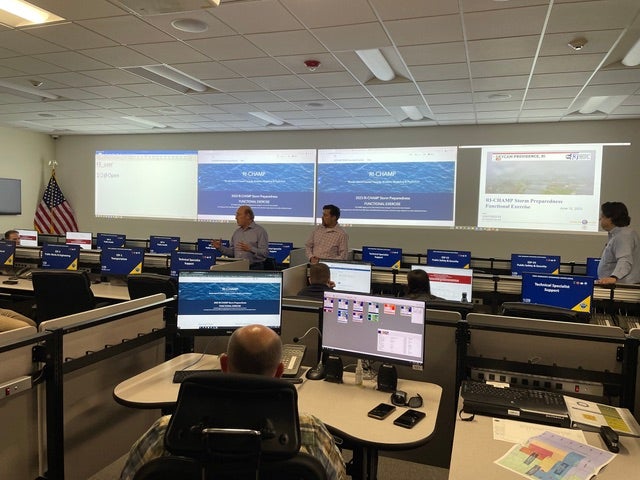
His research centers on the CHAMP system (Coastal Hazards Analysis, Modeling, and Prediction), a real-time forecasting and planning tool that helps emergency managers anticipate the impacts of storm surge, flooding, and wind. Developed in partnership with state agencies and local communities, CHAMP provides actionable data to model nor’easters and hurricanes, giving officials the information they need to protect lives, infrastructure, and economies.
Last April, federal funding for the program was abruptly cut. Rather than stepping back, Becker joined a symposium at the Capitol in Washington, D.C., where researchers gathered to share the stories behind their canceled grants. The community he found there strengthened his resolve to continue. “It was a very compelling event,” he said.
The symposium drew significant national media attention, and both NPR and The New York Times made it a priority to tell the researchers’ stories in depth. For Becker, that coverage was meaningful in itself. “It took a significant effort on their part,” he said, “and I’m very grateful for it.”
When a Story Sparks Action
The New York Times profile became a turning point. Among those who read Becker’s story were Dr. Neil Hunt and Julie Raymond, who immediately recognized the urgency of the work.
“When it comes to climate change, we think we all need to do whatever we can as soon as we can,” they said. “But sometimes it’s difficult to know what that is, or whether what we do can make a material difference.”
As founders of Vibrant Planet, a wildfire risk modeling and planning company based in California, they see strong parallels between their work and Becker’s. “Our work building vegetation maps, fuelscape models, and models of fire propagation under various weather conditions is quite parallel to Professor Becker’s team’s work in storm and flood protection and mitigation,” they said. “In both cases, better predictions lead to better preparedness, improved adaptation, and better outcomes.”
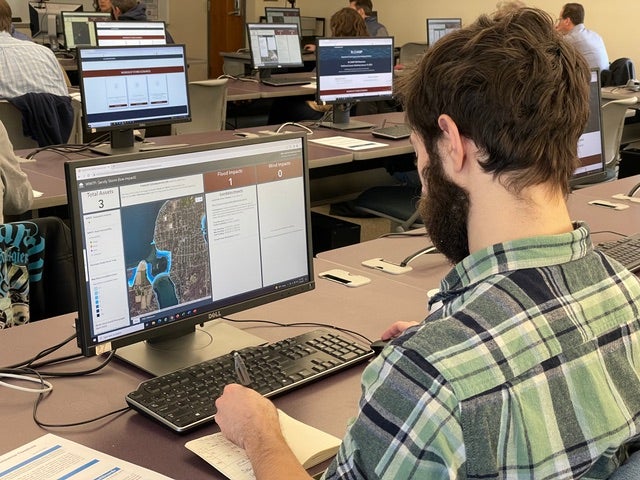
Hunt and Raymond were particularly drawn to Becker’s efforts to develop high-resolution flood prediction methodologies. “It is critical to have scientifically sound models that are accurate and reliable to predict flooding and storm surges,” they said. “The sooner this work is developed and made available, the bigger its impact will be.”
When Becker explained what was needed to sustain his research, the couple quickly saw an opportunity to help. “I had grant funding for one Ph.D. student, but I had two amazing applicants, each with a different skill set and interest,” Becker said. “I could only support one, but saw incredible potential for both of them.”
Their response was immediate. Hunt and Raymond committed to funding the second student for four years. “They just said, ‘yeah, we can do that!’ Becker recalled.
Investing in the Next Generation of Climate Solutions
Becker made a deliberate choice about how to use the gift: invest it in students. For him, ensuring that the next generation of scientists is equipped to tackle coastal resilience is as important as the research itself. The gift is unrestricted, giving him the flexibility to direct funds where they are most impactful. “It’s a really unique kind of funding,” he said. “It allows a degree of freedom that we wouldn’t ordinarily have with grants.”
He is especially excited by the complementary expertise of the two Ph.D. students joining his team. One has been working for USGS on decision support tools for hazards and is exploring ways AI can enhance that work. The other brings both a technical and a legal background and is examining the policy implications of integrating artificial intelligence into coastal resilience tools.
For Hunt and Raymond, supporting students was a way to amplify the impact of the research. “There is huge leverage in funding basic scientific work that will contribute to better methodologies and tools,” they said. “Without the knowledge, preparedness is guesswork, and limited resources will be deployed inefficiently.”
They see the gift as part of a larger mission connecting research to real-world impact. “Science is the search for evidence-based models of reality that make useful predictions, and technology is the vehicle for making them usable in the real world,” they said. “This work brings science, technology, and policy together to make a valuable contribution to humanity.”
“I’m excited to be able to leverage this support to advance our research here in New England,” Becker added, “and also I look forward to learning from Neil and Julie’s experience on the West coast, where they have been doing similar work in wildfire management.”