
You might not think twice about the technology behind your daily routines, whether checking directions, browsing homes online, or swiping on a dating app. But all of those tools rely on the same powerful concept: geographic information systems, or GIS.
“It’s the study of how everything lives in space,” says Lincoln Dark ’21, M.E.S.M ’22. “When you use Google Maps, or Zillow, or even dating apps that tell you someone is ‘within two miles’—that’s all GIS-based data.”
Dark applies that same technology in a very different—but incredibly important—context: managing critical water infrastructure for the city of Providence, Rhode Island.
Mapping an invisible system
After earning his bachelor’s degree in wildlife and conservation biology from the University of Rhode Island, Dark completed URI’s Master of Environmental Science and Management program, where he was first introduced to GIS.
“I was looking for ways to continue my education and expand my skillset,” he says. “GIS ended up being that technical skill that opened doors.”
Today, Dark works as a GIS specialist for the Providence Water Supply Board, where he helps manage a “digital twin” of the region’s water infrastructure—a detailed, constantly updated map of everything from reservoirs to household connections.
“Basically, every pipe, every valve, every hydrant—we map all of it,” he says. “From the second the water leaves the reservoir to how it gets to every single building.”
While the data becomes especially critical during emergencies, most of his work focuses on precision and consistency. He updates the system as infrastructure changes and supports engineering projects with detailed maps and digital documentation. “My day-to-day is making sure what you see on the screen matches exactly what’s in the ground,” he says.
Data in service of community
Beyond the technical work, Dark sees his role as a form of public service. His team helps identify homes with outdated or hazardous infrastructure, including lead service lines, supporting efforts to improve water quality across the region. “We help streamline the process of water maintenance,” he says. “And we help identify areas where people can get their lead pipes replaced.”
For Dark, the impact is personal. “It feels good knowing I’m doing something helpful for the community,” he says.
While GIS may sound niche, Dark emphasizes that it’s everywhere—and that’s exactly what makes it so valuable. Its versatility translates directly into career opportunities, especially for students interested in environmental fields. “There’s GIS in everything,” he says. “You’re guaranteed a job somewhere.”
His own career is proof. What began as an interest in wildlife conservation has evolved into a role at the intersection of technology, infrastructure, and public service—one that quietly supports entire communities every day. While most people never think about the systems beneath their streets, Dark is making sure they work.
10 Under 10
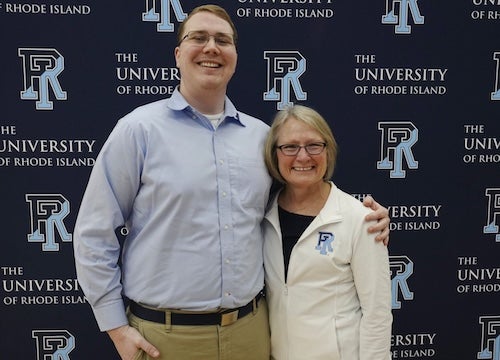
Dark was recently recognized with URI’s 10 Under 10 Award, an honor that highlights young alumni making significant professional and community impact. He earned the recognition not only for his work as a GIS specialist, but also for his continued volunteer leadership with the Audubon Society of Rhode Island.
There, he coordinated a statewide osprey monitoring program, overseeing roughly 150 volunteers and helping track more than 400 nests—contributing to long-term research on the species’ recovery in Rhode Island.