
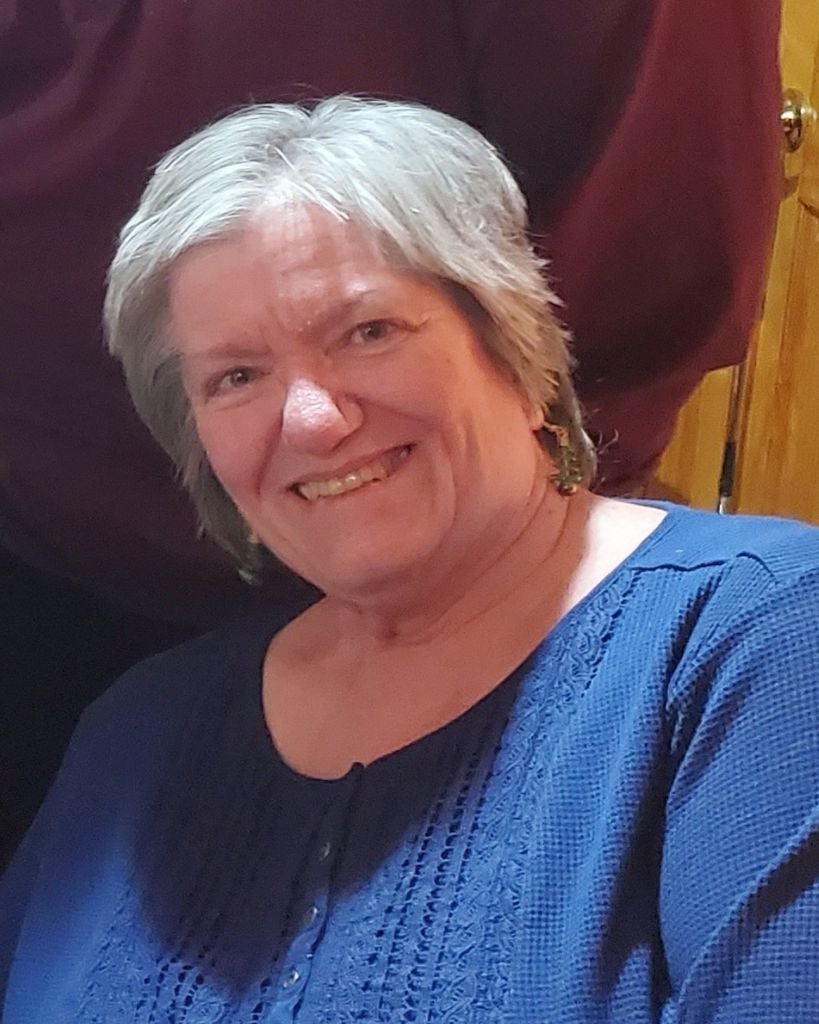
URI community members reflect on the plant sciences professor whose care for the people she taught reached well past the greenhouse.
Last December, then University of Rhode Island plant sciences major Abby Snoeren-Place ’26 sat down with her advisor, Professor Bridget Ruemmele, and broke down in tears. With one semester left before graduation, she couldn’t picture a job that would let her do the work she loved.
Ruemmele listened, talked through options, and floated, half-teasing, a career on a golf course, which was her own specialty. The two laughed together. “Her support in that time of uncertainty meant the world to me,” Snoeren-Place says.
A few months later, when a nursery manager position opened at the Newport Tree Conservancy, Ruemmele helped Snoeren-Place work out a schedule so she could take the job and still finish her coursework and exams.
“She made a huge impact on my life and my future,” Snoeren-Place says.
For 35 years, Ruemmele did some version of that for countless URI students. A turfgrass specialist and plant breeder who joined the University in 1991, she brought a scientist’s knowledge and a farmer’s practical sense of growing things to the classroom and the greenhouse. What her students remember most, though, is how much she cared about them.
She passed away in early October, just shy of her 68th birthday.
Vroom, vroom: Learning plants the Ruemmele way
Ask her students about her classes, and they’ll mention the mnemonics. To teach the arrangement of a flower’s petals, Ruemmele invoked a revving Toyota Corolla. She told stories about her brother back on the farm and nursed a running grudge against taxonomists who kept splitting plants into ever-finer categories. She never seemed to run out of corny jokes.
“She broke information down in a way that was digestible but quirky and funny,” Snoeren-Place says.
For Kaylyn Wood ’26, her stories and personal connections helped the material stick. “Taking that first plant science class with her made me want to do plant science,” she says.
Ruemmele felt just as strongly about her students. “I enjoy the teaching aspect of my position most of all,” she wrote in her syllabus.
When Nolan Banever was building an insect collection for a field entomology course recently, Ruemmele found a way to help. A spotted lanternfly had flown into her car; she caught it and kept the specimen for him in a McDonald’s cup.
“She cared about what her students were doing even outside of plant science,” he says.
Her classroom extended past campus, too. Allegra Halverson, assistant manager of URI’s farms, remembers teaming up with Ruemmele for an elementary school outreach day at East Farm. With the 4-H program coordinating the event, Halverson had little contact with Ruemmele beforehand and worried she might have to manage 60 children on her own.
But Ruemmele arrived right on time, teaching kit in hand, and settled onto the grass among the kids, passing around books, pictures, and medicinal plants. “The kids were truly learning, captivated by her fun and fact-filled charm,” Halverson recalls. “At that moment, I could see exactly why she chose to be a teacher.”
A farmer’s daughter
Ruemmele grew up on her family’s dairy farm in Hudson, Wisconsin. “She was enormously proud of her agricultural heritage,” says Nathaniel Mitkowski, a professor of plant pathology and her longtime colleague. “She loved the soil. She loved plants. She loved farmers. She was a farmer’s daughter.”
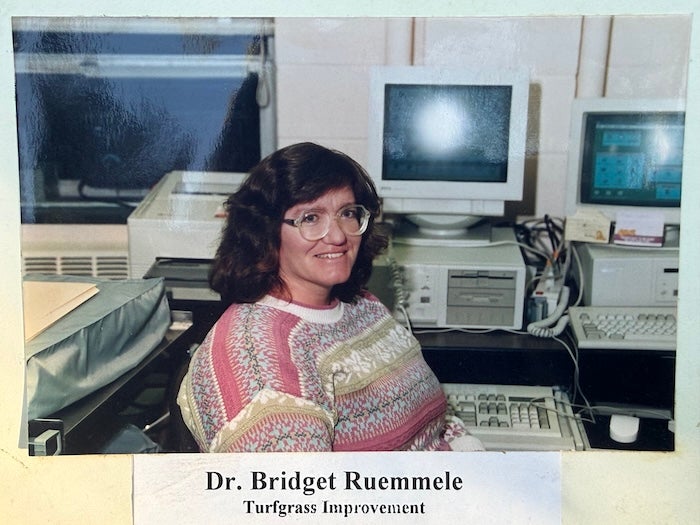
That pride came with serious science. “She wanted to spread the joy and work ethic of a farming lifestyle,” he adds. “But she was also a consummate scientist and geneticist. She knew complex biology and could mix it all together.”
At URI, she and Mitkowski built PLS 150 together, the plant breeder and the plant pathologist each bringing their own lens to the core course for the major.
“I could look at issues and say, ‘What do kids on a busy street need to know about agriculture?’” Mitkowski says, “and she could say, ‘What do farmers need to tell the world?’”
At home, she fed the feral cats that came to her back door and worried when they stopped showing up. “She was one of the kindest, most generous people I ever knew,” Mitkowski says, “and would do anything she could to help anyone.”
Growing together
Ruemmele was a beloved fixture at the URI greenhouse, often parked in the lot with her window rolled down, ready for a chat. No question was too small, and no one who stopped by her car or office left feeling like an inconvenience. She had a habit of giving unexpected compliments, the kind that could buoy someone through the rest of their day.
“When I worked in the greenhouse on weekends, just knowing she was there made me feel safer,” says Sharday Johnson, a plant sciences student.
Ruemmele’s teaching didn’t end when class did. She spent hours in her office helping students plan schedules and find jobs. She cheered from the stands at their hockey, baseball, and basketball games, and she prepared the turf team for national competition.
It didn’t end at graduation, either. Her former students range from their early 20s to their 50s, and they work across Rhode Island’s nursery, landscape, and turf industries, often alongside one another. She didn’t just teach individual students; she brought them together, and the community she built has outlasted their time in Kingston.
At Farming Turtles in Exeter, Wood now works for Nick Testa ’11, also a former student of Ruemmele’s. “She made a difference in so many people’s lives,” Wood says.
“We are all very fortunate to have had the time we had with her,” adds Larry Englander, a retired faculty member, former colleague, and longtime friend.
Ruemmele’s influence grows in yards across New England, too. Cuttings, grafts, and air-layered magnolias that her students propagated in the department’s greenhouse have taken root far beyond Kingston.
Planted in her honor
The day after they learned of Ruemmele’s death, Snoeren-Place went out with her boss, Joe Verstandig ’17, to plant a rhododendron in her honor. Verstandig is also a URI plant sciences graduate; he had taken more classes with Ruemmele than with any other professor.
Come spring, the rhododendron will bloom at the Newport Tree Conservancy.
First Frost by Kaylyn Wood ’26
A poem dedicated to Professor Bridget Ruemmele
The trees are changing color
painting the world in shades of gold
the flowers still clinging to summer
unaware of the coming cold
Autumn has a way of taking what it cannot keep
first frost came without a peep
the flowers never said goodbye
they simply just ran out of time
the first frost, not my first loss
Some things fall with autumn leaves
every season has its end
but knowing flowers cannot stay
you never taught me to let them
Perhaps the flowers never leave
not entirely anyway
for even when their petals fall
something of them stays
Every seed I place in soil
every flower I help grow
will carry something you once taught me
more than you can ever know
The first frost may take the flowers
and winter may take the green
It cannot touch the garden
you’ve planted inside of me
Celebrating Her Life
URI’s Department of Plant Sciences and Entomology is hosting a Celebration of Life in Professor Ruemmele’s honor on Wednesday, October 28, 2026 from 5:00 – 7:00 P.M. in URI’s Avedisian Hall, room 170. Please RSVP here.