
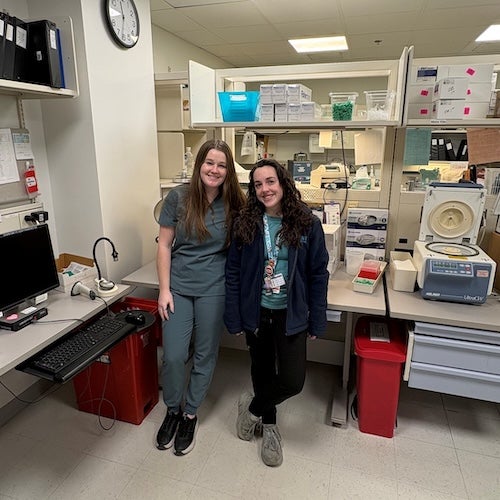
When Kathryn Casey and Sabrina Metallo graduated from the University of Rhode Island’s Medical Laboratory Science program in 2019, they didn’t just enter a career—they stepped into a critical role at the core of patient care.
Medical laboratory scientists are healthcare professionals who perform complex analyses on blood, tissue, and other bodily samples to detect disease, guide treatment decisions, and monitor patient health. Though their work happens behind the scenes, the data they provide is essential.
“Everything in healthcare depends on what we do,” Casey says.
Hidden but Vital
Today, both Casey and Metallo work at South County Hospital in Wakefield, Rhode Island, as board-certified medical laboratory scientists and specialists in blood banking and hematology respectively. Though patients never meet them, their work directly informs diagnoses and treatment decisions.
“The lab is foundational to all patient care,” Metallo says. “Doctors and nurses wouldn’t know how to treat patients without our lab testing.”
In many cases, medical laboratory scientists are the first to detect serious illness–sometimes before a physician ever sees the patient. “Roughly 60% to 70% of all medical decisions affecting patient care are based on laboratory test results,” Casey explains. “Sometimes we’re the first person to see that a patient has cancer.”
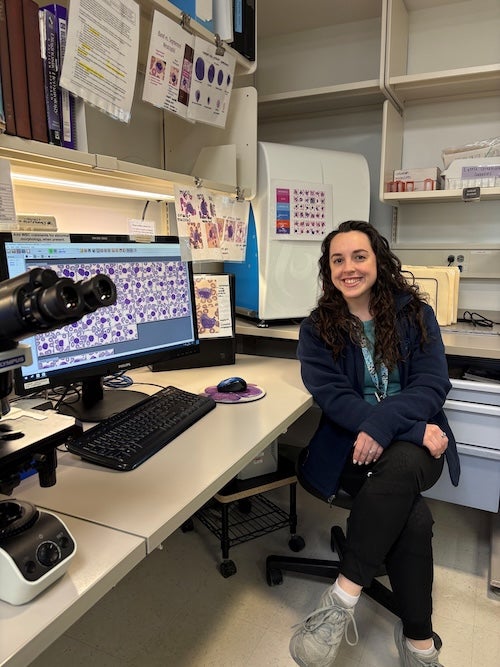
Those moments are unforgettable. “When you look under the microscope and see leukemic cells, it’s a whole-body feeling,” Metallo says. “There’s a moment when you realize you could be the first person to know.” Even without direct interaction with patients, the emotional impact is real. “You feel connected to them without ever knowing them,” she adds.
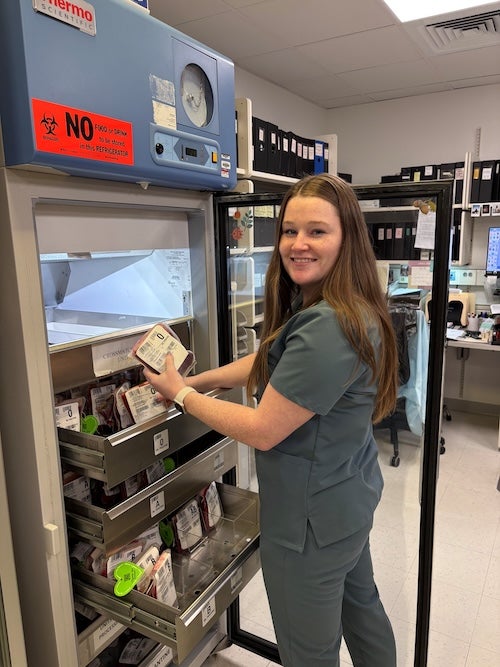
“Working in the hospital’s blood bank has inspired me to become a blood donor and an advocate for others to donate,” Casey says. “So many patients, especially those in treatment for cancer, are reliant on blood product transfusions. They often become a patient we ‘see’ on a weekly basis and I donate in honor of them.”
Giving Back
Despite their critical role in healthcare, medical laboratory professionals often remain unrecognized. This lack of visibility drives both alumni to advocate for their profession and support the next generation of students.
Casey and Metallo serve in leadership roles with the American Society for Clinical Laboratory Science and remain closely connected to URI as guest lecturers, clinical instructors, and mentors—helping bridge the gap between classroom learning and real-world practice.
Metallo became a hematology clinical instructor just six months after graduating, teaching medical laboratory science majors in a hospital-based clinical program that serves URI, Rhode Island College, Salve Regina, and other bachelor’s-level graduates. “I love being able to foster a love of hematology in students,” she says. “When they graduate and say, ‘I got a job in hematology,’ it’s the best feeling.”
Casey leads blood bank lectures for students in the same clinical program, emphasizing clarity and preparation for clinical rotations. “I like knowing that I’m giving students what they need to succeed,” she says. “When they get to their clinical rotations, they’re not walking in saying, ‘What is happening?’”
Both Metallo and Casey also return annually to URI to work with students in an Introduction to Medical Laboratory Science course.
Both bring creativity–and a sense of humor–into the classroom. “When I teach cell morphology, I use food,” Metallo says. “I’ll say, ‘This cell looks like a Cheeto Puff.’ Everybody knows what that looks like, so it sticks.”
Casey takes a similar approach. “We have a donut lecture to explain blood types,” she says. “Using visuals like that actually helps students understand and remember it better.”
Broad Impact
A degree in medical laboratory science opens doors across healthcare and beyond–from hospital laboratories and public health to biotechnology, education, and advanced clinical roles. “It’s a really good jumping-off point,” Casey says. “You learn so much that carries into other fields.”
With growing national demand, the field also offers strong job security and flexibility. “At the end of the day, we’re always going to be needed,” Casey says.
“The field is a lot broader than people think,” Metallo adds.. “And as a student, you might not always realize how much of an impact you will have as a professional—but it’s huge.”
Metallo, who also holds a master’s degree in public health, is now considering pursuing a doctorate and eventually teaching full-time. “I found my way into academics, and I love it,” she says.
As they continue to build their careers, both remain committed to raising awareness of their field and inspiring future professionals.
“We love what we do,” Casey says. “And we love getting more people into it.”