
At the University of Rhode Island, students in the Medical Laboratory Science (MLS) program are stepping into one of healthcare’s most essential roles: delivering the data that drives diagnosis, treatment, and patient outcomes.
Medical laboratory scientists are healthcare professionals who perform complex analyses on blood, tissue, and other bodily samples to detect disease, guide treatment decisions, and monitor patient health. An estimated 60% to 70% of all medical decisions affecting patient care are based on laboratory test results.
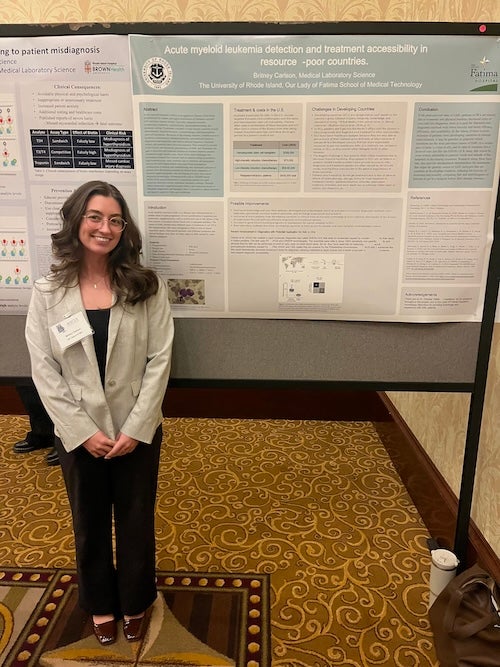
That influence is already evident in the work of URI’s MLS students, who are actively contributing to the field while still in training. At the recent American Society for Clinical Laboratory Science – Central New England regional conference, URI seniors Britney Carlson and Katherine Buffum recently showcased their research highlighting the critical role laboratory professionals play in complex and often life-threatening conditions. Their research posters tied for third place.
Carlson focused on global disparities in diagnosing and treating acute myeloid leukemia (AML), an aggressive blood cancer that disrupts the body’s ability to produce functional white blood cells. While diagnosis and treatment in the United States rely on advanced and often costly technologies, she found that patients in under-resourced countries face significant barriers. “Some of the main challenges include a lack of modern testing accessibility, geographic barriers, early mortality due to infection, and treatment options that are high-cost or, plainly, inaccessible,” she says. These inequities contribute to dramatically lower survival rates.
Her research points toward solutions grounded in collaboration and innovation, including expanding access to affordable diagnostic tools, increasing international clinical trial participation, and standardizing care. “There is potential to reduce mortality and improve equity in AML care worldwide,” Carlson says.
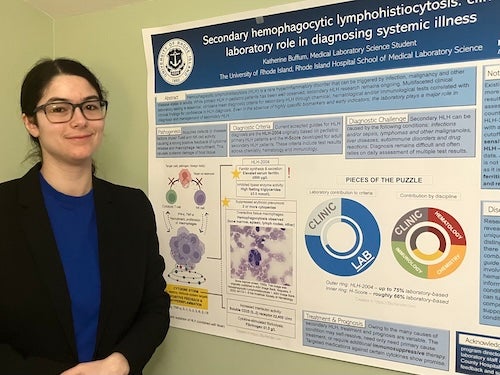
Buffum’s project examined a rare but serious condition known as hemophagocytic lymphohistiocytosis (HLH), which can mimic other illnesses and make diagnosis particularly challenging. Drawn to the overlap of hematology and immunology, she wanted to better understand how laboratory science supports clinicians in these complex cases. “When people have broad symptoms and aren’t getting any better, doctors and nurses need a lot more information to guide diagnosis and treatment–that’s where we come in as laboratory professionals,” she says.
Her research revealed just how central lab work is to identifying HLH. “Anywhere from half to three-quarters of the information used for HLH diagnosis comes from laboratory testing,” Buffum says, pointing to techniques ranging from serum chemistry analysis to microscopic examination of blood and bone marrow.
While their research topics differ, both students note that they were drawn to MLS by a shared desire to make a meaningful impact in healthcare.
Carlson’s interest began early, but it wasn’t until her junior year that she discovered the field. “I heard about the medical laboratory science major at URI my junior year and switched into it as soon as I could after learning what a gem of a career it is,” she says. The balance of scientific rigor and real-world application appealed to her. “MLS provides the medical knowledge foundation I was looking for with the ability to go straight into a rewarding career with lots of opportunities for growth and further education if desired,” she says.
Buffum found her path through community involvement. As a regular blood donor, she became curious about the work happening beyond the donation chair. “I wanted to know what kind of work organizations like the Rhode Island Blood Center and local hospitals do behind the scenes to get resources and results out for the community,” she explains. “It ended up being the perfect intersection of my childhood interest in medicine, lifelong exposure to technology and ongoing community involvement.”
Both students emphasize a shared message: laboratory science is foundational to modern medicine. “There is so much more to healthcare than the patient-facing side,” Buffum says. “This field is an amazing opportunity to make a difference in the quality and effectiveness of patient care.”