
By Jo Fisher
Faculty in the Feinstein College of Education at URI are looking to transform the way educators support multilingual students in their classrooms. A recent grant from the Spencer Foundation will help to kickstart the project.
Principal Investigator Nicole King, along with co-PIs Laura Hamman-Ortiz, Amy Correia, and Steve Przymus, all faculty members with the new Translanguaging Lab (TLab) in the College of Education, are launching “Project TRANSFORM: TRANSlanguaging as Family-ORiented Multilingual Pedagogy” in September. A grant of $50,000 from the Spencer Foundation will provide funding for their research for the coming year.
Their study will explore how educators of multilingual learners (MLLs) who teach in English-medium classrooms can be supported to develop an equity-centered, family-oriented translanguaging pedagogy.
“Translanguage is a theory of language, it is a pedagogy,” says Nicole King, assistant professor of TESOL and bilingual education, “We are taking the next step and framing it as a pedagogy that leverages ‘familylect,’ the multilanguage embodied repertoire that families use in their daily lives. The importance of multilingual families and connections to families continues to be underrepresented in research.”
The group’s proposal notes that translanguaging research has largely been conducted in classroom settings, with limited attention to how teachers’ situated contexts and identities shape their translanguaging practice. There has also been minimal research about how engagement with multilingual families might be meaningfully centered in and through translanguaging pedagogy.
“This is really how families communicate,” King says, “What can we do as educators to bring that language richness in their homes into their classrooms and leverage it into learning for everybody?” The team is looking forward to supporting teachers as they learn about their multilingual learners and their families through projects such as language portraits and multilingual family stories.
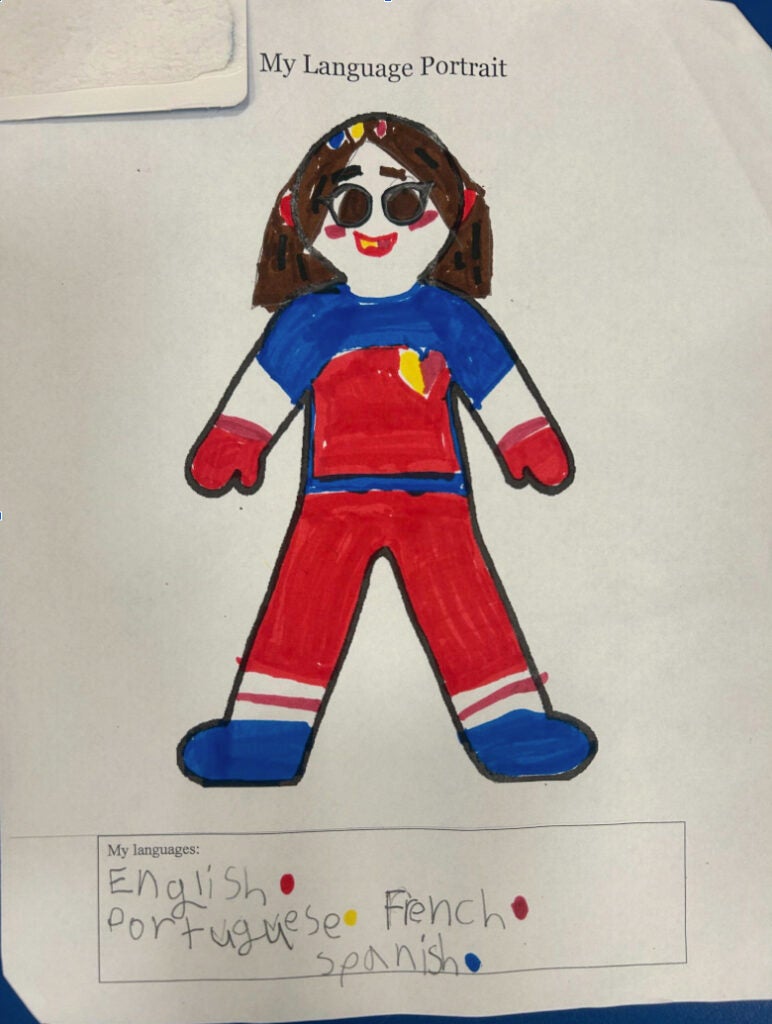
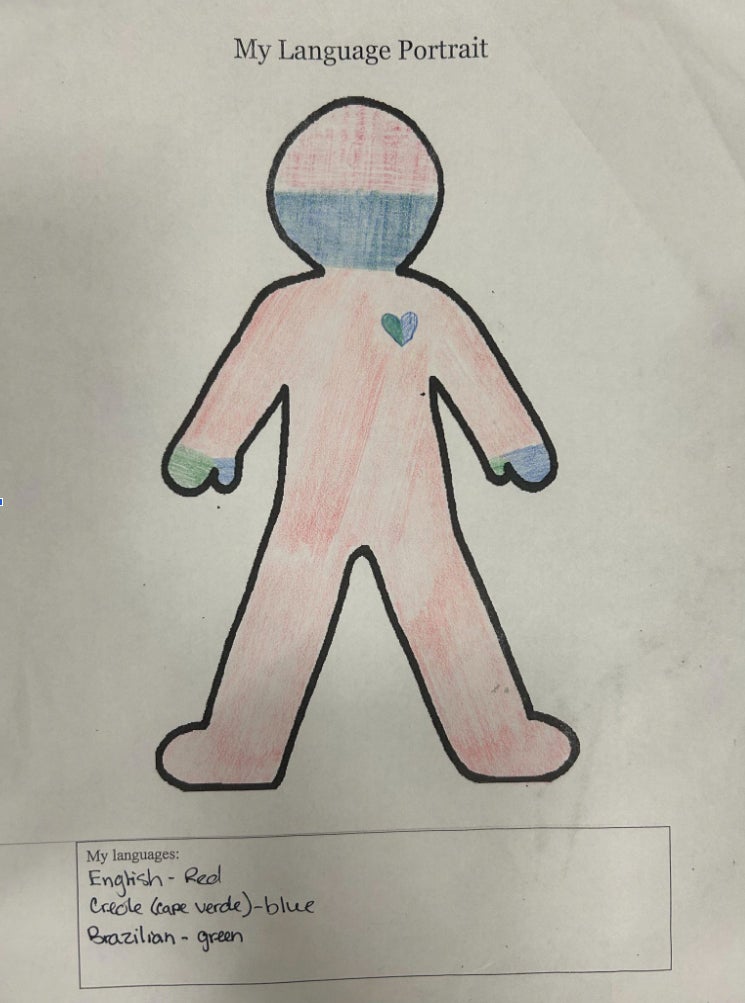
Sample language portraits created by a multilingual student (left) and parent (right). Image courtesy of Nicole King.
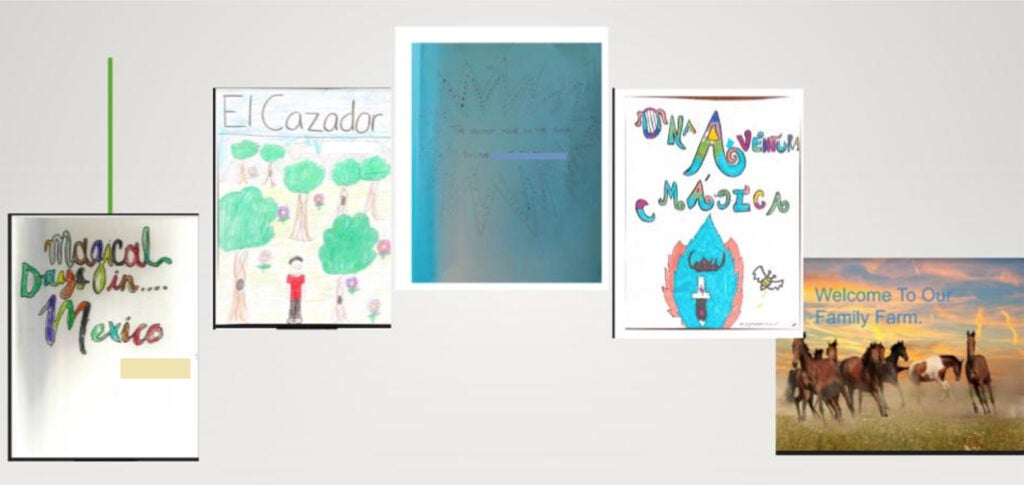
Sample Multilingual Family Stories. Image courtesy of Nicole King.
The study will involve a yearlong professional learning inquiry in which researchers from the TLab facilitate teachers’ development and enactment of translanguaging repertoires and their engagement with their students’ multilingual familylects.
The study will involve partnerships with four Rhode Island school districts: Cranston, Cumberland, Providence, and Woonsocket. From those districts, 15-20 teachers will participate in the learning study to raise their awareness and study their development of equitable practices across time, King says. Teachers will be involved in interviews, a one-day Translanguaging Institute in October, observations, and monthly professional learning community events.
The monthly events will “allow them to plan and collaborate together and with us to develop new family engagement activities,” says King, who notes the TLab team is already starting to develop case studies for the districts using publicly available policies about multilingual learners, translanguaging, family engagement practices, and effective language learning and teaching.
The partner districts have shown “a great deal of support and enthusiasm for raising up teacher awareness of family voices, etc. especially in our current political context,” King reports, “Multilingual families are under attack. We’re looking at what we can do to celebrate their skills and knowledge and to support their teachers.”
The ultimate goal of the study is to “develop more nuanced understandings of the mediated and situated ways that English-medium educators engage with translanguaging pedagogy and develop meaningful partnerships with multilingual families, as we work to transform classroom spaces for multilingual learners.”
The research is especially relevant given that the numbers of multilingual learners in Rhode Island is growing at a rate more rapid than any other state.
In addition to the $50,000 grant from the Spencer Foundation, the TLab team has secured an additional $30,000 in the form of a development grant from URI and a $5,000 faculty seed grant from the Social Science Institute for Research, Education, and Policy at URI. Hamman-Ortiz is the PI of those grants.