
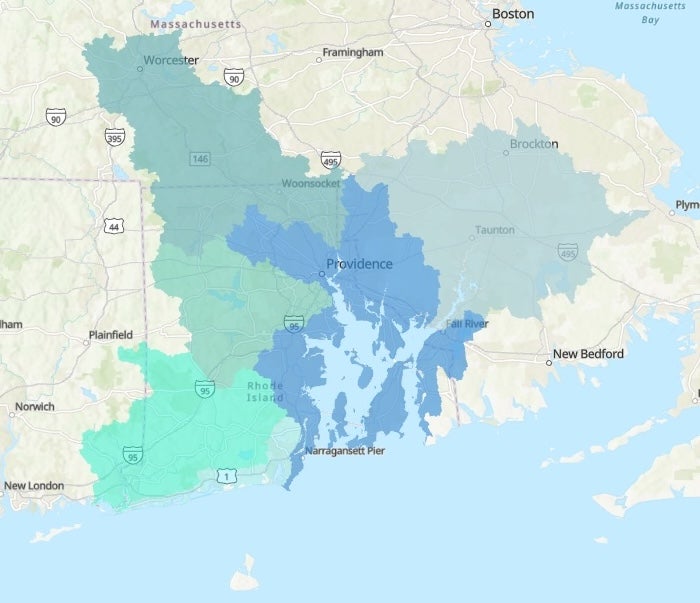
For cell and molecular biology major Carissa Sherman, the CELS Summer Research Fellowship offered a chance to trade classroom problem sets for real watershed data. Using GIS and the EPA’s Pollution Load Estimation Tool, Sherman built a framework for estimating nonpoint-source pollution — nitrogen, phosphorus, and sediment — across watersheds in Rhode Island, Connecticut, and Massachusetts. She divided the region into six major subbasins, including the Blackstone, Taunton, and Pawtuxet watersheds and the southern coastal ponds, to identify which areas contribute the greatest pollutant loads and where efforts like riparian buffers and stormwater controls could have the greatest impact.
It’s Sherman’s second summer working with Dr. Soni Pradhanang; last year, she mapped groundwater following the removal of the Potter Hill Dam. Sherman is entering her senior year at URI on the biochemistry track. She worked with Pradhanang and Geubrina Farjria, a Ph.D. candidate, on this project.
Q. What are you researching?
A. My research looks at nutrient pollution, particularly nitrogen and phosphorus, and how it moves from communities and the landscape into the Narragansett Bay watershed. Too many nutrients entering waterways can contribute to poor water quality and affect aquatic ecosystems. I’m using environmental data and mapping tools to estimate where these nutrients are coming from and how much is entering different parts of the watershed. This can help us better understand where efforts to reduce pollution could make the biggest difference. Ultimately, the goal is to use data to support healthier waterways and a healthier Narragansett Bay.
What does a typical day look like during your fellowship?
A typical day involves a combination of data analysis, GIS work, research, and meeting with my mentor to discuss my progress. A lot of my time is spent working with environmental and land-use data and using tools to estimate nutrient pollution across different communities within the Narragansett Bay watershed. I’m also researching the factors that influence nutrient loading and looking at how different management practices can affect those loads. There is a lot of problem-solving involved, because I’m often figuring out how different datasets and tools can be used together to answer my research questions.
What’s been one of the most rewarding moments of the summer?
When something works right! With this project there has been lots of troubleshooting while using ArcGIS, and sometimes it took a long time to organize data — when I finally get the output I wanted, that’s the best part.
How has working with your faculty mentor enriched your experience?
Working with my faculty/graduate mentors has helped me approach the project more critically and has given me a better understanding of what it means to conduct research. My mentor has helped me work through questions when I get stuck, think about how to interpret my results, and consider why the information I’m finding matters beyond just the numbers. I’ve also learned that research isn’t always about immediately knowing the answer; it’s about asking good questions, being willing to adjust your approach, and learning from the process.
What has this experience taught you that you couldn’t have learned in a classroom?
The biggest thing this experience has taught me is what it actually feels like to work through a real research problem. In a classroom, you usually have a question, the information you need, and a process for finding the answer. In research, the process is much less straightforward. I’ve had to figure out how to work with real-world datasets, troubleshoot problems, decide which information is useful, and think critically about what my results actually mean.
It’s also been rewarding to see how the skills I’ve learned can be applied to an issue that affects my own community and environment. Nutrient pollution can have major consequences for water quality and aquatic ecosystems, so knowing that my work can contribute to understanding that problem makes the project feel much more meaningful. This fellowship has helped me see research not just as something you study, but as a tool that can be used to address real environmental and public health challenges.
Read more about Carissa’s work here.