
This page is currently under construction.
Due to upcoming updates to the Kuali course proposal forms and workflow, some information on this page may become outdated. This content will remain available for faculty who are continuing to work on course proposals during the Summer 2026 Kuali update period.
To learn more about the Summer 2026 Kuali System Updates, please visit https://web.uri.edu/facsen/curriculum/summer-2026-kuali-system-updates/
Quick Links
URI Course Glossary
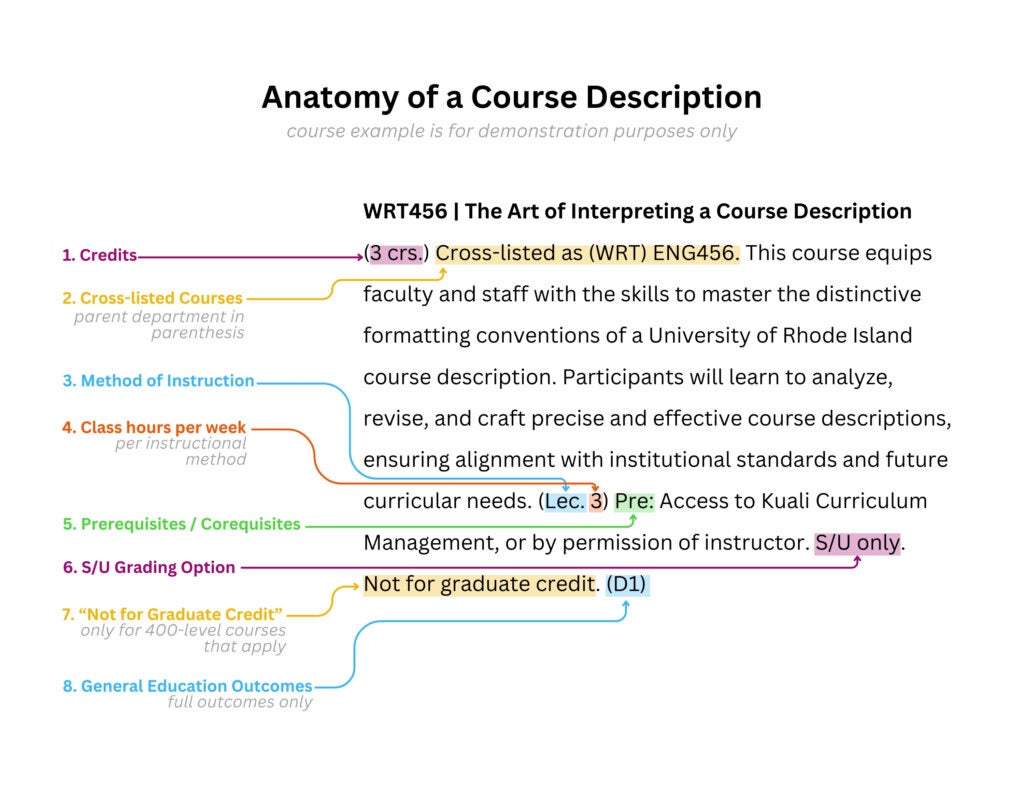
Anatomy of a Course Description
How to modify an existing course
URI Course Glossary
| Item | Definition |
|---|---|
| Class Component | See "Method of Instruction" |
| Code | The three-letter subject area of a course, e.g. ACC, COM, WRT, etc. |
| Combined Section | See "Cross-listed Course" |
| Corequisites | See "Prerequisites" |
| Course Code | See "Code" |
| Course Credits | See "Credits" |
| Course Description | See "Description" |
| Course Number | See "Number" |
| Credits | 8.31.10 Basis for Credit. The basis of a credit shall normally be three hours work; for example, one credit for each lecture or recitation and two hours of preparation, or one credit for each two-hour laboratory and one hour of preparation, or one credit for each three-hour laboratory with no outside preparation, the student workload for an online class shall be equivalent to the in-class and out-of-class work in its face-to-face equivalent. Individual evaluation of courses offering practice in a professional major shall be made by the respective deans to determine non-lecture hour credits and will include at least an equivalent amount of work as required in the definitions cited above. |
| Cross-listed Course | A course offered under multiple course codes, meaning students can register for it under different names, but the course content and instruction remain the same. This is not the same as simultaneous courses. |
| Description | Course descriptions are written for students, not faculty, and must communicate clearly and concisely to them. Jargon, acronyms, and technical language should be avoided as much as possible. Anyone should be able to read the description and understand the nature and intent of the course. An acceptable course description with a maximum of 30 words, begins with a verb, e.g. examines, introduces, explores, investigates. Articles, adjectives and adverbs are seldom necessary. Sentence fragments are acceptable. |
| General Education Learning Outcomes | Courses approved for Gen Ed credit have that designation listed at the end of the description (e.g. (A2) (C1) for a course that fulfills the full A2 and C1 outcomes). Only full outcomes are listed; partial outcomes are not. 8.20.10 The General Education program will assess student exposure to twelve Student Learning Outcomes in four areas: A. Build knowledge of diverse peoples and cultures and of the natural and physical world. (A1) STEM Disciplines (A2) Social & Behavioral Sciences (A3) Humanities (A4) Art & Design B. Develop intellectual and interdisciplinary competencies for academic and lifelong learning. (B1) Write Effectively (B2) Communicate Effectively (B3) Mathematical, Statistical, or Computational Strategies (B4) Information Literacy C. Exercise individual and social responsibilities. (C1) Civic Knowledge & Responsibilies (C2) Global Responsibility (C3) Diversity & Inclusion D. Integrate and apply these abilities and capacities, adapting them to new settings, questions, and responsibilities to lay the foundation for lifelong learning. (D1) Integrate & Apply |
| General Education Learning Outcomes Configuration | 8.20.12 All General Education courses will assess two Student Learning Outcomes, in the following configurations: Knowledge (Area A) and Competency (Area B) Knowledge (Area A) and Responsibility (Area C) Competency (Area B) and Competency (Area B) Competency (Area B) and Responsibility (Area C) Integration (Area D) and Competency (Area B) Integration (Area D) and Responsibility (Area C) |
| Grand Challenge | 8.20.13 A Grand Challenge course is an interdisciplinary General Education course that may be offered at any level (100 to 400). It is designed to facilitate students’ exploration of multiple perspectives on areas of contemporary significance, including their ethical implications, and to provide a stimulating and innovative course experience that addresses significant global challenges and broadens students’ understanding of the critical issues facing them in the 21st century. |
| In-Person (modality) | Modality. A course with no more than 24.9% of instruction delivered online. All courses are assumed to be in-person unless otherwise approved by Faculty Senate. |
| Independent Study | Method of instruction. One-on-one instruction in which the student enters into an agreement with the instructor that defines the focus of inquiry and nature of activities. Includes tutorials, directed readings, special projects. |
| Laboratory | Method of instruction. In-class applied course work, generally involving experimentation or observation, typically using special equipment (including computers and specialized software). |
| Lecture | Method of instruction. A course in which the primary method is presentation and students are expected to participate in a variety of ways, such as small-group discussions, questions and answers, writing-exercises, etc. |
| Letter Grades | 8.53.10 Student grades are defined as follows: A – Superior B – Good C – Fair D – Low grade, passing F – Failure 8.53.11 Grades shall be given quality point values as follows: A = 4.00 points A- = 3.70 points B+ = 3.30 points B = 3.00 points B- = 2.70 points C+ = 2.30 points C = 2.00 points C- = 1.70 points D+ = 1.30 points D = 1.00 points F = 0 points U = 0 points U* = not calculated in GPA |
| Method of Instruction | The instructional delivery method. Any given course can have more than one delivery method. URI uses the following methods: Lecture, Laboratory, Recitation, Studio, Seminar, Independent Study, Practicum, Workshop, and Online. Also known as "class component." Current methods of instruction are definied in the Four Hundred Fifty-First Report of the Curricular Affairs Committee (April 3, 2007) |
| Modality | The way a course is delivered. See "In-person" and "Online" |
| Number | 8.30.10 Course Numbering System 001-099 Level. Pre-freshman and special undergraduate. Characteristics: Undergraduate courses not applicable for degree credit. Post-Secondary or sub-freshman remedial courses, Alan Shawn Feinstein College of Education and Professional Studies courses for no credit or for non-credit certificate credit only. 100-299 Level. Lower division undergraduate courses. Primarily for freshmen and sophomores and as electives for upper class students. Characteristics: Little or no prior college level work required. May not be taken for graduate credit. 300-399 Level. Upper division undergraduate courses. Primarily for juniors and seniors majoring in the field or advanced students in other disciplines. Characteristics: Some formal background or sophistication required but not to the extent that would ordinarily justify allowing graduate degree credit. 400-499* Level. Generally limited to juniors and seniors majoring in the field. Open to other advanced undergraduates and to graduate students with permission. Characteristics: Extensive background required, may be taken for graduate credit. (Limitations may be stated by the department if desired.) 500-599 Level. Graduate level courses. The bachelor’s degree is usually a prerequisite but qualified seniors and honors students can be admitted with permission. Characteristics: Comprise majority of course work between bachelor’s and master’s degree. Number 599 reserved for masters thesis research and is graded on an S/U-only basis. 600-699 Level. Advanced graduate courses. No undergraduates admitted except honors students with approval of advisors and the department. Characteristics: Comprise majority of course work between master’s and doctor’s degree but not limited to doctoral students. Number 699 reserved for doctoral thesis research and is graded on an S/U-only basis. 900-999 Level. Special types of graduate courses for which no program credit is allowed. Characteristics: Workshops, institutes, courses taken for certificate credit only, courses taken to remedy deficiencies, and temporary courses which have not been approved by the Graduate Council for graduate program credit. *Courses numbered at the 400 level must have approval of both the Curriculum and Standards Committee and the Graduate Council. |
| Number of Class Hours Per Week | Course descriptions identify the number of class hours per week for each method of instruction (instructional delivery method) in parenthesis prior to the prerequisites (e.g. Lec. 3, Rec. 1): Homework, out-of-class assignments, etc. are in addition to the number of class hours noted. |
| Online (modality) | Modality. A course delivered at least 75% online. |
| Open-ended Course | 8.81.20 An Open-ended Course shall be administered by the department which originated it. Initially, an open-ended course shall be proposed and approved in the same manner as other permanent courses (8.81.10). Prior to offering a specific topic the content of the course shall be approved in a department meeting. 8.81.21 After approval of each offering of an open-ended course topic, a copy of the title, subtitle, and description shall be forwarded for schedule authorization to the Office of Enrollment Services via the dean of the college in which the department resides. The dean’s authorization shall ensure that no overlap exists between specific topics and existing courses. 8.81.22 A specific topic within an open-ended course may be offered three times. After three offerings the topic shall be approved through the appropriate channels as either a permanent course or as a permanent topic within an open-ended course and shall be included in the University Catalog. |
| Permanent Course | 8.80.11 A permanent course is one which has no restrictions on the number of times it may be offered. A permanent course may be open-ended; that is, a course whose subject matter may vary between offerings. Open-ended courses may include workshops, seminars, colloquiums, special topics, special problems, and special projects. Only permanent courses may be listed in the University Catalog. |
| Practicum | Method of instruction. Structured experiences where the primary aim is to connect theory with practice. Includes clinics, internships, externships, student teaching, field experiences. May include regular class meetings. |
| Prerequisites | The items required in order to enroll in a course. This can include completed courses, GPA requirements, academic standing (sophomore, junior, senior, etc.), and can also include corequisites (courses or programs the student must be simultaneously enrolled in), or other conditions such as "for Chemistry majors only," "not for students enrolled in the following classes.." etc. Prerequisites are designated by "Pre:" and are listed after the number of class hours per week towards the end of the course description. |
| Recitation | Method of instruction. Separate sections of a lecture course regularly scheduled for discussion. |
| S/U Grade | 8.53.30 Certain courses do not lend themselves to precise grading (e.g., research, seminar). For these courses, only a Satisfactory (S) or Unsatisfactory (U) shall be given to all students enrolled. To qualify as an S/U course, the course must be approved by the Faculty Senate after recommendation by the Curriculum and Standards Committee and/or the Graduate Council. S/U courses shall be so labeled in the University Catalog. An S/U course is not to be counted as a course taken under the Pass/Fail grading option. Courses numbered below 100 that are graded on an S/U basis shall not be included in the calculation of a student’s quality point average or credits earned. Courses numbered above 500 that are graded on an S/U basis shall not be included in the calculation of a student’s quality point average. 8.53.10 S – Satisfactory, course taught on S-U basis U – Unsatisfactory, course taught on S-U basis 8.20.14 Only courses that fulfill the D1 Student Learning Outcome, Integrate and Apply, may be graded using S/U. Of D1 courses graded S/U, a student may apply only up to 6 credits to the total 40 credits needed to complete the General Education requirements. |
| Seminar | Method of instruction. Course offered to a small group (usually no more than 20 students) where participants actively exchange ideas and findings based on readings or research. |
| Simultaneous Course | 8.30.20 Simultaneous Courses. Departments may offer courses at the 400-level and 500-level taught simultaneously to both undergraduates and graduate students. In such a case students must register for the course under either its 400 number or its 500 number. For approval at two levels course proposals must demonstrate appropriate differences to the satisfaction of both the Curriculum and Standards Committee and the Graduate Council. To be approved at both levels courses must differ substantially in requirements and expectations of students. Assignments, examinations, projects and analyses should require a greater depth of understanding, sophistication and skills for students registered under the 500 number than for those registered under the 400 number. |
| Studio | Method of instruction. In-class, supervised work with an emphasis on performance and creativity in which faculty instruct, assist, and critique. |
| Temporary Courses | 8.80.12 A temporary course may be offered no more than twice and only during a two-year period following its approval. A temporary course must meet one or more of the following criteria: a) it is experimental in nature. It is innovative, using unconventional devices or pedagogical methods, course materials, approach to course content or student-teacher relationships; b) it is being tried out on a temporary basis so that its value and effectiveness can be tested before it is added to a department’s permanent curriculum; c) it is intended for a limited duration, such as in the case of employing a visiting specialist temporarily available or to satisfy temporary needs and interests of students or to deal with timely issues. 8.81.30 A Temporary Course shall have approval of the department(s) or committee proposing it, the dean(s) of the college(s) involved, and the Curriculum and Standards Committee and/or the Graduate Council, except that a temporary University College mini-course (a one-credit lower-level undergraduate course taught during the fall or spring semester) does not require the approval of the Curriculum and Standards Committee. The Curriculum and Standards Committee shall, however, receive information about any temporary University College mini-course after it has been approved by the college dean. The Graduate Council may refuse to grant or may attach conditions to the granting of graduate program credit for a temporary course. Each college may require internal channels of approval in addition to those specified here. 8.81.31 The Curriculum and Standards Committee and the Graduate Council shall give priority at their meetings to the consideration of proposed temporary courses. Prior to approving temporary courses, these committees shall distribute to all faculty a description of these courses and shall provide faculty members with a seven-day period in which to register comments with the Chairperson of the Curriculum and Standards Committee and/or with the Dean of the Graduate School. 8.81.60 It is the responsibility of the Office of Enrollment Services to limit the offering of a temporary course to only twice during a two-year period and to limit to three times the offering of a specific topic within an open-ended course. |
| Workshop | Method of instruction. Similar to a seminar, with emphasis on applied rather than theoretical learning, but not offered for degree-program credit. |
| X-Courses | See "Temporary Courses" |
How to modify an existing course

To Start →
Open up Kuali and select “Curriculum”. This will bring you to directly to your Kuali Dashboard.
If you need access to Kuali, please follow the directions on the Kuali Access page.
Open the current version of the course you want to modify →
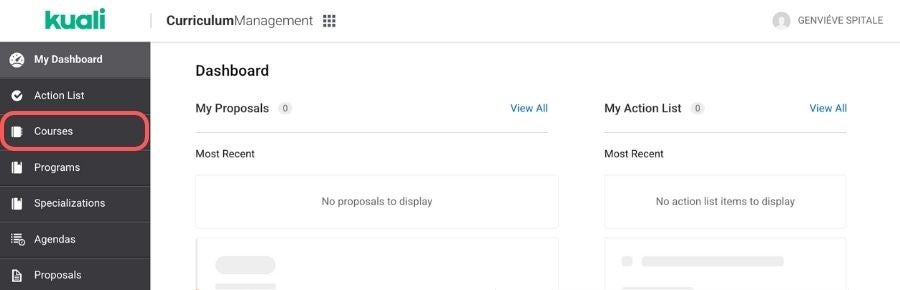
- In your Kuali Dashboard, select Courses from the left-hand menu.
- Search for the course
In the search bar, type the course title or code (e.g. Introduction to Music or MUS101) - Open the course
Click anywhere on the row with the course title - Propose changes
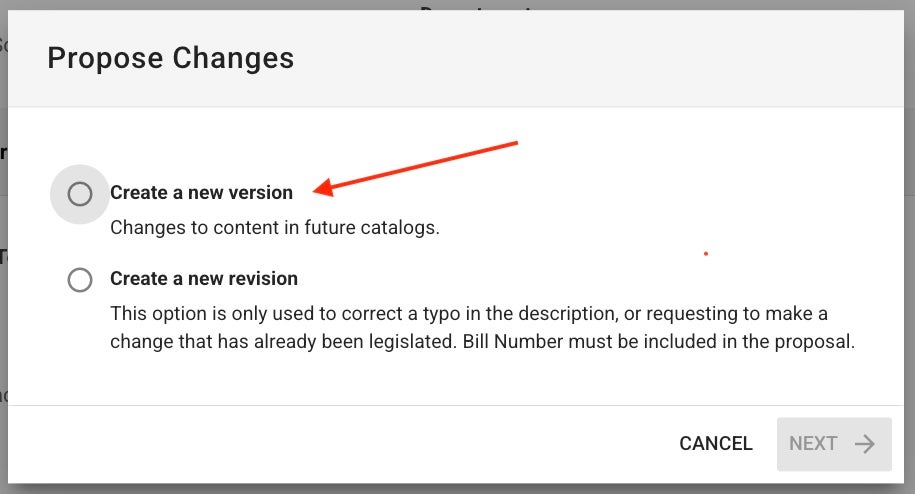
On the course page, select Propose Changes from the right-hand menu - Create a new version
In the pop-up window, choose Create a new version, then click Next.
**If you are unable to select “Create a new version”, please contact Genviéve Spitale by email or phone to correct the issue.
- Working on a proposal
Once you start a proposal form, it’s automatically saved as a draft while you work. No need to finish in one sitting. - Saving your work
Your changes save automatically, so you can exit Kuali or navigate to other items at any time. - Accessing your draft
Find drafts and submitted proposals in your Kuali Dashboard, or go to Proposals in the left-hand menu and filter by My Proposals.
Completing the Proposal Form
This section explains each part of the proposal form and highlights sections that may need extra attention. Some panels will only appear based on your selections.
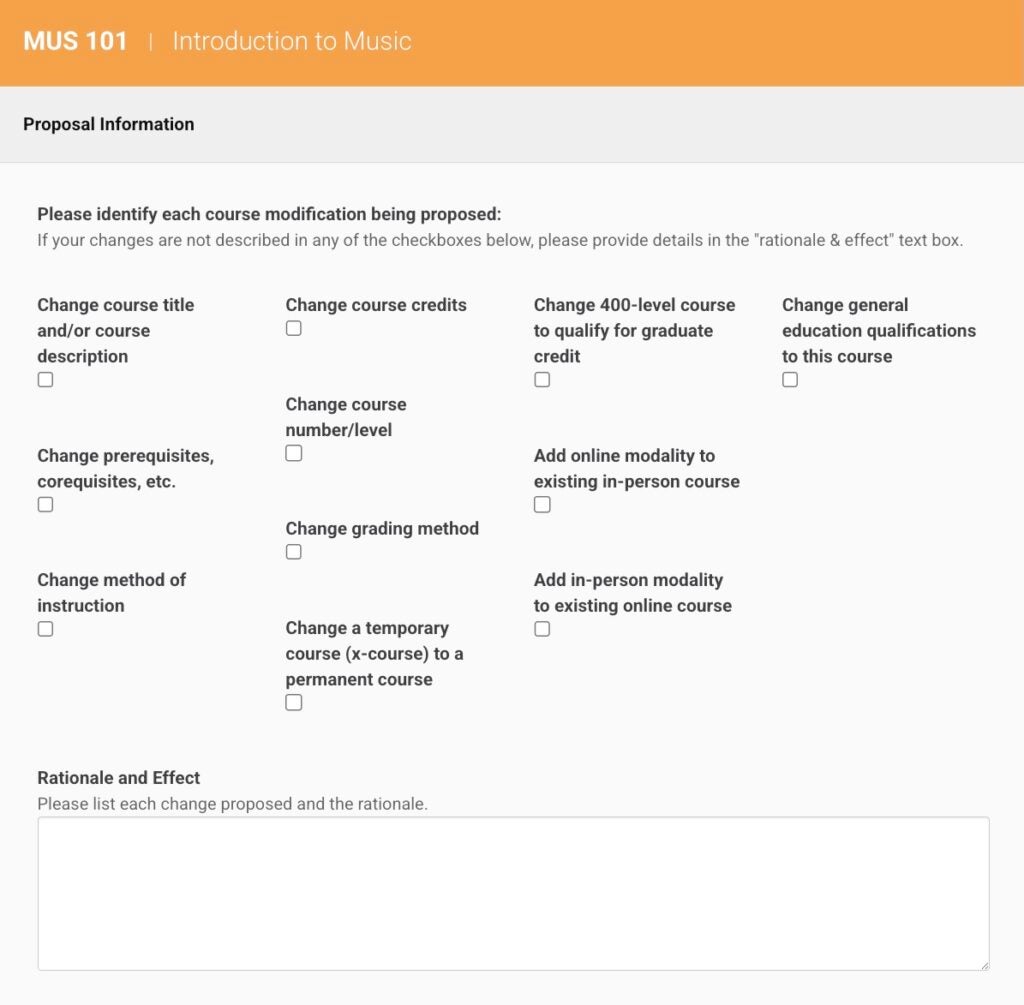
Proposal Information Panel
- Select Changes
Check the boxes for the changes you’re making - Explain Changes
Use the text box to describe the purpose of your changes and any additional changes not covered by the check boxes.
General Information Panel
- Enter your name and email
- Confirm the course’s correct college and department
- If “Invalid ID” appears, delete it and enter the correct department
Course Information Panel
- Effective Term & Year: Check the Dates & Deadlines page to ensure your proposal meets the timeline for your intended start term.
- Academic Career:
- Adding a version of the course in another academic career? Keep the original career, you can’t select two.
- Moving the course entirely to another career? Select the new career.
- *Tip* Clearly explain your intent in the Rationale; mistakes can be fixed if your explanation is clear.
- Catalog-ready Course Description: URI’s course descriptions have specific requirements. See Anatomy of a Course Description for details
Scheduling Information Panel
- Cross-listed Courses: Review the Cross-listed Course Breakdown for guidance
- All cross-listings share one parent course code (the only one with a Kuali profile).
- All other cross-listings appear in this section and in the description
- This does not limit student registration – students can register using any listed code
- Can this course be repeated for credit? If yes…
- Set the maximum number of times the course can be taken (must be 2 or more)
- Specify if the course can be repeated within the same term
- Enter the maximum number of credits allowed
- Credits: Choose whether the course has fixed or variable credits, then enter the appropriate number(s)
- Primary Method of Instruction: Specify the primary method(s) of instruction
- If the course is offered as both a lecture and and online course, both would be listed under primary method of instruction.
- Secondary Method of Instruction: Specify the secondary method of instruction
- If this 3-credit course is listed as both a lecture (for 2 credits) and a lab (for 1 credit), please indicate the second method of instruction in this section.
- Contact Hours: Enter 15 hours per credit for each method of instruction.
Requirements for Enrollment Panel
- Prerequisites and Corequisites (Rule Sets): Ignore this, we don’t use these yet, however we may in the future
- Other Prerequisites: Clearly list all prerequisites, corequisites, antirequisites, and any related course requirements
Online Course Preparation Panel
- Is your name on URI’s Qualified Online Instructor list? All faculty preparing to teach an online course must be qualified. The list of qualified online instructors, as well as information regarding the paths to becoming an online instructor can be found here: URI Online Faculty Resources
General Education Learning Outcomes Panel
If you are adding general education outcomes to an existing course, or making changes to the current outcomes, you will need to complete the corresponding rubrics. More information regarding the general education outcomes and rubric requirements can be found here: Rubrics & Proposal Templates.
Syllabus and Staffing Panel
- Staffing plans: If the instructor is known, it’s helpful for the review committees to know who to direct questions to.
- Syllabus: Upload a course-ready syllabus
Submitting to the Workflow
- Leave Edit Mode
Click in the top-right corner - Submit for Approval
Click in the top-right corner