
Angela Slitt, professor and chair of the Department of Biomedical and Pharmaceutical Sciences, and Fabian Fischer, assistant professor in the Department of Biomedical and Pharmaceutical Sciences, study how PFAS (per- and polyfluoroalkyl substances), often called “forever chemicals,” affect human health.
While PFAS contamination is often discussed in the context of environmental and water systems, Slitt and Fischer’s research focuses on how these persistent chemicals accumulate in the body, how they interact with biological systems and how exposure may be reduced. Their interdisciplinary research program grew from more than a decade of collaboration with Rainer Lohmann, professor in the Graduate School of Oceanography and director of the NIH-funded Sources, Transport, Exposure and Effects of PFAS Superfund Research Center. Their teams have brought together trainees from oceanography and pharmacy to address complex issues surrounding PFAS.
“Together, these projects aim to advance scientific understanding of PFAS while identifying practical approaches to reduce exposure and protect human health.”Angela Slitt, Ph.D., and Fabian C. Fischer, Ph.D.
PFAS enter the environment through industrial processes, consumer products and contaminated water systems, eventually moving through ecosystems and reaching people through multiple exposure pathways. Understanding what happens after these chemicals enter the human body is a central focus of the team’s work.
A recently accepted study from their laboratories analyzed 54 PFAS compounds in 211 human liver samples collected in the United States between 2000 and 2024. PFAS were detected in nearly every sample. The study found that overall PFAS concentrations declined substantially over time following regulatory phaseouts of several legacy compounds, demonstrating that policy actions can reduce human exposure. However, the research also showed that newer and less-regulated PFAS are increasingly contributing to the body’s overall chemical burden.
The research team is also investigating the biological mechanisms that allow PFAS to accumulate in the body. A recently funded NIH R01 grant examines how PFAS bind to albumin, a key blood protein that may play a major role in PFAS transport and retention.
Beyond understanding these mechanisms, Slitt, Fischer and collaborators are working to identify strategies to reduce PFAS levels in exposed populations. Through a Department of Defense clinical trial, the team is testing whether the FDA-approved medication colesevelam can help eliminate PFAS from the body by binding these chemicals in the intestine and preventing their reabsorption.
Additional studies focus on veterans, including research examining potential links between PFAS exposure, thyroid cancer and metabolic liver disease. Together, these projects aim to advance scientific understanding of PFAS while identifying practical approaches to reduce exposure and protect human health.
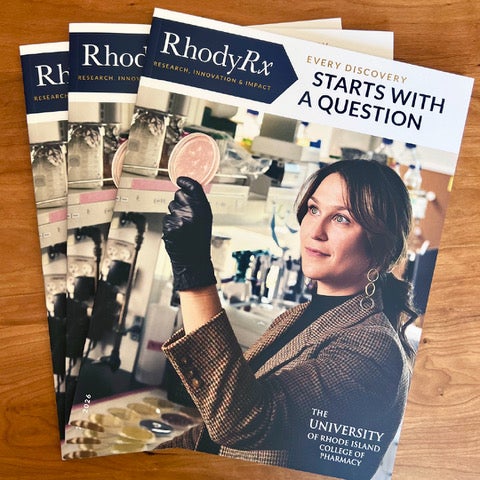
RhodyRx – Research, Innovation & Impact
We have some exciting news… the newest issue of RhodyRx is here!
VIew the Full report