
Whenever a patient presents with a bacterial gastrointestinal illness, the common response is to prescribe an antibiotic that kills the disease-causing bacteria, allowing the patient to recover. While effective, they often eliminate not only harmful bacteria but also beneficial microbes that support digestion and overall health.
Amanda Alker, Ph.D., assistant professor at the University of Rhode Island, is working to change that approach. Her research focuses on developing targeted microbiome-editing technologies that selectively modify harmful bacteria while preserving beneficial ones.
“Antibiotics indiscriminately kill the bacteria in your gut, including those that help us digest our nutrients and protect us,” Alker said. “What if microbiome editing could be used as a targeted therapeutic that reduces the need for antibiotics? The potential is there, but significant foundational work is still needed. We are helping lay the groundwork for a new field.”
“What if microbiome editing could be used as a targeted therapeutic that reduces the need for antibiotics? The potential is there, but significant foundational work is still needed. We are helping lay the groundwork for a new field.”Amanda Alker, Ph.D.
Traditional methods in bacterial genetics typically require removing bacteria from their natural environment to manipulate their DNA. Alker’s research builds on a newer technology known as CRISPR-associated transposons, or CASTs, which enable precise genetic edits directly within microbial communities.
Her lab is working to adapt these tools to target specific bacterial species and genes associated with disease, without disrupting the broader microbiome or relying on antibiotics.
“My work focuses on understanding how bacteria interact with the environment, how they cause disease and how they can also protect against it,” Alker said. “To study that, we often need to modify bacterial DNA to really understand how they function. These technologies allow us to do that within the microbiome itself, which was not possible before because we always had to remove the bacteria from their environment to perform these kinds of manipulations. We’re excited to bring microbiome editing to different disease systems for the first time.”
Beyond human health, Alker’s research has applications for environmental and agricultural systems, including Rhode Island’s growing blue economy.
One example involves oysters, a valuable regional food source that can sometimes harbor Vibrio bacteria, which may cause gastrointestinal illness, particularly in warmer months. Because antibiotic use is not a viable option in aquaculture due to concerns about resistance, Alker’s lab is developing DNA-based tools that can selectively target harmful bacteria while preserving the surrounding microbial ecosystem.
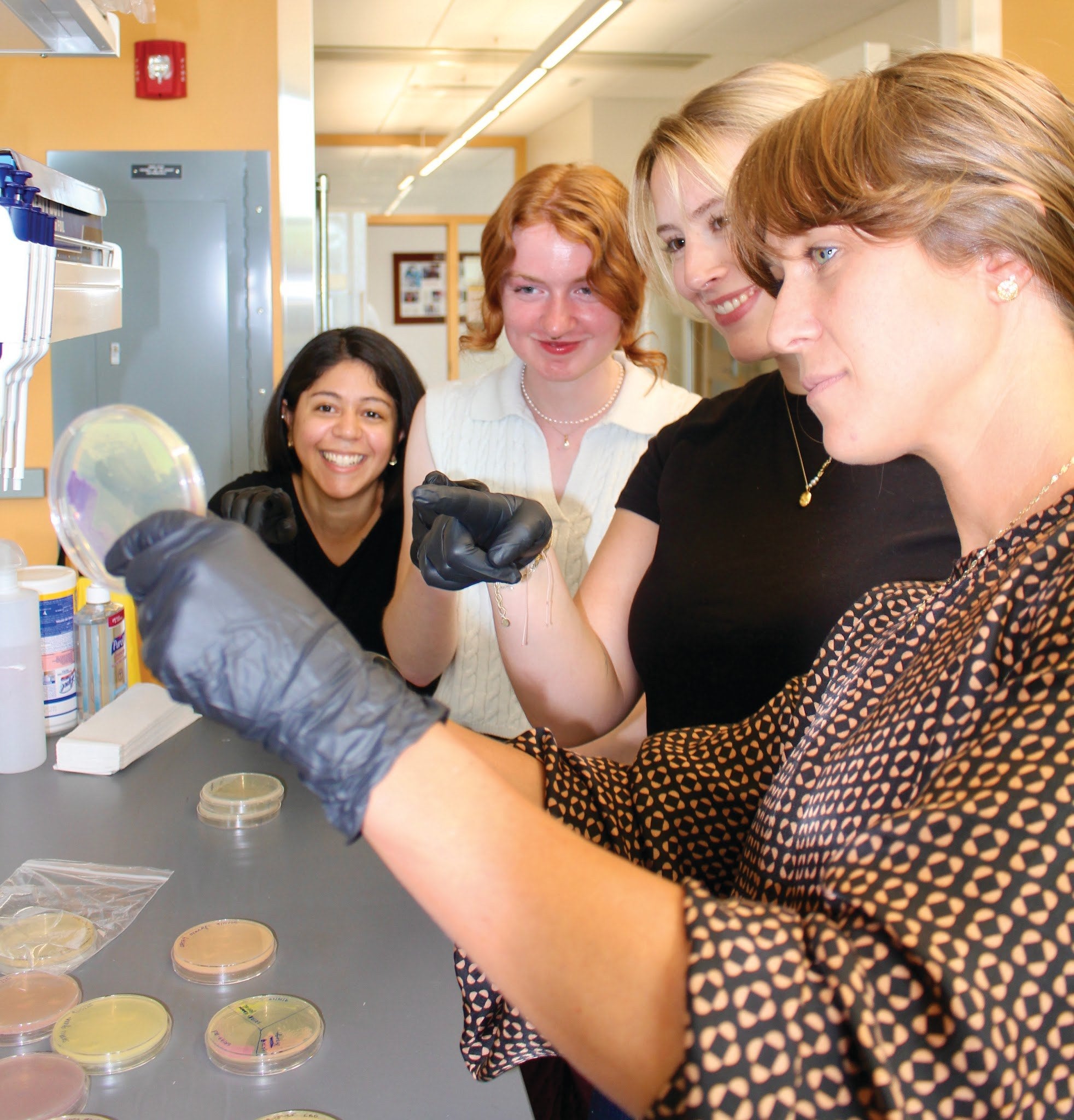
Using controlled aquaculture systems, her team is testing whether these genetic tools can be delivered through water, taking advantage of oysters’ natural filter-feeding behavior. As oysters filter water, they can ingest the gene-editing tools, which are designed to disrupt harmful bacterial DNA without affecting beneficial microbes.
“What if we could intervene so people don’t get sick from eating oysters?” Alker said. “We are using this as a proof of concept to show that microbiome editing could become a powerful way to prevent and control disease.”
If successful, this approach could extend far beyond aquaculture, offering new strategies to treat infections, reduce antibiotic use and better manage microbial ecosystems.
“We are developing genetic tools tailored to specific bacteria,” Alker said. “Once we demonstrate that this system works, the possibilities are extensive.”
RhodyRx – Research, Innovation & Impact
We have some exciting news… the newest issue of RhodyRx is here!
VIew the Full report