
Scientists around the world are exploring natural environments in search of novel treatments for drug-resistant infections. At the University of Rhode Island, Bailey Miller, Ph.D., assistant professor, is investigating marine symbiotic bacteria as a promising source of new therapeutics.
Symbionts are organisms that live closely with another organism, often in a mutually beneficial relationship. Miller’s research focuses on wood-eating marine shipworms, bivalve mollusks similar to clams, and the bacteria that live within them.
These bacteria produce a wide range of chemical compounds, known as secondary metabolites, that may have potential as new drugs.
Before joining URI, Miller discovered a new class of molecules called turnercyclamycins while working in the lab of Eric Schmidt at the University of Utah. These compounds have demonstrated strong activity against gram-negative bacteria, including Acinetobacter baumannii, a highly resistant pathogen associated with serious infections in wounds, the bloodstream, the urinary tract and the lungs.
“Acinetobacter baumannii is a lethal infection that develops resistance very easily and is very hard to kill,” said Miller. “We identified a compound produced by these symbionts that can effectively kill it. It works in animal models, not just in petri dishes, which makes it especially promising.”
“Maybe we can produce a valuable antibiotic, and the main feedstock going into it is paper waste or corn husks.”Bailey Miller, Ph.D.
Miller harvests marine shipworms from driftwood found in the ocean, including from the nets of a fishing boat in Narragansett Bay. The mollusks bore into the wood to create a den, eating the cellulose in the wood, which their symbiotic bacteria help them digest. Those bacteria produce multiple metabolites including turnercyclamycins, for which Miller holds a federal patent as a co-creator.
In his laboratory, Miller and his team of graduate and undergraduate students are working to identify and genetically engineer the bacterial strains harvested from the mollusks’ gills. Through genomic analysis, they have identified numerous genes that encode the enzymes necessary to produce potentially new antibiotics.
Their research focuses on activating these genes to increase production and better understand their biological activity.
“The more we sequence these genomes, the more potential we uncover,” Miller said. “There are hundreds of biosynthetic gene clusters that may produce new compounds. By using genetic engineering to activate them, we can explore whether they have antibiotic, anticancer or anti-inflammatory properties. We’re looking to leverage biodiversity to find new drugs, and trying to expand that research into new avenues.”
In addition to drug discovery, Miller’s work may also contribute to sustainable biotechnology. His research has shown that these bacteria can grow on waste materials such as paper, breaking down cellulose in the process. This approach could help convert waste into valuable products, such as new antibiotics.
“It’s an example of green biotechnology,” Miller said. “We may be able to produce valuable compounds using waste materials like paper or agricultural byproducts as the primary input.” At the core of Miller’s research is a broader question about the role of chemistry in biological systems. “I’m interested in understanding how chemical interactions shape relationships between bacteria and their hosts,” Miller said. “At the same time, we are exploring how to harness those interactions for drug discovery.”
By studying marine symbiosis and leveraging biodiversity, Miller’s work is helping to uncover new pathways for developing treatments against some of the most challenging infections.
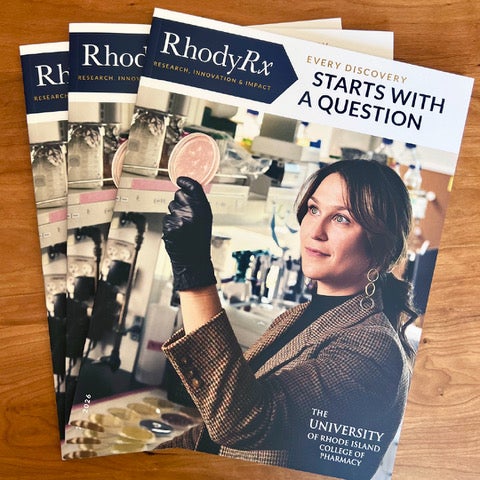
RhodyRx – Research, Innovation & Impact
We have some exciting news… the newest issue of RhodyRx is here!
VIew the Full report