
Why certain parts of the brain are more vulnerable to aging and disease remains one of the most important questions in neuroscience. At the University of Rhode Island College of Pharmacy, Merina Varghese, assistant professor of biomedical and pharmaceutical sciences and George and Anne Ryan Institute for Neuroscience faculty member, is investigating the cellular and molecular mechanisms that make specific brain regions more susceptible to neurodegenerative and neuropsychiatric disorders.
Varghese’s research focuses on how the molecular features and physical structure of cells influence the development of diseases such as Alzheimer’s disease. Her work examines how different cell types, cellular states, and surrounding microenvironments interact to drive regional vulnerability within the brain.
To answer these questions, Varghese uses advanced spatial imaging technologies that allow researchers to visualize proteins and metabolites directly within brain tissue. These tools provide an unprecedented view of how molecular activity varies across different brain regions and how these patterns change during aging or disease.
By combining disease biology with spatial molecular mapping, her research aims to identify biomarkers that could help detect neurological diseases earlier and uncover new therapeutic targets that may slow or prevent disease progression.
“By uncovering why certain neurons are more vulnerable than others, her research aims to provide new insights into the biological pathways that drive neurodegeneration and ultimately guide the development of more targeted therapies.”Merina Varghese, Ph.D.
Varghese joined the URI College of Pharmacy in January 2025. Before joining URI, she served as an assistant professor in the Nash Family Department of Neuroscience and the Ronald M. Loeb Center for Alzheimer’s Disease at the Icahn School of Medicine at Mount Sinai.
During her postdoctoral training at Mount Sinai, she investigated metabolic and synaptic changes that contribute to regional brain vulnerability in neurodegenerative disease. Using transgenic rodent models and human postmortem brain tissue, her research explored mechanisms underlying Alzheimer’s disease, amyotrophic lateral sclerosis (ALS, or Lou Gehrig’s disease), and neurodevelopmental disorders such as Phelan-McDermid syndrome.
Her studies also examined human brain samples from individuals with Alzheimer’s disease, Prader-Willi syndrome and epilepsy, helping reveal how molecular changes within neurons contribute to disease progression.
At URI, Varghese continues to expand this work by integrating molecular neuroscience, advanced imaging and systems biology approaches to better understand the earliest changes that occur in the brain during disease.
By uncovering why certain neurons are more vulnerable than others, her research aims to provide new insights into the biological pathways that drive neurodegeneration and ultimately guide the development of more targeted therapies for Alzheimer’s disease and related disorders.
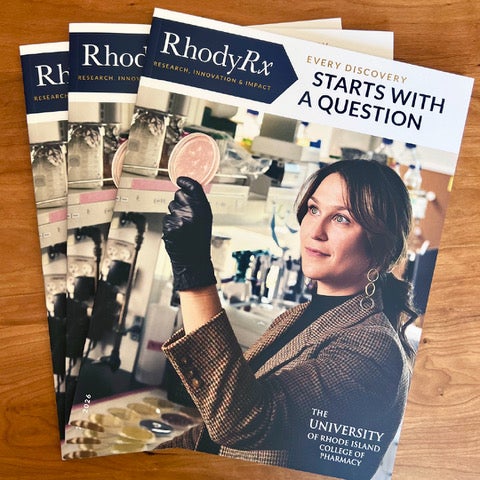
RhodyRx – Research, Innovation & Impact
We have some exciting news… the newest issue of RhodyRx is here!
VIew the Full report