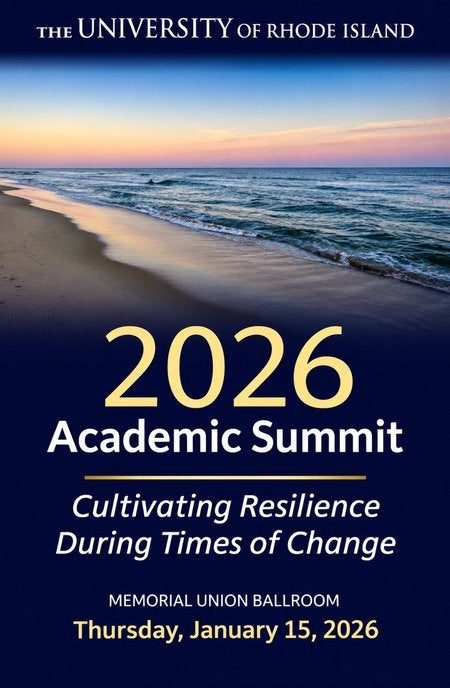
SAVE the DATE – Thursday, January 14th, 2027
2027 Academic Summit: Navigating Change While Cultivating Hope
Higher education is navigating a period of profound change, uncertainty, and opportunity. The 2027 Academic Summit will invite the URI community to consider not only how universities respond to change, but how imagination, hope, and purposeful action can help shape what comes next.
Through a keynote address from Kevin Gannon, facilitated conversations, URI-led panels, and practical sessions, participants will explore how hopeful thinking can translate into meaningful action across teaching and learning, student success, leadership, research, organizational culture, innovation, and the broader work of the University.

2027 Academic Summit: Schedule
| 8:15 – 9:00 | Registration and Breakfast – Memorial Union Ballroom | |
| 9:00 – 9:45 | Welcome — Why Imagination and Hope, Why Now? President Parlange and Provost Wolfe | |
| 9:45 – 9:55 | Break | |
| 9:55 – 11:00 | Keynote: Clearing A Path: Navigating Change while Cultivating Hope Kevin Gannon (The Tattooed Professor) | |
| 11:00 – 11:10 | Break | |
| 11:10 – 11:45 | Guided Table Conversations & Reflections | |
| 11:45 – 12:45 | Lunch & Networking | |
| 12:45 – 1:00 | Break | |
| 1:00 – 2:15 Concurrent Sessions | Breakout Session 1 – Humans Teaching Humans: A Critical Reflection Tool for Cultivating Classroom Agency Breakout Session 2 – Strengthening Colleagueship: The Long View Breakout Session 3 – Listening to Pushback: What Hesitation Can Teach Us | |
| 2:15 – 2:45 | Community Gathering Time | |
Keynote
Kevin Gannon is Director of the Center for the Advancement of Faculty Excellence (CAFÉ) and Professor of History at Queens University of Charlotte, North Carolina. He spent nearly 25 years as a faculty member, serving as a program coordinator and department chair along the way, until moving full-time into faculty development. He is the author of Radical Hope: A Teaching Manifesto (West Virginia University Press, 2020), and the co-editor of The Campus Crisis Toolkit: Strategies and Solidarity for the Rest of Us (SUNY Press, 2026). His writing has appeared in outlets such as Vox, CNN, and The Washington Post, and he has been a regular contributor to The Chronicle of Higher Education. Even in an administrative role, Kevin continues to work with first-year students (a particular passion of his) by teaching sections of Queens’ new student seminar course, the Queens Roadmap, every fall semester.
Clearing A Path: Navigating Change while Cultivating Hope
There are two ways to read the title of this session, and both are correct. Hopefully, we can navigate this new landscape upon which we find ourselves. And we can navigate that landscape with Hope as our guiding principle. Hope in higher education might seem difficult to come by in our particular moment, as we’ve been rocked by repeated body-blows: funding shortfalls, a pandemic, a fraught socio-political context, the rise of generative AI and its challenge to ways of learning and knowing…it’s a tough list, and it goes on. And yet—hope is the most essential when it feels the most tenuous. This talk will explore how Hope as a foundational ethic can shape not just our teaching, but how we show up for ourselves, and our colleagues and students. Drawing upon insights from cognitive psychology, critical pedagogy, and the hard-won experiences of both students and teachers, we’ll examine how we can make Hope not simply an idea or slogan, but an actual and durable practice. In the process, we’ll have the opportunity to re-connect with our own senses of vocation and agency, and formulate strategies for putting them into practice.
Breakout Sessions
Session 1 – “Humans Teaching Humans: A Critical Reflection Tool for Cultivating Classroom Agency”
Reflection
with Keynote Kevin Gannon
This interactive session models the critically reflective practices that can help us and our students foster the trust and confidence necessary for meaningful learning. Participants will have the opportunity to engage in a set of guided reflections and small discussions which can easily be adapted for use with students. Our goal will be to not only add a potentially transformative teaching tool to our pedagogical toolboxes, but to reconnect with and re-center our own vocational purpose and the common humanity we share with one another, even as we make our way through uncertainty and change.
Session 2 – Strengthening Colleagueship: The Long View
Panelists
Leonard M. Kahn – Department of Physics
Marc Hutchison – Department of Political Science
Cheryl Foster – Department of Political Science
URI has weathered hard seasons before, and the people who lived through them are still part of our community. In this session, seasoned faculty share an honest conversation about what kept them going through difficult stretches, including the times when the way forward was hard to see. Their stories offer perspective on how colleagues and communities come through uncertainty, and on the everyday interactions and shared practices that build support, belonging, and collaboration. Participants will reflect on why people stay, what sustains them, and how faculty, staff, and academic leaders can create conditions in which people and their work can thrive.
Session 3 – Listening to Pushback: What Hesitation Can Teach Us
Panelists
Travis D. Williams – Department of English and Creative Writing
Sue K. Adams – Provost Office & Department of Human Development and Family Science
Amy Broemmel – Feinstein College of Education
When change is on the table, pushback is often treated as something to overcome. This session offers a different view: resistance is often a form of care. When colleagues hesitate, they’re frequently protecting something that matters to them, such as students, the quality of their work, or one another. Treating those concerns as valuable information rather than obstacles opens the door to better decisions and stronger working relationships. Participants will explore how to listen for what pushback is really saying, how to bring hesitant voices into the conversation, and how understanding resistance can make change efforts more thoughtful, more inclusive, and more likely to last.