
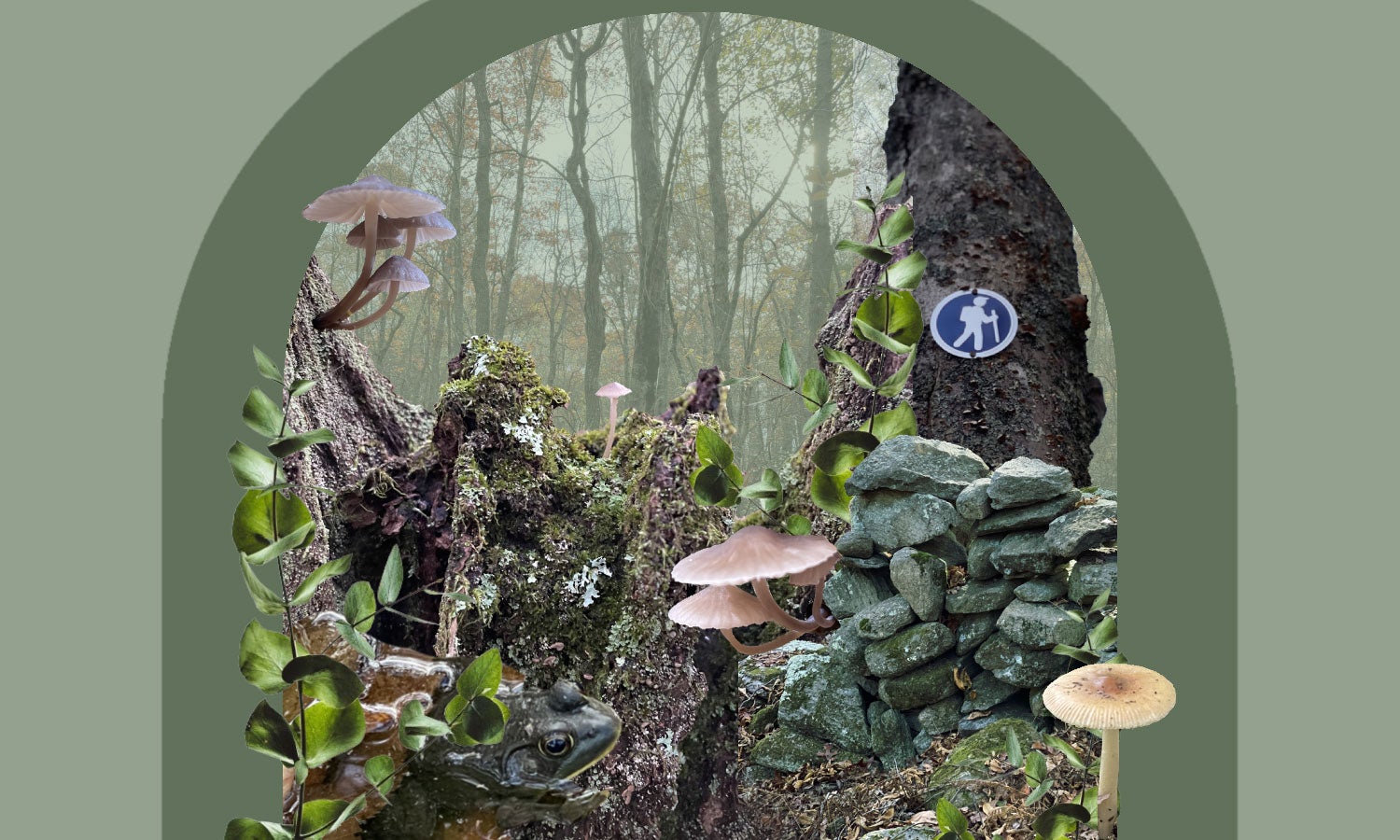
KINGSTON, R.I. – July 21 – The landscape of the North Woods has been shaped by humans, just as humans are shaped by the landscapes in which we inhabit. Nestled in South Kingston as part of the University of Rhode Island’s Kingston Campus, the North Woods are within walking distance of all dorms for students to explore, and many classes take advantage of North Woods as a living laboratory and experiential learning destination.
Stephanie West-Puckett, associate professor of professional and public writing, is leading a project to develop the first edition of the North Woods Field Guide, a DWELL Lab project that brings together scientific and creative perspectives to celebrate URI’s North Woods. With the help of Madison Jones, associate professor of science communication, and Rhode Island School of Design (RISD) student and SURF fellow, Ellie Lin, the guide will be a collection of science and technical writing, creative writing, and journalistic writing that cover animals, vegetation, flowers, minerals, and other elements of the woods.
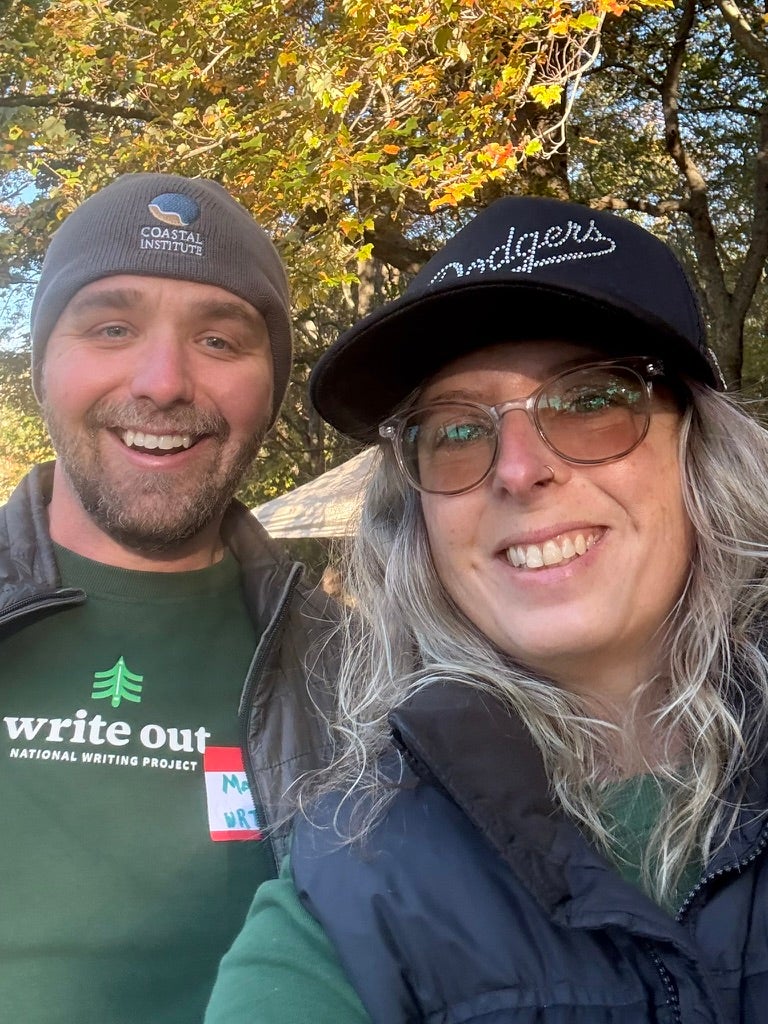
The project is backed by a Rita Allen Civic Science Media Grant that funds the project’s public-facing science communication work, specifically the model of pairing journalists with academics and scientists. Bonnie Phillips from Eco RI News is the designated journalism collaborator, as part of the grant’s requirement for journalist-academic partnership.
“Bonnie brings a deep knowledge of environmental issues and advocacy in Rhode Island. She helped us to plan, organize, document, and publicize events that connected with public interest. She has also written two features on the North Woods that were published in EcoRI News. These will also be included in the field guide,” says West-Puckett.
Other contributors to the field guide range from natural resource sciences (NRS) graduate students, URI undergraduate students, third and fourth graders from The Compass School, RISD and CCRI students, and 4-H south County Groups in coordination with Christina DiCenzo, professor Tolani Olagundoye, and wetland specialist professor Michelle Peach.
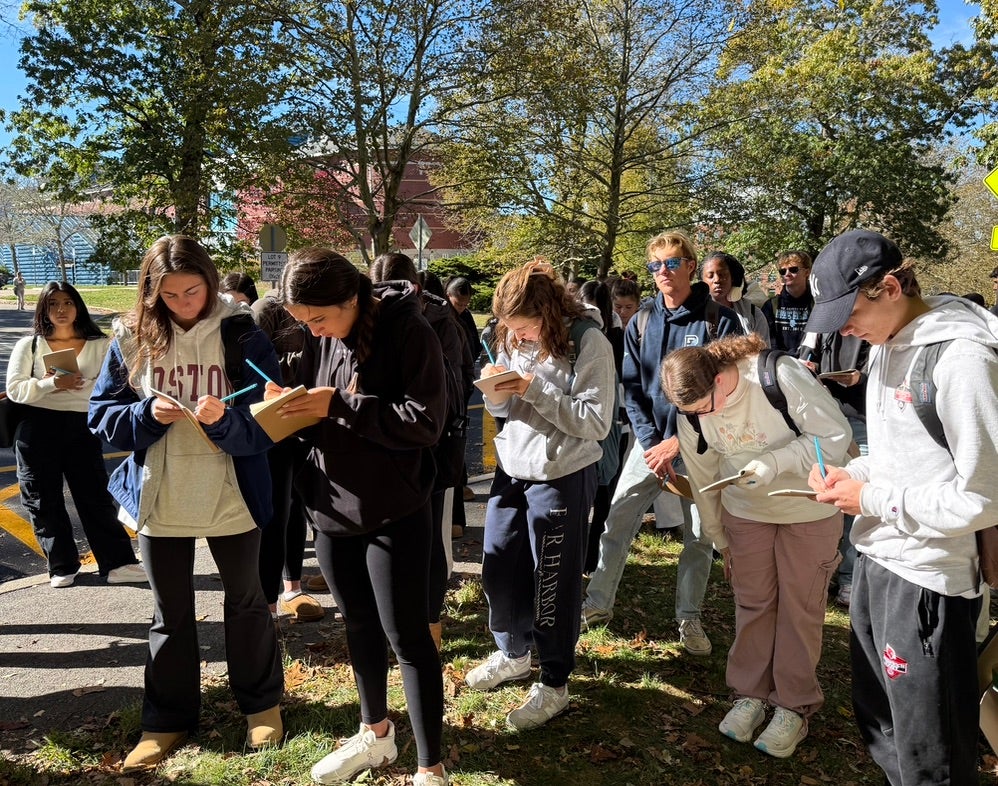
The project evolved from the ongoing work that DWELL Lab has been doing with The North Woods Project, including the WriteOut event held each October (this will be the 10th celebration of National Day on Writing), during which Jones and West-Puckett began discussing ways to publish student work and deepen connections between writing and ecological thinking. Inspired by the Cascadia Field Guide model (blending art and poetry with place-based and ecological writing) the team expanded the concept to also incorporate journalistic and scientific writing.
The project operates under the concept of “deep mapping*” which places multiple, sometimes incommensurable ways of knowing a place (indigenous history, colonial history, ecological science, creative writing) side by side without forcing synthesis. North Woods is positioned as a microcosm of broader conservation themes such as stone walls, colonial settlements, Narragansett history, and contemporary environmental disturbance are all observable.
“There’s a perceived deficit on part of the writers and scientists; the idea is often that scientists are poor communicators, and writers are unable to engage with science. This field guide is designed to break those preconceived notions and provide a variety of ideas of how science can be communicated to a broader audience,” says Jones.
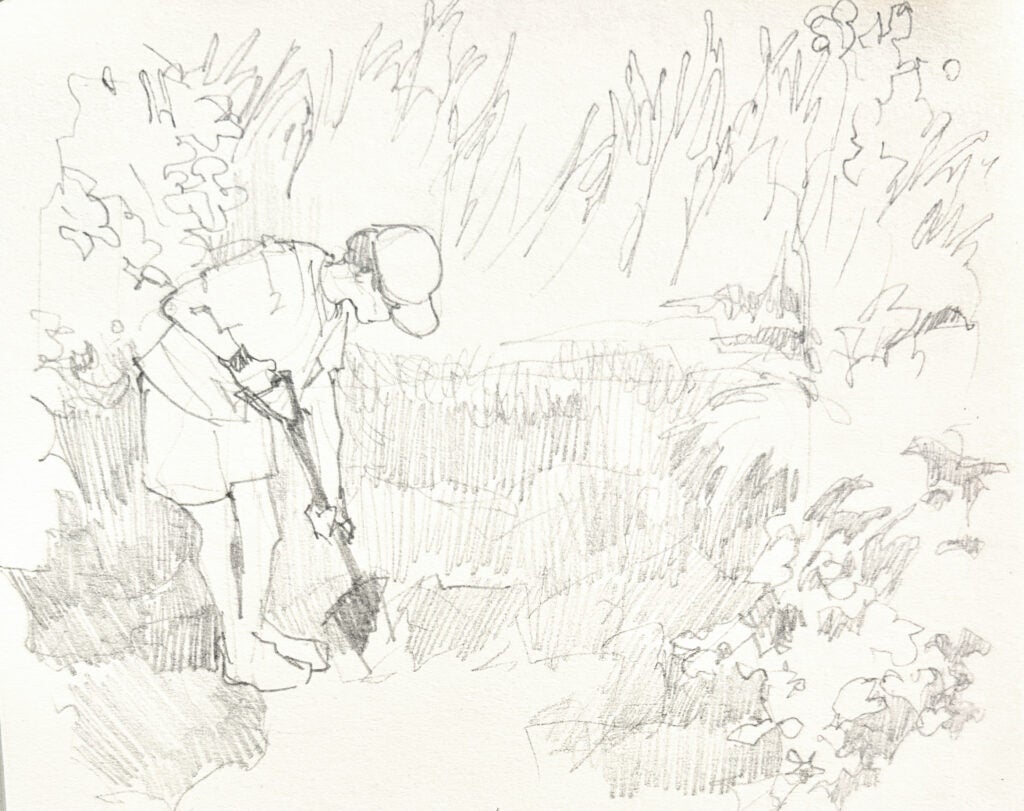
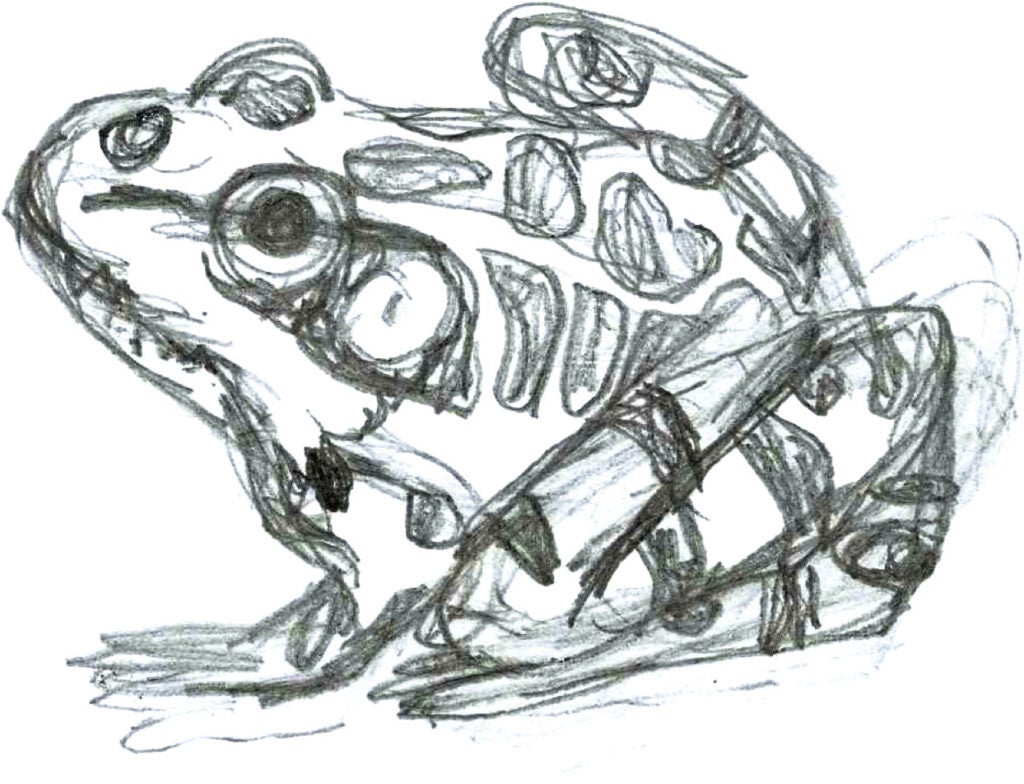
Ellie Lin, an ascending senior at RISD majoring in illustration with a concentration in Nature-Culture-Sustainability Studies, joined the team as an RI NSF EPSCoR’s Summer Undergraduate Research Fellow (SURF). Lin has been working closely with West-Puckett and Jones as a science illustrator and a community/researcher outreach coordinator. Through her work, she has engaged with natural resource science students to contribute research and visualization and entries on topics like bobcat tracking, stone wall ecology, and wetland ecology.
In addition, two Digital Writing and Research Studio students – Brissia Rodriguez ‘29 and Calder Puckett ‘26 – with expertise in Adobe Creative Suite collaborated with Lin on the field guide’s visual concepts such as font, color, and layout. Ultimately, their goal is to establish an interactive design for both the print and digital versions of the guide.
This summer Lin also led a free North Woods Art and Writing Workshop on Sunday, June 28 hosted by the Department of Professional and Public Writing and the DWELL Lab. The event included field sketching, journaling, and place-based making in the North Woods to seam together engagement and content generation for the field guide.
“The Workshop was excellent. It was great to see the cross-pollination and the sense of wonder and curiosity students from URI, CCRI, and RISD brought to the North Woods,” says West-Puckett.
Ultimately, the common thread through all the contributions and areas of interest is to bring forth important ideas about connecting with the wildlife in our own backyards. And more importantly, how our own living habits impact them. The North Woods Field Guide is a means to connect the community and archive a variety of perspectives and experiences with the natural world. Further, it provides an excellent example of the interdisciplinary culture that is encouraged at URI.
The first edition of the North Woods Field Guide is anticipated this fall, available as a physical book and as an e-book. The long-term vision includes a robust anthology available on campus, along with ongoing online content with periodic formal print volumes.
If you are interested in contributing or participating in future field guide workshops and projects, please contact Stephanie West-Puckett at stephwp@uri.edu.
*Shannon Butts and Madison Jones. 2021. Deep mapping for environmental communication design. Commun. Des. Q. Rev 9, 1 (March 2021), 4–19. https://doi.org/10.1145/3437000.3437001
OTHER CONTRIBUTORS
Quest Lab – Dr. Kathleen Carroll (https://connectivityandconservation.com/)
Bobcat research – Christopher Hickling
Small Mammals – Ashley Olah
Stone Walls Ecology – Madalyn Stoltz
Stone Walls Mapping – Elliot Vosburgh
Teaching/Outdoor Classes, Field Botany – Nathan Lambstrom
Teaching/Outdoor Classes, Soil Science/Soil Pits in North Woods – Joe Manetta