
For many homeowners, septic systems are largely invisible infrastructure. But their effectiveness depends on a careful evaluation of the soil beneath them, which determines whether wastewater is safely treated or if pollutants reach groundwater and nearby ecosystems.
With nearly half of New England homes relying on septic systems, the ability to understand and interpret those underground conditions is essential.
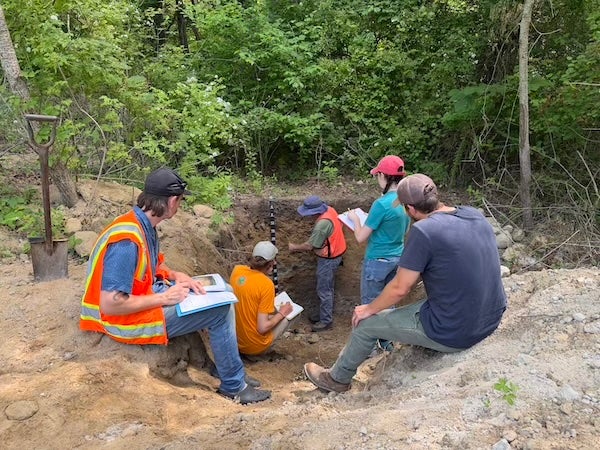
Professionals from across New England recently gathered at URI’s East Farm and Peckham Farm for a hands-on workshop hosted through a collaboration between the Society of Soil Scientists of Southern New England (SSSSNE) and URI Cooperative Extension’s New England Onsite Wastewater Training Program (NEOWTP), bringing together soil scientists, consultants, and state and federal employees, students, and alumni.
Since 1993, NEOWTP has trained thousands of designers, installers, inspectors, and other wastewater professionals, helping ensure the latest advances in wastewater treatment reach the people responsible for protecting public and environmental health.
“There’s no better way to learn about a landscape than by looking at the soils. Workshops like these where we connect students and professionals from different backgrounds to advance soil science are vital to URI’s land-grant mission,” says Joe Manetta ’21 M.S. ’23, a research associate in URI’s Department of Natural Resources Science and secretary of SSSSNE.
Reading soil
By studying soil pits — deep excavations that reveal layers of the earth — participants learned to read the hidden record beneath their feet. The color, texture, structure, and composition of soil reveal how a landscape formed, how water moves through it, and whether it can safely treat wastewater.
Unlike plants or changing surface conditions, soil preserves a long-term record of the landscape. “Soil tells an amazing story. You can see so much history,” said Brett Still, clinical associate professor in URI’s Department of Natural Resources Science.
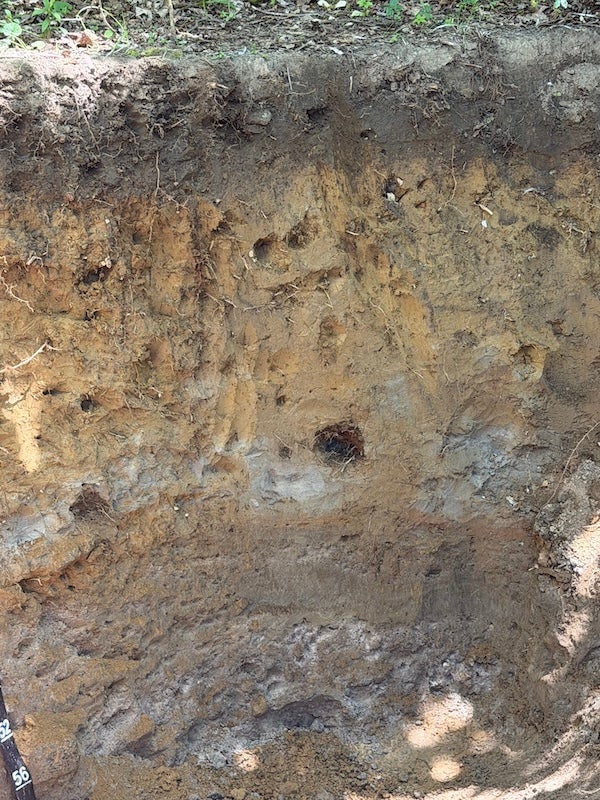
Soil characteristics can change dramatically over short distances. The dense soils at URI’s East Farm, for example, hold water close to the surface and are unsuitable for conventional septic systems, requiring alternative designs. At Peckham Farm, just a few miles away, the soils are much coarser and better drained.
“Those characteristics are dramatically different, and we’ve driven just a few miles,” Still said. “It’s important for working professionals to recognize these differences in the field, make accurate soil descriptions, and guide the correct type of system that should be placed in these areas.”
Alissa Cox, director of the NEOWTP, said soil evaluators may not be the ones designing a system, but their interpretation — and how they communicate risk — plays a critical role in shaping those designs, especially as rising groundwater, flood risk, and other changing conditions create new challenges not fully captured in current regulations.
Those decisions can have consequences that extend beyond an individual property. In densely developed or coastal areas, septic system failures can affect neighboring properties and increase the potential for human exposure, making soil evaluation an important component of public health. Instructors emphasized that a soil evaluation is not simply a descriptive task, but a way to anticipate how site conditions, climate pressures, and landscape context may influence system performance over time.
Jennifer Grandin, program coordinator of the NEOWTP, shared, “Our goal was to encourage soil evaluators to recognize their influence on the design of septic systems. We need to focus beyond regulatory compliance, toward resilience.”
Ultimately, that expertise helps ensure onsite wastewater systems are designed to function effectively over time, protecting groundwater quality and reducing the risk of environmental contamination.
“Soil never lies”
The workshop also highlighted URI Cooperative Extension’s role in translating university research into practical solutions for communities.
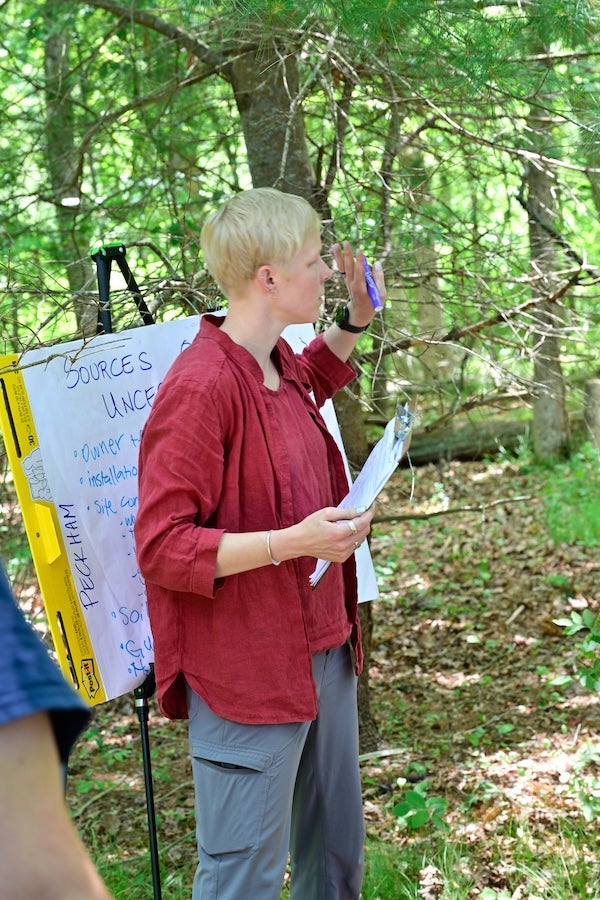
“With development increasingly taking place on constrained sites, where the easier locations have already been built, understanding risk and context, and communicating that effectively, is more important than ever,” says Cox.
The collaboration reflects a decades-long relationship through which SSSSNE has supported student training, professional development, and soil science certification alongside URI and other land-grant institutions.
Many of the professionals attending the workshop were former URI students, illustrating the lasting connection between URI’s classrooms and the environmental workforce. The training also gives current students the opportunity to learn how experienced professionals translate soil science into real-world decisions.
Those lessons are rooted in a simple truth: soil provides the information needed to make informed decisions about how we build and protect the landscape.
As Tim Piacentini ’17, M.E.S.M. ’22, an environmental scientist and workshop participant, put it: “Soil never lies.”