
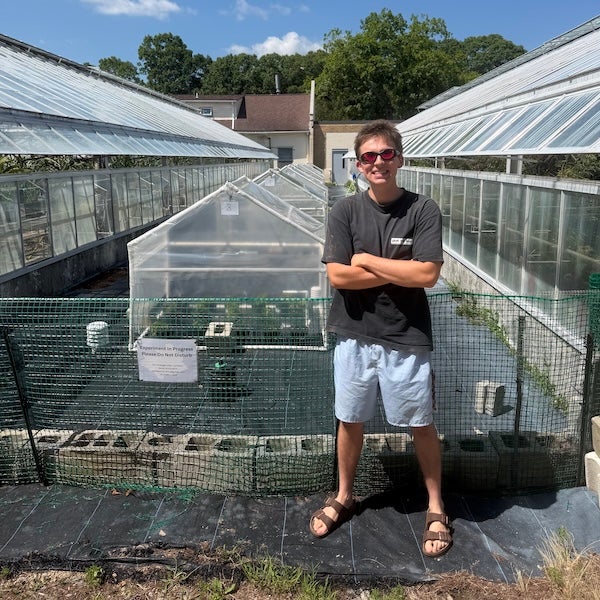
A first-year plant sciences major concentrating in sustainable crop production, with minors in cannabis studies and cell and molecular biology, Noah Antonellis is conducting research through the CELS Summer Fellowship program under the mentorship of Assistant Professor Camilo Villouta. Inspired by a lifelong interest in gardening and sustainable agriculture, Antonellis is investigating whether a specialized infrared-blocking film can keep greenhouses cooler while maintaining healthy plant growth. This summer, he’s monitoring experimental tomato greenhouses, collecting data, and gaining hands-on experience in a research lab. Learn more about his research below!
Q. What are you working on this summer?
A. My research looks at whether a 3M multilayer infrared (IR)-blocking film can reduce daytime heat inside small greenhouse structures. Greenhouses absorb a large amount of the sun’s energy as near-infrared (NIR) radiation, which creates heat but does not help plants grow. The IR-blocking film is designed to reflect this heat while still allowing the light plants need for photosynthesis to pass through. Throughout the experiment, we compare greenhouses using the test film with those using a control film by measuring the air temperature inside and outside each greenhouse, as well as the soil, fruit, and leaf temperatures of the tomato plants and the quality of light inside and outside the greenhouses. At the end of the experiment, we will harvest the tomato plants and evaluate their root structures, leaf photosynthetic rates, and the total weight of the tomatoes collected to determine whether the test film can reduce cooling costs and energy use without affecting plant growth.
What’s the coolest thing you’ve experienced so far?
The answer is definitely becoming comfortable in a lab setting. Before this fellowship, the only lab experience I had came from labs at school, but this opportunity has shown me what real research is like. I’ve loved learning how all of the instruments and equipment work and being part of research that could have real-world implications.
What’s been one of your favorite moments this summer?
My favorite moment was when the greenhouses were finally set up and the data started being recorded. It took about two weeks of work to assemble the greenhouses and configure all of the data loggers, so it was exciting to see everything up and running. Seeing all of our hard work finally pay off made the moment especially rewarding.
How has working with your mentor influenced your experience?
Working with Dr. Villouta has been incredibly rewarding. His knowledge of plant science is extensive, and he has guided me throughout the summer in a way that has allowed me to take ownership of my work while always knowing I have support if I’m unsure how to perform a task. His mentorship has helped me become much more confident working in a research lab.
What has this experience taught you that you couldn’t have learned in a classroom?
Some of the biggest things that come to mind are learning how to use various devices and data collection methods, as well as understanding how to be successful while working in a lab setting. Every day brings something new, and you never know what you will be working on or learning. Knowing that the research and work I am doing is creating a direct positive impact on the environment is extremely fulfilling. It makes the long days feel worthwhile because I know the work I am doing not only allows me to learn something new each day, but also contributes to creating a more sustainable future.