
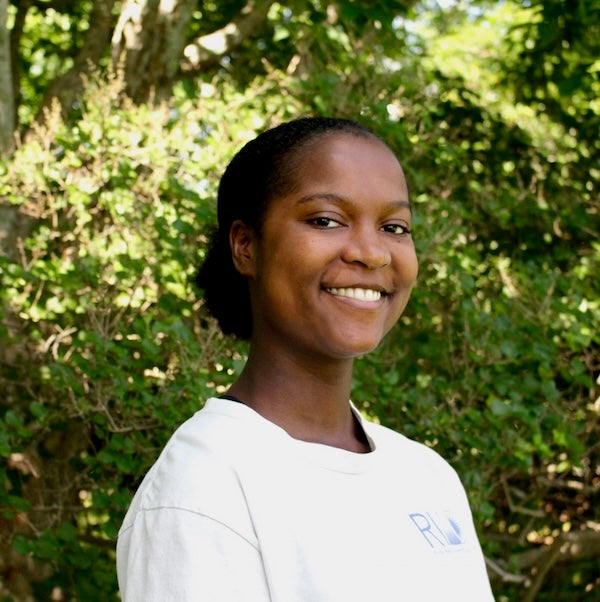
A rising senior double majoring in plant sciences and fine arts, Sharday Johnson is conducting research through the CELS Summer Fellowship program in the Biocontrol Lab. Passionate about insects and sustainable agriculture, she is investigating whether a tiny parasitoid wasp is successfully controlling populations of the tarnished plant bug, a major agricultural pest in Rhode Island. This summer, she’s splitting her time between local farms and the laboratory, collecting insects, analyzing data, and contributing to research that could reduce pesticide use while supporting healthier ecosystems. Learn more about her work below!
Q. What are you working on this summer?
A. Tarnished plant bug (TPB) is an insect that is a pest of concern for many growers—especially those who work with cut flowers, apples, peaches, and strawberries. This insect can cause high amounts of losses, and traditional methods of control—often pesticides—can be ineffective. In the 1970s a wasp (Peristenus digoneutis) that kills TPB was released, and it significantly decreased their population, helping growers and their crops. However, recently in Rhode Island, reports of TPB have been increasing, which begs the question: is P. digoneutis still effectively parasitizing TPB? The way that we are answering this question is by collecting TPB juveniles (a life stage where they are most likely the be attacked) and storing them for dissection or DNA identification—both ways we can use to find out if P. digoneutis is still enacting its intended purpose.
What’s the coolest thing you’ve experienced so far in your fellowship?
It has been fascinating to look at TPB underneath the microscope. They look like little bronze statues or brown gemstones when the light shines onto them. It really gave me a new appreciation for this pest.
What have you enjoyed most about your fellowship?
My favorite moments this summer have been the fieldwork– exploring different farms with my coworkers and engaging with growers who are extremely interested in what we are doing. Many growers want to tag along while I collect TPB samples and ask questions and it’s just amazing to see how much farmers are willing to do to learn more about Integrated Pest Management.
What is it like working with your mentors?
This year is the first time we are running my project, and my principal investigator Lisa Tewksbury as well as my graduate mentor Lexi Johnson have placed a lot of trust in me with this project, as it involves independent work and research. Their faith in me gives me more confidence when pursuing a career in entomology in the future.
What is the impact of this work—on you and the RI community?
My fellowship mostly involves fieldwork and is almost always hands-on which means most of my time is spent on real-world issues that impact growers directly. It has taught me the importance of being adaptable and creative on the go and how to engage with and “pitch” my research to a broader audience. The idea that my work positively impacts my community feels extremely fulfilling, especially since people can use this knowledge going forward.