
The insects Alyssa Clark studies are only a few millimeters long, but they could play an outsized role in protecting forests, vineyards, and orchards from one of the Northeast’s most destructive invasive pests.
Clark, a plant sciences major at the University of Rhode Island from Barrington, RI, is spending the summer as a CELS Summer Research Fellow in URI’s Biocontrol Lab, where researchers investigate natural ways to reduce pests’ ecological and social impacts.
Working alongside Dr. Lisa Tewksbury, an entomologist specializing in integrated pest management and biological control, Clark is collecting native planthoppers and studying the parasitoid wasps that attack them. Her work supports ongoing efforts to understand whether native insects could eventually play a role in managing the invasive spotted lanternfly.
Researchers focus on planthoppers because the spotted lanternfly is also a planthopper. Studying its closest relatives—and the tiny wasps that attack them—gives scientists a clearer picture of which insects might safely help keep the invasive pest in check.
Supporting biological control research
Clark’s work is part field survey, part insect detective work.
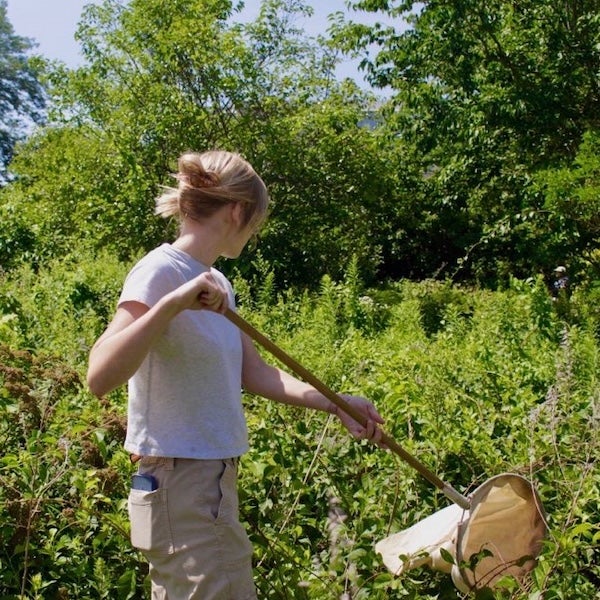
She visits fields, meadows, and forest edges across Rhode Island, using sweep nets to collect planthoppers from herbaceous vegetation. For treehoppers, which often live higher in vegetation, she uses additional techniques, including beating tree branches over collection sheets to dislodge insects.
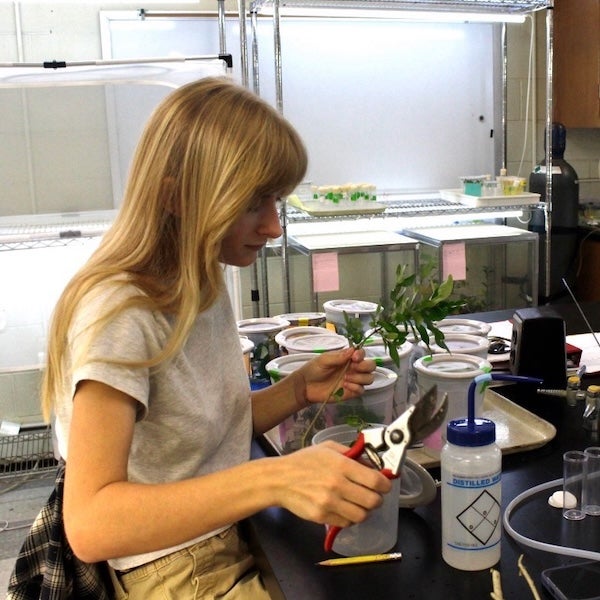
She then carefully raises them in the lab to see which ones develop signs of parasitism. “My morning starts with checking to see if any of them have molted or developed a thylacium overnight,” she says. A small dark structure called a thylacium appears when a parasitoid wasp is developing inside the planthopper, giving researchers a visible clue that the insect has been parasitized.
The planthoppers she collects are not just helping researchers understand Rhode Island’s native insect communities—they are also part of a larger collaboration with the U.S. Department of Agriculture (USDA).
The lab supplies healthy native planthoppers to USDA researchers, who are evaluating a parasitoid wasp as a potential biological control agent for spotted lanternfly. At the same time, URI researchers are asking a complementary question: could native parasitoid wasps already present in New England also help suppress spotted lanternfly populations?
“We’ve been collecting the hopper nymphs that we provide to the USDA, but we were also finding a lot of native parasitoid wasps,” says Alexandra Johnson, a graduate researcher in the Biocontrol lab. “We’re looking at some of these native wasps and spotted lanternfly nymphs—doing the opposite of what the USDA is doing—and seeing if our native wasps would help attack spotted lanternfly.”
Clark’s collections are essential to that work because different families of plant hoppers host different species of parasitoid wasps.
Small insects, large environmental impact
Before any new biological control agent can be released, researchers must conduct years of host-range testing to ensure it targets only the intended pest and poses minimal risk to native species.
Clark’s research also helps scientists better understand native beneficial insects already living in local ecosystems. If those wasps prove capable of attacking spotted lanternfly, they could become part of broader conversations about biological control strategies that work alongside other management efforts and reduce reliance on chemical insecticides.
It will likely be years before scientists know exactly how native wasps can safely be incorporated into spotted lanternfly management—the vetting and testing process demands it.
But every planthopper Clark collects this summer adds another data point to that long-term question, and brings researchers one step closer to knowing whether Rhode Island’s own insects already hold part of the answer.